Saturday, May 31, 2025

An Introduction to Emergent-Mormonism: How Smith Evolved Away from Anti-Body Augustinian-Evangelicalism to a More Pro-Body Indo-European Spirituality & Pre-1800 versus Post-1900 Mormonism


The simplest way to explain the difference between my Emergent Mormon paradigm and other ways of interpreting Mormonism, is that similar to LDS scholars like Blake Ostler, Terryl Givens, and Jonathan Neville, I see Mormonism emerging out of a cultural soil of Augustinian, Calvanist, and Edwardian ideas (which ideas were rightly criticized by Nietzsche); with Joseph Smith growing up saturated in the mindset and language of the Augustinian mentally but then overtime he mentally and culturally grows out of their grip and away from their influence. So as LDS scriptures unfolds from 1829 to 1844, you see less and less of the the ideas of Augustine, Calvin and Edwards. The biggest leap away from them is Smith's move more toward becoming more of a spiritual naturalist as he develops a more Pro-Body worldview (in contrast to an Anti-Body worldview), which I will summarize below.


A key distinguishing factor between what I call Emergent Mormonism and much of other church culture ideas that are more prudish, ascetic or monastic, is that Emergent Mormonism seeks to return to the original pro-body mentality pre-1900. In order to make this distinction I use the term Correlated Manualism which is intended to make a distinction but not to condemn every LDS leader after 1900. In fact, I defend some forms of "Correlated Manualism" in my blog series here.


What I mean by Correlated Manualism is the puritanical cultural tradition that sprung up in the LDS Church after 1900 and the treatment of current LDS Leaders as if they are infallible celebrity type figures who can do no wrong and it's wrong to even criticize them even if the criticism is true. At one point there was an institutionalization of the attitude and personality of a select few LDS leaders in the mid 1900s, and their teachings and attitudes were codified in the manuals and a correlation program; so that at one point every Mormon was engaging in groupthink and mimicking the personality, opinions and attitudes of a few LDS leaders.


Part of what led to Correlated Manualism was the post-1900 cultural tradition that LDS leaders cannot be criticized and the original concept of Common Consent had been removed; which has led in many cases to a "cult of personality" where Mormon leaders are nearly worshiped as near celebrities. I do not consider this scriptural nor doctrinal Mormonism, but a mere tradition that can be and should be changed in the future.


This cult of personality was compounded by many LDS leaders after 1900 being raised in a post-polygamy, more Protestant cultural environment, and thus now these certain LDS Leader's more Puritantized anti-body perspectives have been treated as unquestionable doctrine. Thus there was spread Augustinian anti-body Puritan ideas into LDS culture post-1900, which I argue contradicts the pre-1900 pro-body paradigm. This can be summarized as follows below.


Pre-1900 Pro-Body Mormonism:


Post-1900 Anti-Body Corporatized Augustinian Correlated Manualism:

  • This original Pro-Body attitude that emerged in 1840s Mormon Scripture was replaced with a more Puritanized Anti-Body ideology after 1900: After the US Government, which was run by mostly Augustinian-minded Puritan types, forced Mormon Leaders to be begin abandoning the practice of plural marriage in 1890, the LDS Leaders began to assimilate into early versions of "Purity Culture" among American Evangelicals. Thus, Augustinian puritanicalism replaced Joseph Smith's origional pro-body restored gospel and Abrahamic expansionism, as the Brighamite/LDS sect after 1900 sought to out "purity signal" the Puritanical types. Then when the temperance movement grew into Prohibition, LDS Leaders again tried to out "purity signal" the Evangelicals behind Prohibition: by ignoring the original meaning of D&C 89 (which clearly says it was not given as a commamd nor constraint), and instead contradicting that scripture and instead making total adherence to D&C 89 (specifically abstaining from alcohol, tea, and coffe), making it a new command and contraint on the Brighamite membership in 1921. Thus one can see a historical development toward a more controlling, body-shaming version of Mormonism by 1900 that was contrary to original 1840s Mormonism: with then eventually "worthiness interviews," an Augustinian Purity Culture, "pay to play" tithing demands (contrary to the original methods of tithing), and an overall atmosphere of emotionally draining Perfectionism in post-1900 Brighamite Mormonism; turning it into a more high demand religion; thus, far removed from the more liberal religion of joy and happiness in original Mormonism.

Original Pre-1900 Pro-Body Mormonism has been replaced with Post-1900 Anti-Body Correlated Manualism; which began after the year 1890 when the LDS Church Leaders sought to begin to be just as puritanical as the other puritan sects in order to prove their "purity" after being forced to abandon plural marriage. The anti-body mentality is manifest in LDS Purity Culture, spread by the post-1900 LDS Correlated Manualism, resulting in a culture of shame, with perfection-demanding "worthiness interviews": where one is either stamped with the label of worthy/pure or unworthy/filthy by LDS leaders. For example, the asking of young men and women questions about their private life, like if they masturbate and individuals even being asked at times to give the priesthood leader graphic details about their private sexual lives; in order to gain the approval of the male adult LDS Priest, in order to be considered and declared pure/clean and "worthy." Or an LDS adult being called in for a disciplinary council for engaging in safe and legal consensual sexual activity with another adult, which in post-1900 Mormonism has come to mean something considered in correlated puritan LDS culture as a "spiritual crime" worst than murder. LDS Missionaries are not allowed to date and are basically expected to be the equivalent of celibate Catholic priest in their youth: completely sexually repressed as if their sex drive should be erased as they are indoctrinated into a kind of gnostic form of anti-body Augustinian ideology: that is at odds with the 1840s Smith-Brigham pro-body ethos, summarized above.

Thus the Emergent Mormon paradigm can also be defined as a distinction between Pro-Body Mormonism and Anti-Body, purity-policing Correlated Manualism. Again, this does not mean that all of the LDS Leaders are part of this anti-body mentality. In fact, in August 2021 a General Authority (member of the 70) named Richard Holzapfel, openly condemned at a pulpit this anti-body cultural trend as found in books like The Miracle of Forgiveness. Unfortunately however this body-despising worldview is still the overall dominant narrative and cultural mentality in the LDS Church today.


Part of the reason for the continuation of this despising of the body is due to the "leadership worship" and conformity to the mind and will of the top LDS leaders (the Brethren). The original pro-body version of Mormonism was more respectful of personal points of view and did not engage in today's near "Brethren worship" and "totalist obedience," but today's LDS Church does. In the LDS Church today, General Authorities (GAs) are read and quoted as if they are on par with cannonized scripture verses. In contrast, Joseph Smith said "a prophet is only a prophet when he is acting as such." LDS members stand when an LDS General Authority walks in a room as if a celebrity just walked in. The phrase, "When the prophet speaks, the thinking has been done" is an unspoken common attitude. When President Nelson came out against former President Hinkley and essentially mandated the name "Mormons" not be used to refer to members of the Church, I watched from the sidelines in shock as LDS members followed in lock step conformity to the new demands as conforming members as they obediently puppeted the will of Nelson saying awkwardly in conversations the full name of the Church to virtue signal their allegiance to Nelson. Many members did this even with me personally in private conversations. Seeing such glossy eyed obedience to the "Dear Leaders" troubled me then and now; and it made me realize the core ingredient that earns one the label of "active/worthy" LDS member today is not one's convictions or even their ethical behavior but their totalist, obedient conformity to the Brethren (the top leaders). I call this Correlated Manualism. More examples of Correlated Manualism could be given. The adulation toward top LDS Leaders is and was the most off-putting thing for me personally in modern LDS culture, as it reminds me too much of the leader worship in North Korea. This was not the pre-1900 attitude in original Mormonism. For example, Joseph Smith himself was called in for disciplinary councils and so it was not wrong to criticize the Brethren. Thus I would argue that what I am calling "Correlated Manualism" here is not original Mormonism. So that I see Correlated Manualism as the LDS leadership after 1900, adopting a Corporate CEO type business structure and a North Korea style leadership worship and puritanical mindset (as covered in the book Make Yourselves Gods: Mormons and the Unfinished Business of American Secularism by Peter Coviello). In other words, what has happened is that the anti-body puritan mindset which Joseph Smith was emerging out of by the 1840s and had rejected, became reestablished in the minds of most of the post-1900 LDS Brethren. And because of the post-1900 "cult of personality" which grew up around the LDS Brethren, their puritanical attitudes became the dominant mindset of all LDS members and LDS culture.

This anti-body mentality was spread mostly through the uptight personalities and teachings of Joseph Fielding Smith, Spencer W. Kimball, and Boyd K. Packer, etc. So whether it was the book The Miracle of Forgiveness or the My Little Factory pamphlet, one can see a clear attempt to return to an anti-body puritanism which Joseph Smith had clearly rejected. For these Augustinian attitudes were in direct opposition to the radical affirmation of the body one finds in the Smith-Brigham pro-body paradigm: wherein Joseph Smith produced scriptures and sermons and private letters where he clearly broke away from this anti-body mentality and even corrected for the Pauline despising of the body by radically affirming the body and even declaring God the Father has a body of sensual flesh.
Brigham Young in turn, while flawed, nevertheless maintained the radical pro-body mentality and more Indo-European pantheonistic theology of Gods plural. For example, in The Discourses of Brigham Young (which I read on my LDS mission), Young refers to the Gods plural. He did not try to sound Catholic and monotheist and he distinguished between the monotheistic Sectarian Puritans and the more sex positive body-affirming polygamist Mormon mindset and believed in and spoken openly of the Gods plural. So what we find in original 1840 to 1890 Mormonism is a pro-body mentality. All of this changed after Brigham Young died and when the more Puritan American government forced the Mormons to basically change their pro-body practices which also altered their original more pro-body mentality: in that after 1890, the LDS Brethren gradually began to adopt and spread the more Puritanical ideology which was more anti-body; as they sought to be just as anti-body or puritanical as the Puritans who had forced them through the power of the government to abandon polygamy. Thus, after Brigham Young and Joseph Smith and the Pratt Brothers had died, the radical physicalism/spirit-materialism of early Mormonism was replaced with a return to Augustinianism in LDS culture. In other words, there was a return to a division of the body and the spirit, while Joseph Smith himself had clearly fused the sensual body and spirit together as good and holy. This Emergent Mormon Perspective is therefore the position that LDS theology evolved to a pro-body ideal in the 1840s to 1890, and has since then declined into a more anti-body organization after 1900.

I realize that this point of view is obviously a threat to the "Correlated Manualism" point of view, or the position that the Brethren are doctrinally infallible, or the position that from the beginning there was one single consistent doctrine or dogma. For in contrast, from my emergent perspective, I do not see One Dogma held steadily since the beginning of Mormonism in 1830, but instead I see conflicting and dynamic ideas within the LDS scriptures themselves. What I see is a progressive growth of emerging ideas. The position of Emergent Mormonism, is that since Joseph Smith is the primary conduit of the alleged divine communication as the Prophet of the Restoration, it stands to reason that his final words on what is and what is not doctrine, should be respected the most which were consistently pro-body. This introduction will now cover the main ideas of Emergent Mormonism, but a good way to understand my perspective is my blog series herewherein I compare Joseph Smith's theological philosophy to that of Nietzsche's philosophy. Similar to Nietzsche, Joseph Smith died before he could complete his evolving theology. This lack of completion is unimportant from the emergent perspective, for what is important is seeing the emergence away from Augustinian-Christianity and Joseph’s growing more toward a theological structure more in line with a form of "European Christianity" (as I cover here). So rather than a top down process of revelation from "on high" with Joseph Smith being merely a puppeted conduit of divine communication, I instead try to humanize Joseph Smith and see Mormonism through his own lived autobiography and bio-physiology. In other words, I see Mormonism emerging out of not just Smith's intellectual learning and cultural environment but emerging from his bodily instincts, which led to the production of Mormonism by 1844. In other words, I see a bottom up cultural evolution within Mormonism, with Joseph Smith himself going through a transformation in worldview: as he moved more and more away from the Augustinian mindset to a more Hebraic, Indo-European, and Nietzscheanish perspective. Thus, the Emergent Mormon Perspective is not a Creed or Dogma but a way of seeing and understanding the emergence of Mormonism. Thus, it is about finding value in Mormonism through the interpretive lens of Joseph Smith as a kind of a "role model," intellectually speaking, when its comes to Smith's open minded exploration of ideas: wherein, just as Joseph Smith went through an evolution in thought and perspective, from a more Augustinian or Puritan Anti-Nature perspective, to a more Nietzscheanish life-affirming Pro-Nature worldview, so can you.

From this emergent perspective or interpretive lens, Mormon scripture and sermons by Smith are reexamined as containing a progression in thoughts and ideas, and not as one consistent theology or dogma. With the final ideas emerging through Joseph Smith's own bodily vitality as Mormonism begins to take on a more body-affirming energy, especially after 1835.


The Emergent Mormon paradigm therefore does not try to harmonize the conflicting ideas in the span of LDS scripture from 1829 to 1844, which would be like trying to fit a square peg into a round hole. Instead, looking through the emergent lens, LDS Scripture is looked at historically and chronologically (like Marcus Borg's chronological New Testament), with previous LDS scriptures being interpreted through the later insights that Joseph Smith came to by 1844 (which was the year of his final edit and publication of his authorized canonized scripture); which is similar to Brian McLaren's idea of reading the Bible forwards from Genesis to Abraham to Jesus, rather than backwards through the theological opinions of Augustine, Luther and Calvin, etc. As illustrated below (click on image to enlarge):
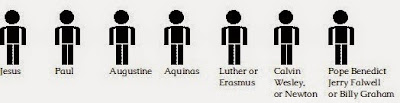


Only rather than McLaren's more Protestant-Jesus, as the ultimate lens of interpretation, the Emergent Mormon lens would instead turn to the "Mormon-Jesus" (as persuasively argued for in Terryl and Fiona Givens book The Christ Who Heals). Therefore, from the emergent perspective, the ideal is to read and interpret Mormon scripture forwards from Joseph Smith to the Pratt Brothers to John A. Widtsoe, and not backwards through the opinions of those like Boyd K. Packer.


Joseph Smith's Transition from Protestant to more Humanistic Spiritual Naturalist is a Key Component of the Emergent Mormon Perspective 


What I basically describe throughout this blog is the thesis and/or theory that Joseph Smith began his Christian ministry in the 1830s as mostly a typical Protestant minister in his mindset; but that over time he grew out of the Puritan Creeds and studied other philosophies and the sciences; to the point that by the 1840s, Smith had become a more humanistic and Nietzcheanish theological philosopher.


The Emergent Mormon Perspective sees Mormonism as an emergent phenomenon growing from the Kirkland-Missouri phase (or the Smith-Rigdon phase) to the Smith-Brigham phase in Nauvoo when Joseph Smith began to fully embrace Renaissance Enlightenment Humanism. Thus we see an emerging development in the theology and interpretations of LDS Scripture as covered in books like “This Is My Doctrine”: The Development of Mormon Theology by Charles R. Harrell and Line upon Line: Essays on Mormon Doctrine by Gary James Bergera. For more details see my blog post here.


The Emergent Evolution of Christianity from the Markan Community to the Johanine Community:


After I had resigned my membership in the Brighamite church around 2004, and after then becoming a skeptic, I then reconstructed a non-fundamentalist philosophical Christian position after being influenced by the writings of Marcus Borg and John Spong. In particular, Spong's book on biblical literalism introduced me to the concept of midrash, which led me to do a deep dive into the ancient Jewish practice of midrash. I then learned from many other biblical scholars that the apostle Paul and the Gospel authors were basically creative artists using midrash or what Richard Hays calls figural reading. In other words, rather than merely direct "revelations" from a deity, the content of Paul's letters and the Gospels had more to do with the intelligence and innovative creativity of Paul and the Gospel authors themselves. This knowledge would later allow me to reexamine Joseph Smith's scriptural creations and appreciate them as similar works of midrashic art through Smith's own intelligence and creativity.


Spong's book on the Johannine Community led me to further research biblical studies and I began to realize there was a distinct difference between the Pauline-Markan Christian worldview and the Johannine Christian worldview. For example, in the Gospel of John (produced by the Johannine Community) there is no mention of casting out demons, a major feature in the synoptic gospels, like in Mark. According to Where Have All the Demons Gone?: The Role and Place of the Devil in the Gospel of John (2017) by Andre van Rheede van Oudtshoorn:


John's Gospel is marked by a complete absence of demons. This is not due to John reflecting a more secular worldview than the Synoptics. ... Through Jesus' death on the cross, the devil has been exorcised from the whole world.

I personally do not believe in a literal "Satan character" nor demons, after studying the origin of the devil character. So John's demonless gospel began to appeal to my rational sensibilities. It was also clear to me that each gospel version was an evolving change in the Christian tradition as time passed.


My differentiating between the Johannine Gospel and the synoptic Gospels was further augmented by my appreciation of Nietzsche's dionysian philosophy and learning about how the Johanine Community may have or even likely based their gospel in part off of the dionysian mythos (see the book The Dionysian Gospel); which is why in the Gospel of John for example, Jesus is presented more as a festive Party God turning water into wine, to basically keep the party going. In fact, according to biblical scholars, the clay jars were meant to represent religious jars of ceremonial water; so Jesus turning purity jars of water into party wine symbolized an affirmation of song and dance and sexual relations in marriage over being a life long celibate and practicing only stifling purity rituals. Thus the water into wine was basically representing a "holier than thou" type attitude in contrast to a playful and joyful attitude. So the episode is all about a celebration of life. Similar to how the god Dionysus represented passion-filled Life. So the Johannine Jesus is clearly a different Jesus from the Pauline Jesus who was primarily an exorcist encouraging celibacy if one was able in the context of apocalyptic end times (see 1 Corinthians 7; Mathew 19:12).

This philosophical move in my worldview toward considering myself open to the Johanine perspective (over and above the synoptics), led me to further realize that Joseph Smith was simply expanding this ongoing Christian tradition of midrashic modification and expansion of earlier religious texts into new ones. For, Joseph Smith could be seen doing the same thing with his own updated version of Christianity with a more "Abrahamic gospel." I began to see that just as the Gospel of John can be seen as making corrections and changes or even improvements upon the earlier Synoptic Gospels, Joseph Smith's "fifth gospel" so to speak, could be seen as a midrashic attempt to move Christianity further forward toward a more science-based, body-affirming, naturalistic worldview.


A picture is worth a thousand words, so I put together this visual to present how I see Mormonism emerging over time toward a more dionysian and/or Abrahamic theo-philosophy:


Click image to enlarge


The image on the far left in the visual above is the book Radical Martyrdom and Cosmic Conflict in Early Christianity by Paul Middleton. A book I read that helped me see that the Gospels and most of the New Testament, are apocalyptic radical martyrdom texts. The next image is the book cover of The Dionysian Gospel, that shows how just as Mathew presents Jesus as a new and greater Moses, the writers of John’s Gospel portray Jesus as a new and greater Dionysus; in doing so some of the Dionysian mythos enters into the Christian tradition. Interestingly, Nietzsche spoke favorably of the Gospel of John for this reason.

 To represent the Book of Mormon, I presented a painting of Captain Moroni by Arnold Friberg. Note that a core theme of the Book of Mormon is one’s direct ascent to the throne-room of God, thus bypassing any ecclesiastical membership requirements and any Creeds and preachers’ alleged “authority.” 

Next, in the image above I depict the image that Joseph Smith chose to depict God the Father, which is an image from the pagan Egyptian scrolls of a phallic deity representing sexual potency and fecundity.


Finally, I depicted Orson Hyde’s diagram of God’s Kingdom. This is a more dionysian kingdom of growth and becoming, via Abrahamic expansionism just as Life itself evolves through ascending hierarchical growth and expansion. As Abraham 3: 16 puts it, “If two things exist, and there be one above the other, there shall be greater things above them; …” Thus the Mormon restored gospel emerged out of being a more Apollonian structure with only an Evangelical emphasis on merely “resting in the Lord” -- in a static Evangelical type heaven, and a focus only on utopian leveling communal living -- and overtime moved more toward a theology of dionysian becoming as a mythic form of will to power.


In other words, Hyde's diagram signifies an ever increasing merit-based hierarchical expansion in manly enthronement as a form of will to power: rising upward in rank, growing in power and dominion dynastically: a compounding of power, kingdom upon kingdom, expanding the lineage of kings with an increase in acquired wealth, strength, status, friendships and relationships; as represented in each pronged section of Hyde's diagram pointed upwards toward the crown. For more details on Orson Hyde’s diagram see here. So just as life itself is organic beings ordered by rank in hierarchies, the affirmation of hierarchy in later Nauvoo era Mormonism, was the affirmation of life itself.


So, to better understand Mormonism, it is best I think to see it as a restoration of the ancient religions that affirmed the procreative body, in contrast to the trend that developed in Christendom of rejecting the procreative body. So I formed this visual below: on the left is the ideal of the pillar saint and other ascetic trends as one extreme on a spectrum, with Joseph Smith and his plural wives as the opposite extreme on a spectrum:


Click image to enlarge

Image sources from here, here, and here.


The pillar saints were celibate Christian extremists who would literally live on top of a pillar to avoid the world of the flesh. The image of a pillar saint on the left in the image above in my visual and the image of the polygamist Joseph Smith on the right, is meant to convey the idea that Joseph Smith's practice of plural marriages was meant in part as a movement away from anti-body Creedal Christianity: as a rejection of the anti-body creeds and an immaterial bodiless deity and celibate priests, etc. So that Joseph Smith can be seen as restoring the original Hebrew Bible theology when God the Father had a body and a wife. So that it took a Joseph Smith type, a more masculine, testosterone-fueled alpha male type to emerge out of puritanical Augustinianism and the body despising sectarian Creeds, and grow something new and life-affirming: a philosophy springing forth from Smith's own innate vitality and nobility; as he moved away from the idea of a bodiless deity without passions, and broke free from puritanical sectarianism, and moved toward a more humanistic Nietzscheanish body-affirming philosophy of life: by creating a more pro-European, pro-American, life-affirming tribe of Supercouples, a quasi-ethnic Peoplehood, as he elevated his mostly European converts in the 1800s to the highest status among the Lost Tribes of Israel. From this perspective of growing a new culture and people through the procreative body, polygamy can be seen as a form of selective breeding or birthing a new Tribe, just as the polygamist Abraham birthed or bred a new Abrahamic Tribe. Joseph's polygamy can also be seen as a radical extreme pendulum swing away from the anti-body ideal of the pillar saint and what Elizabeth A. Clark calls the anti-familial tendencies in the New Testament. For Joseph Smith had restored the original Hebrew deity that had a body and thus by extension the sexual human body was validated and made healthy again; not sick and depraved as taught by Augustine and Calvin. For a bodiless deity made in the image of a nothingness, without parts or passions, led to an attack on the human body! Just read Augustine's Confessions! This is why Nietzsche rightly called this anti-body ideology a sickness, a life-denying sickly mentality. For the belief in the depravity of the body and the rejection of biology and life itself, in pursuit of another Truer World beyond this earthly material world is the ultimate attack on the real, the biological and fleshly. In contrast, Joseph Smith returned to the solar pantheonism in ancient religion that affirmed materiality (even declaring all earthly matter to be spirit matter in D&C 131:7). Thus Joseph Smith affirmed the physically real and vitally alive as the good, by revitalizing the procreative spirit of Life itself which cuts into itself to create new forms most beautiful; by restoring both ancient Hebrew religion and ancient Indo-European solar pantheonism through his Nauvoo era theo-philosophy of the body, he restored ancient hierarchal tribal religion. So that rather than the anti-body ideal of the celibate priest or pillar saint seeking to escape the sexual body and the material fleshly world, denying the biological procreative body, Joseph Smith instead affirmed the body and its procreative nature; even elevating the procreative energy of man, the seed of his male body, as the very purpose of priesthood and religion, as the means of producing a people via the selection of the noble and great ones (see Book of Abraham 2:11 and chapter 3); thus the funneling of European genes into the early Church through polygamist Europeans declared Ephraimites, formed the first Mormon People who gathered in Utah in the 1800s. Thus, we see that regardless of the veracity of the supernatural truth claims of Mormonism, it is at the very least something real, a real people as a quasi-ethnic culture as originally a people spawned from the seed of real Europeans who were elevated to a higher status than mere second class citizens needing to have their genes swapped out. So that just as we see the proof of a healthy vibrant garden, the formation and growth of the Mormon European People who gathered to Utah in the 1800s, and that people's growth culturally into what we find today as a vitally alive procreative and civil people, is real evidence of at least the pragmatic power of Joseph Smith's Abrahamic covenant religion. For at the very least, Mormonism is proven to produce a good and noble culture that as Jacob Hansen rightly argues is at least a net good for society. Is this not evidence enough of the overall goodness or lifeward healthiness of the Mormon mythos? So in the image above I mean to convey a spectrum of two extremes: from Anti-Body puritanical perfectionism on the left with the pillar saint, and the Pro-Body biologically thriving Mormon community on the right with the image of Joseph Smith. Neither extreme is ethically ideal from our modern 21st century American perspective. I would argue that while one could certainly criticize the methods and ways of Smith's 1840's Nauvoo practices of plural marriage; however, in the context of the 1840s cultural milieu, it was a radical way of affirming the biological body and the Hebrew Bible theology of dominion and dynasty. So by contrast, 1840s Pro-Body Mormonism was in a sense a counteractive corrective as a philosophical mythology: correcting for the anti-body mythology of Augustinian puritanism within traditional Christendom. To put it another way, if the New Testament contains anti-familial tendencies, then Mormonism can be seen as more pro-family as a “familial theism”: with its focus both on a mortal and divine family, which is far more species preserving, species empowering, and a more pro-human philosophy than pillar saints and the ascetic ideal which can be interpreted to a certain degree as a form of anti-natalism.

The Divine Center & The Phases and Strategies of God

Because I do not see the Divine as a top down controlling phenomenon treating humans like puppets with strings, and instead see humans with their own minds and creativity forming religion more as artistic expression that dogmas, I don't have to accept all of the New Testament or Mormon Scripture as perfect advice for all people in all ages. Instead, I begin with what I call the Divine Center and then I see an interplay of dynamic natural forces moving along spectrums, with competing ideas throughout religions' history; and I resolve this tension, for example between the ascetic martyr-centric New Testament and the more virile Old Testament, with my theory the Phases and Strategies of God: with Mormonism presented as a mythological unification or synthesis of the Old and New Testament as a more practical life-affirming field of mythological energy.


Evolution of the Word(s)

Marcus Borg's book Evolution of the Word: A Chronological Look at the New Testament, is the popular NRSV translation but puts each New Testament document in chronological order. This helped me see a clear evolutionary development within the Christian communities, culminating in the emergence of the Gospel of John. This allowed me better appreciate a similar chronological evolution in Mormonism, from the early 1830s to the 1840s; for, Joseph Smith, as a midrashic artist himself, clearly evolved from a more Protestant mindset pre-1835, to a more Abrahamic Life-affirming mindset post-1835. Thus the title for this blog, the Emergent Mormon Perspective.


The Emergent Mormon Perspective embraces and applauds this evolution and sees Joseph Smith maturing overtime as a writer, thinker, and creative artist; with his Nauvoo Era Mormonism being the pinnacle of his more fully emerged and matured philosophical development: wherein he fully moved toward synthesizing science and biblical spirituality and affirming life in the body.


Beyond Saint or Sinner - Smith as more Higher Man than Last Man:


Another way to understand the Emergent Mormon Perspective, is that I'm not beginning with an oversimplistic judgment of Joseph Smith as either a lying scoundrel or infallible humble saint; as if he needs to be some infallibly pure moral example like a Mother Teresa type for his theological philosophy to have any value. 

Using analogous examples from characters in movies, I think Smith is more like Steve Martin's character as a revival preacher and faith healer in the 1992 movie Leap of Faith: Martin's character has some change of heart at one point in the movie and begins to believe. I think Joseph Smith is more like Steve Martin's character in that movie, as he began with some degree of misdirection and props to induce faith but I think he always believed that he was inspired. 

I also compare him to a kind of wild west cowboy character, less Catholic Monk in a monastery and more of a Wyatt Earp type. Like Wyatt Earp, Smith is definitely not a typical "nice guy," but his overall goal was to produce an orderly society around a shared Ethos. How Smith goes about doing that was not always "nice." So when for example, Sandra Tanner has a whole section in one of her books on Joseph Smith a "fighting prophet," this does not bother me; because I am not looking at Joseph Smith through the lens of a perfect infallible "nice guy" saint. I am instead looking at Joseph Smith through the lens of him as an imperfect biological body expressing will to power like a plant in a greenhouse growing strong or weaker. From this Growth Perspective, I see Joseph Smith as an example of healthy vitality at the very least. 

I think Smith needed to have a big ego and a strong will in order to  break out of his upbringing within an Augustinian Puritan anti-body mentality that had saturated his culture. Thus, like a vitally alive healthy plant breaking through concrete on a sidewalk, I see Joseph Smith emerging incrementally out of his Augustinian cultural mindset; as each new revelation and scriptural production exemplifies his further growth out of a despising of the body mindset as his bodily instincts and will to power bursts forth onto the page of holy writ producing a more Indo-European and Hebrew Bible type pro-body lifeward mentality of embracing the fleshly body and having joy with friends and family in the here and now.

From this perspective, I would not expect an overly conciliatory "nice guy" following all of the Protestant social norms to end up at the place where Joseph Smith arrived. For a more docile and conforming type personality, unwilling to break any Puritan norms or proper etiquette, would have never broke free of his cultural indoctrination and Augustinian Calvinist mindset. 

Every other preacher of the 1800s was simply just manifesting their own personality and agendas by interpreting the Bible to fit their own perceptions, needs and proclivities; which just ended in interpretation wars. Joseph Smith had enough confidence and a belief in himself, that was necessary for him to be capable of believing he was revealing the will of God. The fact is, Joseph Smith needed to play the same "revelation game" that the Apostle Paul (and those forging letters and epistles in Paul's name) had started in the New Testament; and so like the Apostle Paul, he also claimed to be a conduit of the divine will as a Seer and Revelator. This gave him, in the minds of the religious, the authority to override the anti-body ideas of the New Testament and reinterpret certain New Testament passages or argue that those passages were not translated correctly. For example, Joseph Smith's Bible translation changes the verse where Jesus says to pluck out your eye which I discuss here

Since the New Testament itself is full of competing human voices claiming to be the voice of the divine, Joseph Smith had just simply added one more voice as the new conduit of the divine. Claiming such power and authority unto himself, as many had done before him, Joseph Smith corrected for the body despising and often emasculating elements in New Testament Christianity, with his more body-affirming muscular version of Christianity.

Joseph Smith needed a "big ego" and a willingness to play the same "revelation game" that the authors of the New Testament played, in order to tear through the concrete walls of Catholic and Protestant dogma, and again like a plant growing out of concrete, burst forth with a more vitally alive and healthy Christo-mythos that was more life-affirming than the more celibate monkish oriented mentality.

So when I examine Mormonism from 1829 to 1844, I am not expecting a perfect linear theological consistency, or Joseph Smith acting as a risk-averse docile Monk walking out of a Catholic monastery after decades of self-shaming flagellations as a body despising celibate "nice guy." I'm looking at Joseph Smith as more like Martin Sheen's character and a Wyatt Earp type; as somebody who is representative of a healthily alive instinctual body, more satyr than stylite, as evaluated from a more Nietzscheanish perspective.


Mormonism as an Indo-European-Adjacent Mythos

In composing this blog, I had been inspired by websites like churchistrue.com, staylds.com, a thoughtful-faith.com, and wardradio.com, etc. When composing this blog, I was not attempting to be a scriptural-literalist or True Believer by any sense of the word for I had simply outgrown that stage of faith; but I thought I could kind of wiggle my way back into the Brighamite-Mormon Church as a non-literal believer, like the way Jordan Peterson interprets the Bible. This became an option for me when I became more aware of the early philosophical insights of Nauvoo era Mormonism: which was more pro-bodied, scientifically oriented, and philosophically rich with life-affirming ideas.

I see 1840s Mormonism as a movement away from Augustinian anti-body puritanism and more toward a more pro-body theology which I cover on this blog in my blog series Mormonism as Christian-Europeanism. So this part of early Mormonism is a more pro-body version of Mormonism.


Mormonism through the Lens of A New Kind of Christianity


Another good way to understand where I am coming from is Brian D. McLaren's book A New Kind of Christianity. In this book Brian presents the position that how one interprets the Bible begins with one's starting perspective or paradigm. He uses diagrams like this one to point out that if we begin with for example a Platonist point of view, and read the New Testament through that perspective, we will come to different conclusions than if we had for example a more Hebrew paradigm. John Spong makes a similar argument in his book This Hebrew Lord.


Brian McLaren goes on to make the important point that if we read the New Testament through the interpretive lenses of for example Martin Luther, Calvin and Augustine, we will come to certain prepackaged dogmatic conclusions that may not be the most accurate interpretation of the New Testament. He then suggests reading the New Testament afresh through the teachings of Jesus and not instead read into the New Testament the later interpretations provided by Augustine, Luther and Calvin, etc.


So a good way to understand where I am coming from is that I am taking a similar approach to Mormonism as does Brian McLaren, in that I am not interpreting Mormonism through the lenses of Brigham Young, Joseph Fielding Smith, James Talmage, Boyd K. Packer and Bruce R. McConkey, etc., who represent what I call Post-1900 Brighamite Mormonism (which is different from the Pre-1900 Mormonism of Joseph Smith and Parley P. Pratt). Since the current LDS leaders operate within the Post-1900 Brighamite paradigm, this and other reasons is why I choose not to blindly "obey" their dictates but instead choose to exercise "the privilege of [experiencing religion and spirituality] according to the dictates of [my] own conscience, and [I] allow all men the same privilege, let them worship [or experience religion and spirituality] how, where, [they choose] or what they may" (LDS Article of Faith #11). Like McLaren reading Scripture through the lens of the New Testament Jesus rather than through the lens of Augustine, Luther or Calvin; similarly, I choose to read the original LDS Scripture (which included the doctrine of the Lectures on Faith) through the lens of the Mormon Jesus: as revealed through the lens of Joseph Smith and Parley Pratt, as well through the lens of an Indo-European and a more Nietzcheanish perspective, rather than interpreting Mormonism through the lens of the current LDS "Brethren." Although, whenever the current LDS "Brethren" say or do something that is inline with my own values based on the dictates of my own conscience, I will of course support them and sustain them and endorse them.


Another thing I should make clear upfront is that I have simply grown out of scriptural literalism. My approach to Mormon Scripture now is influenced by the interpretive approaches of Jordan Peterson, Joseph Campbell, Marcus Borg, Rob Bell, and John Shelby Spong. In other words, after learning how to interpret the Bible more historically and metaphorically (thus rescuing the Bible from Fundamentalismas Spong puts it) by using historical biblical scholarship: I was better able to then turn this scholarly eye to Mormon Scripture, and also see it through the interpretive lens of what Marcus Borg calls the historical-metaphorical method. This does not mean I see all of scripture as complete fiction and useless. On the contrary, when LDS Scripture is better understood as literary art and metaphor -- as poetry, allegory, and midrash -- one is able to treat it like all great art: as potential pathways towards inspiration and illumination, as potential symbolic energy moving one ideally towards changing their psyche and behavior for the better, like all great art and theater can do.


There is an LDS member that has attempted to understand Mormonism through this metaphorical perceptive at churchistrue.com. Doing this myself, I was able to see how Mormon Scripture can be psychologically useful in being inspiring and providing existential meaning through a 21st Century Rational Worldview.


A Personal Aside: Moving from Hurt and Victimhood toward Healing and Empowerment 


Now, to speak more personally regarding the Emergent paradigm, upon reflecting on all that I've written on this blog and elsewhere up to 2025, I would say that this perspective has been a source of psychological healing and empowerment for me; which I think might be helpful to others on a similar journey. 

You see, I went through my "LDS faith deconstruction phase" in the early 2000s, after growing up LDS and serving an LDS mission in the 1990s during the "McConkey era," when there was a lot of ecclesiastical shaming and control and manipulation by LDS leaders; which many current LDS members growing up in the 2000s don't realize what the Church used to be like. Though many of these McConkey era type puritanical, shaming, and controlling mechanisms are still in place to a large degree still. So what Emergent-Mormonism has done for me is provide a path of healing: moving my psyche beyond my angry phase of grief after deconstructing the traditional LDS Narrative, and growing a more mature James Fowler Stage 5 and 6 faith-stance. 

Prior to my formation of the Emergent paradigm, if an LDS family member mentioned Nephi to make a point, I used to recoil in phobic frustration. When I approached LDS scripture or Mormon ideas, I only came at it from a place of deconstruction and rejection of it from a more cynical and critical point of view. I feel like now I have reached a place of greater healing and am now able to synthesize my childhood unconscious experience growing up in the LDS Church (singing hymns and attending LDS activities), with my more mature adult psyche after spending decades studying religion and philosophy and science. 

Today, I have merged my inherited LDS tradition with my adult self in ways I find empowering rather than feeling shamed or controlled like I felt in the 1990s in the LDS Church. The Emergent Paradigm is a way for me to find value in and appreciate Mormon scripture, theology and history, from the Emergent Mormon Perspective. In doing so I have since been able to no longer recoil in hurt but embrace Mormonism after reformulating how I interpret all things LDS.

This process moved me past the place of anger and hurt and feeling manipulated, shamed and controlled, to instead taking back my power by now having mature boundaries and turning my Mormon experience growing up LDS into something positive as the Victor; rather than defining myself as a Victim of ecclesiastical deception (e.g. their hiding the real LDS history) and the shaming manipulation and overall Orwellian "controllingness" by LDS leaders I experienced in the 1990s. In other words, rather than defining my Mormon experiences in the 1990s as being a victim of being lied to about the true LDS history, or certain leaders being shaming and manipulative, I now reframe it as that was just "one version of Mormonism," and just one personality type with poor character. I now reframe those experiences as part of dealing with the difficult personalities and temperaments of certain individuals, which occurs in any and all organizations both religious and secular. 

The Jesus of the Gospels dealt with these controlling manipulate types himself as well and he did not bend his will to them but retained his own spiritual identity; while he also maintained his Jewish identity and heritage within Judaism, regardless of the religious fakers and manipulators in his own Jewish religion of the day. Similarly, being a Mormon by heritage with LDS Pioneer ancestors on both sides of my family, I see no reason to let "the bastards get me down" and tell me how to be Mormon today. One way I choose not to be manipulated and controlled is to not join a particular Mormon Sect as I currently choose to be a Nondenominational Mormon.

 Rather then just "crap on my Mormon ancestors" as so many ex-mormons do today, I instead choose to be pro-mormon and show respect to my own ancestors who contributed to the formation of Mormonism. I choose to honor them and respect their legacy but on my own terms and in my own way outside ecclesiastical control and manipulation. In this way I am actually honoring their legacy and the "spirit of Mormonism" itself which began with Joseph rejecting the controlling and manipulative sects of his day.

The Emergent paradigm is in part my way of respecting and valuing LDS scripture and my LDS heritage but without checking my brain at the door of any church building. 

This has become for me personally the best of both worlds. I have been able to retain the grounding of my LDS upbringing, the metaphysical bedrock and meaning-making foundation of the core insights of Mormonism, while moving past the scriptural literalism of those like Joseph Fielding Smith and Bruce R. McConkie; by utilizing the new insights of many LDS Scholars today and reformulating my own version of Mormonism that works for me. 

I share my Emergent paradigm here with the thought that it might work for others as an option in their own transitional phase. 

So in short, I have moved from the grief phase of feeling angry, manipulated and controlled -- and recoiling with phobic reactions to all things LDS -- to now taking back my ancestral heritage and childhood experiences and reframing it all into something positive. My former reactive cynical critical phase, quite frankly just drained me and was disempowering as a position of defensiveness and reaction, putting me perpetually on "the back foot." But now, it feels like I am "stepping forward" with something positive and empowering in how I experience Mormonism today. 

I have learned how to have healthy boundaries and better autonomy compared to being LDS in the 1990s. With that growth and maturing, I have been able to realign my psyche with the original Mormon philosophy my own ancestors helped create, through more metaphorical interpretations of scripture and my Emergent paradigm; so that Mormonism is for me now a source of freedom and empowerment, rather than formerly feeling controlled and disempowered (with a lack of freedom) in the 1990s.

 I'm no longer reacting against my Mormon years in the 1990s and recoiling in anger with phobic distance from religious trauma syndrome. Rather than seeing my negative experiences growing up LDS in the 1990s as being a victim of someone else's "belief system" (like Talmage and McConkie, etc.), I now see that my own Mormon ancestors helped contribute to the formation of original Mormonism (which is at odds with the "Mormonisms" of  Talmage and McConkie, etc.). So that I have taken back my power while expanding my self-esteem by aligning with my ancestors who co-created Mormonism with Joseph Smith. So that now I feel like we (my ancestors and family line) helped form Mormonism into what it is today. Therefore, certain leaders in the 1990s are not for me now a true representation of all things Mormon. I instead align with my Mormon ancestors and original Mormonism. I now understand that those negative experiences in LDS culture in the 1990s was not due to original philosophical Mormonism, but the "traditions of men," in particular certain disordered personality types seeking to control and manipulate others. By merging the good memories of my LDS upbringing with my respect and loyalty to my LDS ancestral heritage, my nondenominational Emergent Mormon paradigm has become a source of empowerment for me personally.

So the main reason I offer this paradigm is because I think it might be helpful as an option for others going through a "dark night of the soul" and LDS faith deconstruction; as an optional way to help them move past the angry "anti-Mormonism" phase and toward a more healthy and positive appreciation of Mormonism; and toward it even possibly even becoming a source of philosophical empowerment as it functions for me today through my Emergent paradigm. 


Responding to Ex-Mormon Critics Who Ask: "Why Even Bother with an Emergent Mormon Perspective?"


If the atheistic or agnostic exmormon reader is wondering why I have bothered reconstructing an Emergent Mormon worldview as an option, I answer that in detail in my blog post herewherein I discuss the work of Joseph Campbell and the power of a worldview. But the short answer is along the lines of why did Marcus Borg reconstruct a Christian worldview based on biblical scholarship and his historical-metaphorical lens of interpretation (which has greatly inspired me in producing this blog)? Short answer, because he wanted to and it worked well for him. Why did Nietzsche write Thus Spoke Zarathustra and call it a holy book (which also inspired this blog)? Short answer, because he wanted to and it worked well for him.


Why did the Founders of the United States write The Declaration of Independence that speaks of Nature's God and "all men are created equal" based on the worldview that we "are endowed by [our] Creator with unalienable Rights, that among these are Life, Liberty and the pursuit of Happiness?"

I answer these questions in more detail in my blog post here. The short answer is that we are pattern-seeking, story-making creatures that form worldviews. We all have a worldview. So why not form one that empowers you rather than hold a depressing nihilistic worldview where you are just thought of as a clump of cells with no soul and life has no ultimate meaning? This site is my own attempt at rejecting philosophical pessimism and atheistic nihilism and forming a more empowering worldview!


In Conclusion


The Emergent Mormon Perspective is not about creeds and doctrine, but the philosophy of Mormonism. There's not actually one true "Mormon Doctrine" anyway. For example, the original "doctrine" of Mormonism was the 1835 Lectures on Faith, which was less about dogma and instead they were lectures on conveying the attributes of God. Interestingly, the Lectures defined "faith" as "a principle of action." In other words, it was less about blind belief and more about trusting in God to empower you to take action. Thus it had a more practical intent rather than a dogmatic intent.


The Emergent Mormon Perspective is in brief the point of view that sees the 1840s as emergent pinnacle of Joseph Smith's revelatory genius and the formation of his Americanized Gospel. Alongside Parley P. Pratt, Joseph Smith produced a unique pro-body theology in Nauvoo which made it distinct and different from the anti-body attitude in the Augustine-Luther paradigm.


The core theological innovation of 1840s Nauvoo and the Americanized Restored Gospel was revealing the bodily nature of God, which changed the trajectory and began the process of reinterpreting all previous Mormon Scripture from a more pro-body perspective. For the view that God the Father has a sensual body of flesh and bone, affirmed one's own sensual body and earthy life. In other words, 1840s Nauvoo marked the pinnacle of American Mormonism through the Pro-Body paradigm, as it radically affirmed bodily life. For by presenting God as flesh and bone, enthroned on high with a goddess wife, meant man was made in the mirror image of a sensual being of status and power. So that the healthy human drive for sex, status, and power was the way of God Himself; which was combined with the American principles of life, liberty, and the pursuit of happiness (or lasting joy). Thus man was not designed to deny his sex drive and be sexually repressed or permanently celibate, or seek to be low-status while virtue signaling one's humble piety; for all of that was based on Platonism and Creeds emerging from people like Augustine who had a body-despising neurotic mindset. Thus God was described in the Creeds as a body-less, passionless, immaterial deity; which in turn led to a culture of shame. For more details see my Blog Series: Sex, Gods, and Zion, as well as my document The Secret Doctrine of God: Moving Toward A Theology of the Body.


Recently in 2022, the LDS scholar Patrick Mason said on the Mormon Stories Podcast that he was open to seeing The Book of Mormon as midrash. This is how I see and interpret The Book of Mormon, and the Gospels too for that matter. So I see no reason not to do what what Marcus Borg did in applying biblical scholarship to inform his Christian faith by doing the same with how I experience my Mormon faith.

The Emergent Mormon Perspective sees that polygamy was only a temporary practice, implemented in the mid 1800s in order to expiate the body-denying Creeds from the consciousness of the early Mormons. Now that that has been accomplished today, polygamy is finished and done away with. For more details see my post, The Expiation of Sectarian Dogma & The Seeding of The Mormon People. So in this context, whenever I discuss polygamy in my documents and blog posts I want to make it clear here at the outset that I don't think polygamy should be practiced today the way it was in Utah in the 1800s. In my introductory blog post to the Sex, Gods, and Zion blog series (and in the document The Secret Doctrine of God), I make the case that nineteenth century Mormon polygamy can be interpreted as an expiation ritual that was intended to change the consciousness of Mormons during the nineteenth century; so I am not saying that that form of polygamy should be practiced today. I instead make the case that the practice of polygamy, from an Emergent Mormon Perspective, ended permanently in 1890; and I give theological reasons for that conclusion based on LDS Scripture and Mormon History showing why we can say it was meant to permanently end around 1890. I just wanted to clarify that here at the outset in this introduction and I will end on that.


For a larger treatment of Emergent Mormonism see my larger thesis document on Emergent Mormonism here.

Article on American European Ephraimites & Joseph Smith Decending from an Irish Chieftain


According to this site:


 [Joseph Smith's] parents were of sturdy New England stock ...

Joseph Smith had descended on his paternal side from Robert Smith, who emigrated from England in the year 1638. ... [His ancestor] Captain Samuel Smith, receiving his military title during service in the militia of Massachusetts. ... [His, grandfather Asael Smith served during] the Revolution [following] the example of his illustrious father and served with the Colonial forces. ...


On his maternal side, Joseph Smith was descended from John Mack, who was born in Inverness, Scotland, March 6, 1653. ... [Regarding the maternal grandparents of Joseph Smith:] Solomon, son of Ebenezer Mack, was born in Lyme, Conn., Sept. 26, 1735. At the age of twenty-one years he enlisted in the services of his country under the command of Captain Henry, and the regiment of Col. Whiting. ... In 1748 he enlisted under Major Spenser and was engaged in several bloody engagements ... In 1776, Solomon Mack enlisted in the American army. For some time he served in the land forces and later was transferred to the navy. With his two sons, Jason and Stephen, he was engaged in a privateering expedition commanded by Captain Havens. In this service they passed through some thrilling experiences, but escaped without great harm. His service in the war covered a period of about four years. ... His son Stephen moved to Vermont and later to Detroit, where he engaged in mercantile pursuits and was one of the founders of Detroit. During the war of 1812 Stephen again entered the service of his country. He held the commission of a captain at the time of the siege of Detroit and was ordered by his superior officer to surrender, which he boldly refused to do. Breaking his sword across his knee he threw the parts into the lake and said he would not submit to such a disgraceful compromise while the blood of an American ran in his veins. Such is the character of the forbears of Joseph Smith.


According to the articles at this site:


Ugo Perego research – Joseph Smith [was] English or Irish, probably Irish ... Smith family DNA matched very closely with the many descendants of “Niall of the Nine Hostages,” a fifth-century Irish warlord who was the ancestor of the kings of Ireland up to the 10th century. Joseph Smith’s ancestors along his paternal line were not just Irish, but probably related to Irish royalty. ... Joseph Smith Jr., was shown in 2008 to have descended from Irish royalty.

King Niall

King Niall of the Nine Hostages


The article Joseph Smith Jr. Descended from Niall of the Nine Hostages, an Irish Chieftain of the 5th Century by Leland Meitzler reiterates this:


Mormon prophet Joseph Smith Jr.,was definitely descended from Niall of the Nine Hostages, an Joseph Smith Jr.Irish chieftain of the fifth century, Ugo Perego, a senior DNA researcher at Sorenson Molecular Genealogy Foundation has discovered.


Recent DNA tests show that the Irish connection is even more certain for the founder of Mormonism and the Church of Jesus Christ of Latter Day Saints. ...


To learn more the article above then links you to the article Irish roots of Mormon founder Joseph Smith discovered by Gerry Bailey @IrishCentral (Aug 09, 2010).


I would argue that Joseph Smith's Irish Indo-European DNA drove him unconsciously to return to the cultural energy of the Hebrew Bible: which unlike the Pauline (and later Augustinian mindset), was more life affirming and pro-body; with a more warrior spirit among the early Hebrews (when Yahweh (God the Father) had a body and a wife or consort).


What this means is that when LDS Scripture says that Joseph Smith is an Ephraimite from the loins of Joseph of Egypt, according to scripture, Smith would be a mix of Israelite and Indo-European ancestry. So when LDS Scripture repeatedly talk about Ephraimites gathering from the "northern countries" (i.e. European countries like Britain and Scandinavia) to come to America and build the tribe of Ephraim, this was a calling forth of Joseph's ethni, those who like him descend from royal kings among the Indo-Europeans, as his ancestral people, which Anglo-European people LDS Scripture designates as Ephraimites hidden among the Gentiles. For more details see my webpage here. This is what distinguishes Mormonism from Protestantism and Catholicism, this literal gathering of Anglo-European Ephraimites to the New Jerusalem (Zion) in North America in the 1800s by a new Moses-like figure Joseph Smith.


Excerpts from The Land of Joseph (America), the Gathering Place of Ephraim, Manasseh & Judah by Rian Nelson (2024) (emphasis added):


“It was not by chance that the Puritans left their native land and sailed away to the shores of New England, and others later followed. They were the advance guard of the army of the Lord, predestined to establish the God-given system of government under which we live and to make America, which is the land of Joseph, the gathering place of Ephraim, an asylum for the oppressed of all nations, and prepare the way for the restoration of the gospel of Christ and the establishment of his church upon the earth” – Heber J. Grant, Conference Report, April 1930.


... Joseph Smith was a pure Ephraimite:

“It is the house of Israel we are after, and we care not whether they come from the east, the west, the north, or the south; from China, Russia, England, California, North or South America, or some other locality. … The Book of Mormon came to Ephraim, for Joseph Smith was a pure Ephraimite, and the Book of Mormon was revealed to him.” (Brigham Young Journal of Discourses 2:268–69.)

“In this Dispensation of the Fulness of Times, the gospel came first to the [cultural] Gentiles and then is to go to the Jews. However, the Gentiles who receive the gospel are, in the greater part, Gentiles who have the blood of Israel in their veins. There is a very significant statement in the words of Moroni as recorded on the title page of the Book of Mormon that it was ” … ‘To come forth … by way of the Gentile. …’ Joseph Fielding Smith

So many immigrants from Europe are as Elder Smith said above, “Gentiles who have the blood of Israel [e.g. Ephraim] in their veins.”

“Mormon prophet Joseph Smith Jr., was definitely descended from Niall of the Nine Hostages, an Irish chieftain of the fifth century, Ugo Perego, a senior DNA researcher at Sorenson Molecular Genealogy Foundation has discovered… Perego identified a part of Joseph Smith’s DNA that had a very rare marker called M222. With this “higher resolution” he found that the same marker was found in Northwest Ireland — with a little bit in Lowland Scotland.” Source


... America will not be Destroyed!


When this nation was established, the Church was restored and from here the message of the restored gospel has gone forth-all according to divine plan. This then becomes the Lord’s base of operations in these latter days. And this base-the land of America—will not be shifted out of its place. This nation will, in a measure at least, fulfill its mission even though it may face serious and troublesome days. The degree to which it achieves its full mission depends upon the righteousness of its people. God, through His power, has established a free people in this land as a means of helping to carry forward His purposes. It was His latter-day purpose to bring forth His gospel in America, not in any other place. It was in America where the Book of Mormon plates were deposited. That was no accident. It was His design. It was in this same America where they were brought to light by angelic ministry. It was here where He organized His modern Church, where He, Himself, made a modern personal appearance. It was here under a free government and a strong nation that protection was provided for His restored Church.


Now God will not permit America, His base of operations, to be destroyed. He has promised protection to this land if we will but serve the God of the land. He has also promised protection to the righteous even, if necessary, to send fire from heaven to destroy their enemies. No, God’s base of operations will not be destroyed.” Ezra Taft Benson, This Nation Shall Endure Teachings of Ezra Taft Benson; “I Testify”, General Conference, October 1988


... Elder Ballard Continues:

“A Pilgrim named John Howland, who landed at Plymouth Rock as a young unmarried man. His story is fascinating and it affects every member of The Church of Jesus Christ of Latter-day Saints. The Lord is definitely involved in our lives, each and every one of us individually. What a blessing.

During that historic voyage, the crew and passengers of the Mayflower encountered many turbulent storms, which kept the passengers below deck. In the middle of one storm, John emerged and was swept overboard.

William Bradford, also a passenger on the Mayflower, reported:

“In these storms the winds were so fierce and the seas so high the Pilgrims were forced to remain below deck. And one of them John Howland came above and, with a roll of the ship, he was thrown into the sea; but it pleased God that he caught hold of a rope that was trailing in the water and held on though he was several fathoms under water till he was hauled up by the same rope to the brim of the water, and then with a boat-hook and other means got him into the ship again and his life was saved; and though he was something ill with it, yet he lived many years after, and became a profitable member both in church and commonwealth… “Later, a leader of one of the villages arrived in the struggling settlement to help the Pilgrims. They formed an alliance, and during the second fall after their arrival in the New World, 52 colonists and some 90 natives celebrated Plymouth’s first successful harvest — the first Thanksgiving in Plymouth.

“At the time, John Howland was not as famous as fellow passengers William Bradford, John Carver and Myles Standish. However, standing where we now stand, with nearly 400 years between us and these courageous Pilgrims, he may have had a greater impact on the history of the United States than any of them.”

President Ballard explained that four years after arriving in the New World, John married fellow Mayflower passenger Elizabeth Tilley. From that union came 10 children and nearly 90 grandchildren.


Today, an estimated 5 million Americans trace their roots to John and Elizabeth, according to President Ballard. Their descendants include three U.S. presidents… American poets Ralph Waldo Emerson and Henry Wadsworth Longfellow; and two influential 19th-century American religious leaders — the Prophet Joseph and his brother Hyrum Smith, explained President Ballard.” President Ballard pleads with Latter-day Saints to ‘pray for this country’ as United States is at ‘another crossroad’ By Sarah Jane Weaver 21 Oct 2019,


... We also know that the Prophet Joseph Smith was a direct descendant of John Howland’s oldest son named John Howland. ...


“These surely are the latter days, and the Lord is hastening His work to gather Israel. That gathering is the most important thing taking place on earth today. Nothing else compares in magnitude, nothing else compares in importance, nothing else compares in majesty. And if you choose to, if you want to, you can be a big part of it.” —President Russell M. Nelson, “Hope of Israel,” Worldwide Youth Devotional, 3 June 2018.


Land of Joseph is North America

The Book of Mormon tells us that America is a land of promise, a land choice above all other lands. Nephi said that whosoever should possess it must serve the God of the land or they would be swept off. And we have read in the Book of Mormon of the nations that have been swept off because they ceased to worship the God who had led them and their forefathers here to this land. We have a great responsibility as citizens in this land, for the Lord said that he would fight its battles and be its king, if we will just serve him. So it’s appropriate at this time that we express our appreciation for this great land. I like the words Moses used when he gave a blessing to the twelve tribes of Israel. When he blessed Joseph, he promised him a new land in the utmost bowels of the everlasting hills (see Deut. 33:15).

Now that isn’t in Jerusalem because they don’t have everlasting hills over there, and the prophets have never predicted a regathering of all nations to the land of Israel. But they have predicted the gathering of Israel to this land of America, which is the land of Joseph. And we are the only people in the world who know what that land is that Moses promised to Joseph. It was so great in his eyes as he received the revelations of the Holy Spirit that in describing the land, he used the word “precious” five times in just four verses…We have so much to be grateful for. We are not here by chance. We are here because of the sacrifices of our pioneer fathers who came to this choice land that the Lord, according to the Book of Mormon, had hidden away from the eyes of the world that it should not be overrun. [Remember the original place Adam was placed was in Missouri, which is the original New World]. He preserved it for us, for the day and time in which we now live here in these valleys of the mountains.” Thanksgiving, LEGRAND RICHARDS of the Quorum of the Twelve Apostles Nov. 18, 1980


In Elder McConkie’s book “Mormon Doctrine”, he states:


“One of the greatest spiritual gatherings of all the ages took place in the Valley of Adam-ondi-Ahman [in today's Missouri in North America] some 5,000 years ago.… At that great gathering Adam offered sacrifices on an altar built for that purpose. A remnant of that very altar remained on the spot down through the ages. On May 19, 1838, Joseph Smith and a number of his associates stood on the remainder of the pile of stones at a place called Spring Hill, Daviess County, Missouri. There the Prophet taught them that Adam again would visit the Valley of Adam-ondi-Ahman, holding a great council as a prelude to the great and dreadful day of the Lord…”


The World has Gathered From Asher to Zebulon

Sister Wendy Nelson said,
“One of my favorite places is Moscow, Russia. Why? Because of what I experienced there within one 24-hour period of time, which commenced on Saturday, June 15, 2013. While my husband taught the priesthood leaders of the area, I had the privilege of being with some of the sisters. I love our Russian sisters. They are spectacular! That Saturday happened to be one of those rare spring planting days in Russia, so less than 100 of us gathered. When I went to the pulpit, I found myself saying something I’d never anticipated: “I’d like to get to know you by lineage. Please stand as the name of the tribe of Israel, as declared in your patriarchal blessing, is spoken.” These women knew each other, but they didn’t know each other’s lineage. As the names of the twelve tribes of Israel were announced, from Asher to Zebulon, and as the women stood, we were all thrilled with what we were feeling, witnessing, and being taught. We were being taught about the reality of the days in which we now live! Question: How many of the twelve tribes of Israel do you think were represented in that small gathering of less than 100 women on that Saturday in Moscow? Eleven! Eleven of the twelve tribes! All but the tribe of Levi! Now here’s another question: How fast does news travel where you live? Pretty fast? Well, it certainly travels quickly in Eastern Europe. I went directly from that unforgettable gathering to the airport to meet my husband. We then flew to Armenia, where he was to create the first stake of Zion in that country the next day. The first people we met as we got off the plane were the mission president and his wife. And the first thing she said to me was, “I’ve got Levi!” Just imagine—one of their missionaries, from Gilbert, Arizona, no less, was of the tribe of Levi! This address was given Thursday, April 30, 2015 at the BYU Women’s Conference


Thursday, May 22, 2025

Northern Indo-European Converts that formed Zion in America in the 1800s as a Seed-Gene Planted Ensign


According to mormonwiki.com on Mormon Ancestry


... When The Church of Jesus Christ of Latter-day Saints was first founded in 1830, the original members were of Western European descent. Early on, missionary work was performed among the Indian tribes, and there were a small number of members of African descent. Early in the history of the Church, missionaries were sent to the South Pacific, where Mormons now make up a large percentage of the population in some areas. Missionaries were also sent to Western Europe, and the strongest members of the Church, when westward migration to Utah began, were from the British Isles and Scandinavia. Indeed, these members were the backbone of the Church. Once the Church was established in the U.S., missionary work bore great fruit in Latin America. Many members of the Church are Spanish-speaking. The greatest growth at this point in time is in Africa and Asia. There are more LDS members outside of the United States than in it.

The Church as Israel:

Most people who are attracted to the LDS Church are descendants from the tribes of Israel. Once in their lifetime, LDS members are priviledged to receive a Patriarchal Blessing which reveals to them their lineage in Israel. In the United States, most Latter-day Saints are descendants of Ephraim. In the Orient and among Native Americans, the most common lineage is of Manassah.


According to 


... When God covenanted with Abraham that through his posterity all the families of the earth would be blessed, he promised "the blessings of the Gospel, which are the blessings of salvation, even of life eternal" (Abr. 2:11). The scope of these promises, both here and hereafter, is outlined in modern day scripture:


Abraham received promises concerning his seed, and of the fruit of his loins;which were to continue so long as they were in the world; and as touching Abraham and his seed, out of the world they should continue. This promise is yours also, because ye are of Abraham, and the promise was made unto Abraham [D&C 132:30-31].


An essential part of a patriarchal blessing is a declaration of lineage. The patriarch seeks inspiration to specify the dominant family line that leads back to Abraham. The majority of modern blessings have designated Ephraim or manasseh as the main link in this tracing, but others of every tribe of Israel have also been named. Whether this is a pronouncement of blood inheritance or of adoption does not matter (see Abr. 2:10). It is seen as the line and legacy through which one's blessings are transmitted. Thus the blessings "of Abraham, Isaac and Jacob" are conferred.


The early growth of the LDS Church in Utah in the 1800s thus became a bottle neck for funneling the seed of Indo-European genes via these first European Mormon polygamists "from the British Isles and Scandinavia ... [who] were the backbone of the Church ..." 


The Guide to the Scriptures (under "Ephraim") states:


... The children of Ephraim will crown with glory those from the north countries who return in the last days (D&C 133:26–34).


Note the emphasis on crowning the people of the north countries.


The Guide to the Scriptures (under "Israel") states: 


... Ephraim and Manasseh (1 Chr. 5:1; Jer. 31:9), who were counted as separate tribes of Israel (JST, Gen. 48:5–6 [Appendix]).


Members of the tribe of Judah were to be the rulers until the Messiah came (Gen. 49:10; JST, Gen. 50:24 [Appendix]). In the last days the tribe of Ephraim has the privilege of carrying the message of the Restoration of the gospel to the world and gathering scattered Israel (Deut. 33:13–17). The time will come when through the gospel of Jesus Christ, Ephraim will have a leadership role in uniting all the tribes of Israel (Isa. 11:12–13; D&C 133:26–34).


The way I see it early Mormonism gave those of European decent, who came to America, a higher self-esteem as members of the "chosen people" as Ephraimites; with a special role in being in charge of gathering the Tribes of Israel and growing the People of Zion. 


In the article The Peoples of Utah, Scandinavian Saga by William Mulder we read:


... Utah looks decidedly Anglo-Scandinavian. History and the statistics confirm the impression. Utah’s Scandinavians and their descendants, as with most of the state’s other immigrants from northern Europe, are largely the fruit of over a century of Mormon proselyting abroad. During the second half of the nineteenth century, when Mormonism preached its doctrine of the “gathering” with vigor and conducted a program of organized migration to Zion, ... Zion as lodestone, however, proved strong enough to attract fresh arrivals from Scandinavia down the years. The mighty stream of the late 1800s diminished in the 1900s, reflecting changes in Mormon policy and program. ...  In every census in the hundred years from 1850 to 1950, Utah residents born in Scandinavia as well as those of Scandinavian stock (those having Scandinavian or mixed parentage) appear consistently as the second largest group of foreign-born or foreign stock in the state, second only to British-born and those of British stock.1 In 1900 Scandinavians formed 34 percent of Utah’s foreign-born, and Scandinavian stock that year formed 16 percent of the total population.  ...


For more details on European Mormons as Ephraimites see Of the House of Israel by Daniel H. Ludlow.


The key I think to understanding Mormonism is that it is more than just a mere belief system but a cultural tribal identity, a quasi-ethnic heritage. The Wikipedia entry for House of Joseph (LDS Church), retrieved 5/22/2025, summarizes things this way (emphasis added):


The Church of Jesus Christ of Latter-day Saints (LDS Church), is the largest and best known denomination within the Latter Day Saint movement (a form of Christian Restorationism). The Church is headquartered in Salt Lake City, Utah, and claims through inspired patriarchal blessings to its members throughout the world that many of these are descendants of Josephite Ephraim and Manasseh, with the tribe of Ephraim holding a responsibility of ecclesiastical leadership, but also of spearheading the Church's worldwide missionary program in what it considers to be 'the last days'.[7] The LDS Church believes that scattered descendants of Ephraim from Europe, Scandinavia, and other parts of the world have been led by the guiding hand of God to settle in the Americas, along with the descendants of the Lamanites and others, and that the Americas are a "promised land" of liberty for those who have been led there.[2][3]

All Church members, however — even if, through their 'patriarchal blessings', they are declared by a church patriarch to be of another Israelite tribe, or from a line of descent other than that of Ephraim, Manasseh, or Israel's other tribes — are yet, through faith and conversion, 'adopted' into the house of Israel and equally 'chosen'.[27] As such, members of the church often refer to themselves collectively as 'modern Israel'. All are an integral part of the restored church and kingdom of God on earth — which, Latter-day Saints profess, is the same organization of the primitive church that existed anciently, as originally established by Christ and His apostles.[7] 


 As descendants principally, therefore, of Joseph of Egypt, and particularly of Ephraim, they believe that theirs is a special latter-day commission from God to 'gather' into 'one fold' the remnants of the house of Israel from the nations of the earth, according to ancient prophecy (2 Ne 9:2; 3 Ne 21:1-11, 22).[3] But this 'leadership' calling with respect to the 'gathering', as they believe, extends far beyond this fundamental Ephraimite mandate to reclaim the family of Israel, for they are to seek, as commanded by the Lord in modern revelation, the conversion of all who seek salvation in the celestial kingdom of God, who will believe on the Lord Jesus Christ, repent, and accept His 'true' gospel (D&C 1:30) that was, after a long 'night' of apostasy, restored through 'the Prophet of the Restoration,' Joseph Smith, Jr.[7][28]


Members of The Church of Jesus Christ of Latter-day Saints, who believe themselves predominantly to be of the Ephraimite branch of the House of Joseph, assert that revelations given of God to the Prophet Joseph Smith (JST Gen 50), and as contained in the Book of Mormon (2 Ne 3), bear witness that the Patriarch Jacob's firstborn 'double portion' of both progeny and lands with which he blessed his son, Joseph of Egypt (and his 'double portion'-inheriting grandsons Ephraim and Manasseh), included the additional 'land' portion of the whole of the American continent — to which (c. 588 BC), from the southeastern coast of the Arabian Peninsula, a "fruitful branch" of Joseph's posterity (the 'Lehite Colony', composed of descendants of both Ephraim and Manasseh) traveled by sea.[3] The Book of Mormon professes to be the abridged history of that Josephite branch — Ezekiel's "stick of Joseph" which, in its marvelous latter-day re-pairing, or re-union, with the "stick of Judah," now rests, or can rest, as 'one' in Israelite hands (see Ezek 37:16, 19).[7]

Footnotes:

[2]:   Whitehead, E. L. (1972) [1947]. The House of Israel: A Treatise on the Destiny, History and Identification of Israel in All the Five Branches. Salt Lake City, Utah: Publishers Press. Originally published by Zion's Printing and Publishing Company: Independence, Missouri.


[3]: Millet, Robert L.; McConkie, Joseph Fielding (2010) [1993]. Our Destiny: The Call and Election of the House of Israel. Salt Lake City, Utah: Deseret Book. Originally published by Bookcraft. ISBN 978-1933317632.

[7]:  Brown, Matthew B. (2000). All Things Restored: Evidences and Witnesses of the Restoration. American Fork, Utah: Covenant Communications.

[27]: "This matter of lineal descent is neither myth nor metaphor. [But neither] should those who are not directly descended from Israel who join the Church feel in any way less than chosen. 'Chosenness' is a status based upon the choice to follow the Lord and associate with his people, and entrance into the true Church qualifies one for the blessings of Ephraim, as though he or she had been born a child of Abraham" (Millet & McConkie, 2010).

[28]:  See Abr 2:10, 11, wherein Abraham's seed — through a great missionary labor that was begun by Abraham himself to the peoples of Canaan — would "bear this ministry" and Priesthood to the nations, thereby blessing them "with the blessings of the Gospel, which are the blessings of salvation, even of life eternal."


The above is corroborated in D&C 64: 36-43: 


36 For, verily I say that the rebellious are not of the blood of Ephraim, wherefore they shall be plucked out.


37 Behold, I, the Lord, have made my church in these last days like unto a judge sitting on a hill, or in a high place, to judge the nations [ethnicities].


38 For it shall come to pass that the inhabitants of Zion shall judge all things pertaining to Zion.


39 And liars and hypocrites shall be proved by them, and they who are not apostles and prophets shall be known


40 And even the bishop, who is a judge, and his counselors, if they are not faithful in their stewardships shall be condemned, and others shall be planted in their stead.


41 For, behold, I say unto you that Zion shall flourish, and the glory of the Lord shall be upon her;


42 And she shall be an ensign unto the people, and there shall come unto her out of every nation [ethnicity] under heaven.


43 And the day shall come when the nations of the earth shall tremble because of her, and shall fear because of her terrible ones. The Lord hath spoken it. Amen.


The LDS Guide to the Scriptures states:


In the last days [Ephraim’s] privilege and responsibility is to bear the priesthood, take the message of the restored gospel to the world, and raise an ensign to gather scattered Israel. … The children of Ephraim will crown with glory those from the north countries who return in the last days. [Source: “Ephraim,” Guide to the Scriptures, the Church of Jesus Christ of Latter- day Saints, accessed May 19, 2021, As quoted in this article


Here are some excerpts from the article The blood of Israel in Europe by Wilfried Decoo:


At a multi-stake conference in Berlin in 2010, Area President Erich W. Kopischke quoted Joseph Smith as having declared that “England, Germany, Norway, Denmark, Switzerland, Holland and Belgium have a considerable amount of the blood of Israel among the people which must be gathered out.” It was surprising to be reminded of that doctrinal concept.[1]


Older members who grew up with the “doctrinal answers” of Joseph Fielding Smith and Bruce R. McConkie are no doubt well acquainted with the notion: scores of Europeans, especially in northern countries, are literal descendants of the House of Israel through the lost tribes, in particular the tribe of Ephraim. That would explain why so many British and Scandinavian citizens in the 19th century were willing to accept the gospel, for their “believing blood” recognized the truth. As these thousands of European converts heeded the call to emigrate to Zion, first to Nauvoo and then to Deseret, it became common to say these “Israelites” saved the fledgling church in America, injecting it with their sheer numbers, their goods, tools, skills, and knowledge. In 1890, two-thirds of Utah’s population consisted of such immigrants and their children.[2] Genetic studies confirm the ancestry of white Utah Mormon residents: 61% British, 31% Scandinavian, with Swiss and German for most of the remainder.[3] ... 


... Joseph Smith frequently stressed universalism, but within it he could simultaneously see the literal gathering of Israel and the restoration of the Ten Tribes. In the original perspective, white Europeans and Americans were considered Gentiles who could through conversion be adopted in the House of Israel. But the recognition of literal Israelite descent, which was first applied to Joseph Smith and his family, became gradually applied to all Latter-day Saints. Such literal descendency could be explained by the mixing of “remnants” of scattered Israelites with Gentiles somewhere in their ancestry. ...


Where do we stand now on lineage issues?


 I look first at lineage related to the preexistence and next at the issue of Israelite blood in Europe.


On the one hand, the notion that “the people of Israel were a distinct and noble people in the premortal existence” and that “foreordination determined, to a large extent, an individual’s placement among tribes and nations” seems to remain official doctrine, as e.g. taught though current CES Institute material, with ample quotations from Joseph Fielding Smith and Bruce R. McConkie, but leaving out the parts about the “less valiant.” The quotations further confirm that “Israel is an eternal people. Members of that chosen race first gained their inheritance with the faithful in the pre-mortal life.” And: “The great majority of those who have come into the Church are Ephraimites. It is the exception to find one of any other tribe, unless it is of Manasseh.”[7] ... 


... In 2006 a clarifying Ensign article about “life before birth” strictly limits information to the Scriptures, without any mention of a premortal chosen race or lineages based on merits obtained in the first estate.[12]


At the same time, in conformity with Joseph Smith’s dynamic incorporation of both lineage and universalism, church authorities continue to use the imagery of the Abrahamic covenant and of the House of Israel, with emphasis on its all-encompassing nature. In Mormon doctrine, indeed, universalism does not exclude the continued recognition of Israel as a separate people, hence in the Book of Mormon the predicted fruitful interaction between the Gentiles and the scattered House of Israel for the salvation of both, as illustrated in Zenos’ allegory of the olive trees (Jacob 5). ... 


... Just like in the days of Peter and Paul, it is not always evident to balance the advocacy of chosen lineage and the acceptance of a totally deracialized humanity. Peter identified the Church contrastively as “a chosen generation, a royal priesthood, an holy nation, a peculiar people” (1 Peter 2:9), while Paul focused on universalism: “There is neither Jew nor Greek, there is neither bond nor free, there is neither male nor female: for ye are all one in Christ Jesus. And if ye be Christ’s, then are ye Abraham’s seed, and heirs according to the promise” (Galatians 3:28–29). Hence the need for clarifications, such as Daniel H. Ludlow was invited to give in the Ensign.[15] Hence also the tensions when some authors, who uphold the doctrines of a preexistent House of Israel and of the subsequent chosen bloodlines based on premortal merit, feel that these insights are now being “untaught” and “ignored.”[16] 

 As to the notion of Israelite blood in Europe, where does it stand now after its extensive use in former decades? Its occurrence seems rather rare, but it tends to turn up at weighty conferences and meetings in Europe, raised by eminent church leaders, in order to boost the faith in church growth. In 1969, when the first British stake was organized, Spencer W. Kimball visited Malvern Hills and declared: “This is a place where the blood of Israel is richly concentrated, and there are many still to gather.”[17] In 1971 Harold B. Lee testified in a regional general conference in Manchester that a temple had been built in Great Britain “because of its great contribution to the early and continuous growth of the Church, which gave evidence to the great outpouring of the blood of Israel among the people of these great British Isles.”18 In 1987 British General Authority Derek A. Cuthbert proclaimed that “these [British] islands have a divine destiny . . . Yes, the blood of Israel is richly concentrated in these islands and the promised blessings will all be fulfilled.”[19]

 Next to Britain, the presence of Israelite blood had also been recognized early on in Scandinavian and Germanic countries. As the church slowly expanded in European Latin countries (Italy, Spain, and Portugal), they too became included in Israelite descendency. In 1995, at a seminar for European stake and mission presidents held in Paris, Jeffrey R. Holland strongly reemphasized the notion:


The Church in Europe must live again. The work of the Church has run on the backs of its European saints since the beginning. Don’t think that you are just minding the shop waiting for the Savior to come. Don’t think that the great days of gathering in Europe are over. This is our time. Europe is the richest composition of the blood of Israel we’ve known. The blood of Israel out of these lands saved the Church. They left behind family members, children, grandchildren, and friends. They are still here. And we must find them. The blood of Israel is here.[20]


In 2010 in Berlin, as mentioned at the onset of this article, Elder Kopischke referred to Joseph Smith as having declared that “England, Germany, Norway, Denmark, Switzerland, Holland and Belgium have a considerable amount of the blood of Israel among the people which must be gathered out.” One should remark that this quotation comes from the White Horse prophecy, which has been identified by Church leaders and by experts as a late nineteenth-century document, of which the content cannot be verified as authored by Joseph Smith.[21] But it is telling that more than one document in the second half of the 19th century tried to foist later Mormon beliefs upon Joseph Smith. The mention of “a considerable amount of the blood of Israel” or “the richest composition of the blood of Israel” in these countries vastly amplifies the early Mormon idea of only “remnants” of scattered Israelites who had mixed with Gentiles.


 Positive views on “believing blood” and “lineage”


The preceding discussion may give the impression that concepts such as “believing blood” and “lineage” are better seen as obsolete because of their position within the doctrinal perspective that later also harbored racist beliefs. That should not be the case as long as the concepts are clearly circumscribed and remain within their proper scriptural realm. Also, sometimes some critics throw the baby out with the bathwater.

 The concept of “lineage” as tied to the House of Israel is deeply ingrained in Mormon doctrine and in the Scriptures. As mentioned supra, it is very possible to combine it with a universalist perspective, without referring to premortal classes. The pivotal principles of scattering and gathering can be interpreted on various levels and in various locations, including their extension to multiple Zions. “Lineage” can continue to have special significance in the patriarchal blessing which, since the dawn of Mormonism, has become a treasured once-in-a-lifetime experience for Latter-day Saints. In earlier times, when nearly all members were of North European descent (including the American-born white converts), it seemed uncomplicated to assume literal tribal descendency from Ephraim, in line with the beliefs of scattering of the lost tribes. For American Indians, as supposed descendants of Lamanites, the physical lineage was evidently traced to Manasseh. But in view of expanding the church to all countries and races, as well as of advancing insights in demography, adjustments in rationale and formulation help smooth the attribution to a certain tribe, such as through adoption, assignment to a tribe, bestowal of the blessings of a tribe upon an individual, or by simply accepting that over some three millennia, the blood of Israel, literally or figuratively, spread to all corners of the world, even to Pygmies and to Aboriginals. Whether literal or spiritual, the determination of tribal descent is meant as an emotional confirmation of belonging to the House of Israel.[24]


Both the concepts of believing blood and of lineage can fulfill a beneficial role in strengthening family bonds and in raising the expectations of children and grandchildren about their loyalty to the gospel. Conversely, it should be added, disaffection from the ancestral faith can also cause greater pain in such tight relationships. We should also be sensitive to the fact that worldwide many converts stand alone, without any or hardly any kin in the Kingdom. Assertions that stress the blessings of belonging to a first-rate pedigree of Mormon ancestors and of having scores of faithful children and grandchildren make the concept of lineage sometimes needlessly ostentatious and distressing to others.


So in conclusion, it is clear to me that what formed early Mormonism in the 1800s, was a close knit tribal identity of mostly European converts believing they were the chosen seed of Ephraim. What this means for me as a European myself with polygamous Pioneer Mormon ancestor's on both sides of my family, is that Mormonism is more than a mere "belief system" but a quasi-ethnic tribal heritage, as my European ancestors helped form early Mormonism.  So as I see it, being culturally Mormon by heritage is to recognize that one's European ancestry carried with it an Indo-European ethno-linguistic and mythological heritage which I believe was funneled into early Mormonism. So that the spirit of my Indo-European ancestors was given roots to sprout anew through the Mormon mythos. 


Friday, May 16, 2025

Section from Encyclopedia of Mormonism on EPHRAIM

 From Encyclopedia of Mormonism under the section on EPHRAIM (pages 461-462):


... Ephraim was the son of Joseph and Ascnath and the younger brother of Manasseh (Gen. 41:50-52). According to the Bible, when Joseph brought his two sons to his father, Jacob, for a blessing, Ephraim received the birthright blessing in place of Manasseh (Gen. 48:13-20), one of the departures noted in the Bible from the custom of bestowing on the firstborn son the special privileges that belonged to him by right of primogeniture. The Lord continued to acknowledge Ephraim's blessing centuries later when he said, "I am a father to Israel, and Ephraim is my firstborn " (Gen. 31:9; cf. l Chr. 5:1- 2). Ephraim's descendants will continue in significant roles. The Book of Mormon records that Joseph of old "obtained a promise of the Lord, that out of the fruit of his loins the Lord God would raise up a righteous branch unto the house of Israel .. . to he remembered in the covenants of the Lord" (2 Ne. 3:5). Further, a "choice seer" would arise from Joseph's descendants who would "do a work for the fruit of [Joseph's] loins, his brethren, which shall be of great worth unto them, even to the bringing of them to the knowledge of the covenants which I [the Lord] have made with thy fathers" (2 Nephi 3:7). Many Latter-day Saints believe that they are of the branch of Ephraim, of whom Joseph prophesied (2 Ne . 3:5-16; D&C 133:30- 34) and that the Prophet Joseph Smith is the "choice seer" (2 Ne. 3:6). 

Because of their rebellion against the Lord many centuries ago, Ephraim's descendants were scattered among the Gentile nations, along with members of the other tribes, beginning with the fall of the northern kingdom of Israel c. 722 B.C. (2 Kgs. 17:5 6; see also ISRAEL: SCATTERTNG OF ISRAEL and ISRAEL: LOST TRIBES OF ISRAEL). 

In the LAST DAYS, Ephraim's descendants have the privilege and responsibility to ... gather scattered Israel (D&C 113:3-6). "We believe in the literal gathering of Israel and in the restoration of the Ten Tribes; that Zion (the New Jerusalem) will be built upon the Ame rican continent" (A of F 10; cf. Deut. 4:27- 31; 28; 29; 30; 3 Ne. 20- 21). The keys of gathering Israel were committed to the Prophet Joseph Smith by Moses on April 3, 1836, in the Kirtland temple (D&C 110:11). Many of Ephraim's descendants are being gathered first, for they have the responsibility of preparing the way for the gathering of the other tribes (D&C 113). "And they [others of the tribes of Israel] shall bring forth their rich treasures unto the children of Ephraim, my servants . . . and there shall they fall down and be crowned with glory, even in Zion, by the hands of the servants of the Lord, even the children of Ephraim, and they shall be filled with songs of everlasting joy" (D&C 133:30-33; see also ISRAEL: GATHERING OF ISRAEL). 

One of the tools to be used in the gathering is the Book of Mormon, also known among Latter-day Saints as the stick of Joseph or the stick of Ephraim (Ezek. 37:15- 19; 2 Ne. 3:12; D&C 27:5). 

... For Latter-day Saints, identification of a person's lineage in latter-day COVENANT ISRAEL is made under the hands of inspired PATRIARCHS through PATRIARCHAL BLESSINGS that declare lineage. Elder John A. Widtsoe, an Apostle, declared, "In giving a blessing the patriarch may declare our lineage-that is, that we are of Israel, therefore of the family of Abraham, and of a specific tribe of Jacob. In the great majority of cases, Latter-day Saints are of the tribe of Ephraim, the tribe to which has been committed the leadership of the Latter-day work. Whether this lineage is of blood or adoption it does not matter" (p. 73; cf. Abr. 2:10). 

The patriarchal blessings of most Latter-day Saints indicate that they are literal, blood descendants of ABHAHAM and of lsrael. Those who are not literal descendants are adopted into the family of Abraham when they receive BAPTISM and CONFIRMATION (see LAW OF ADOPTION). They are then entitled to all title rights and privileges of heirs (TPJS, pp. 149-50). This doctrine of adoption was understood by ancient prophets and apostles (e.g., Rom. 11; 1 Ne. 10:14; Jacob 5; cf. D&C 84:33-34). 


BIBLIOGRAPHY 

McConkie, Bruce R. A New Witness of the Articles of Faith, pp. 541-75. Salt Lake City, 1985. 

Smith, Joseph Fielding. DS 3:244-64. 

Widtsoe, John A. Evide11ces a11d Reconciliations, pp. 72-77. 

Salt Lake City, L943. 

BRIAN L. SMITH

(Source)