Monday, October 30, 2023

The Chain of Belonging and "God" as The Eternal Compound in One - One Eternal Round of Divine Species (Star-like Ones); A Genealogical Family of Supercouples: The Deity as Ahman (God and His Monogene) & the Intelligences as Parts of the Supreme Deity; As the Sun is to lesser Stars, the "Father of lights" is the Supreme Source of all Celestial Bodies (Planets and Supercouples as Gods)

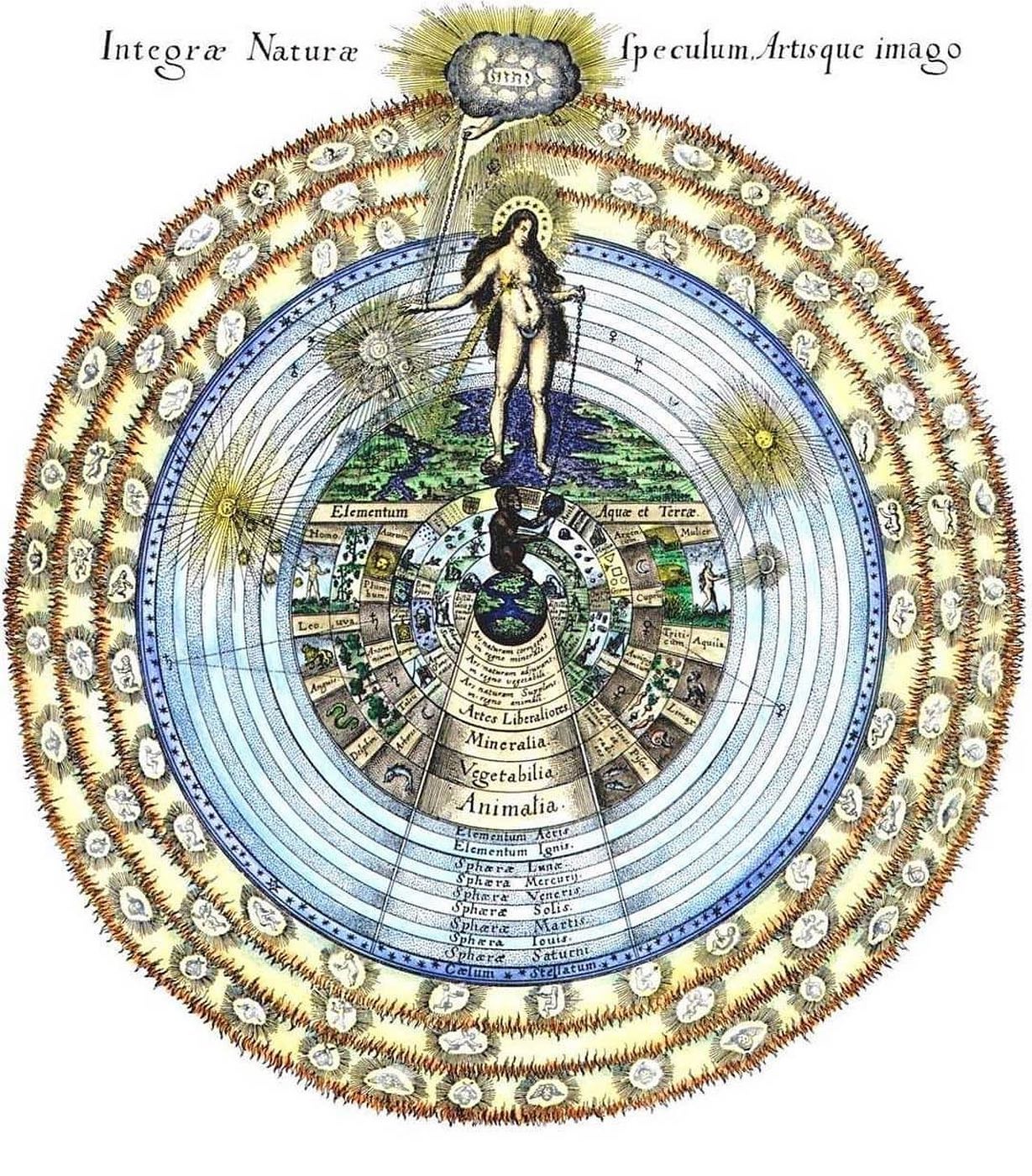
In the beginning of his article, The Early Mormon Chain of Belonging, Samuel Brown discusses this illustration:


(Source)


Robert Fludd (1574–1637) illustrated his 1617–1619 … [“The Mirror of the Whole of Nature, and the Image of Art”], which depicts the Great Chain of Being in its late medieval/early modern splendor. Notice particularly the integration of humanity and cosmos and the incorporation of astral imagery
into the body


Later in the article he compares the LDS Book of Abraham’s illustrations, such as this image in an attempt to show a correspondence of ideas between the ancient Great Chain of Being and LDS Theology:
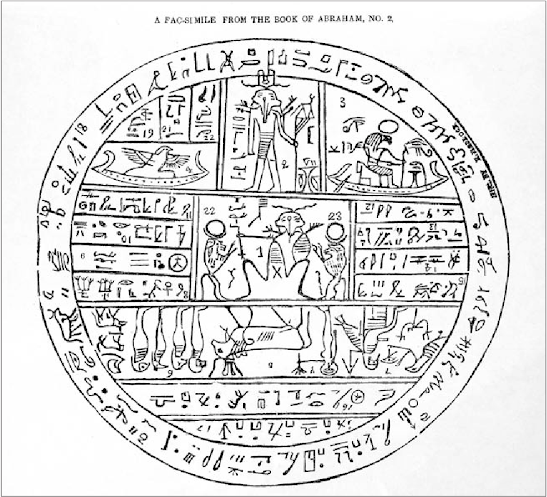


Fig. 1. Kolob, signifying the first creation, nearest to the celestial, or the residence of God. First in government, the last pertaining to the measurement of time. The measurement according to celestial time, which celestial time signifies one day to a cubit. One day in Kolob is equal to a thousand years according to the measurement of this earth, which is called by the Egyptians Jah-oh-eh.


Brown shows Joseph Smith's consistent drive to unite the Divine Realm and humanity into one eternal round of connectivity is based on the Bible itself. Brown's article supports my own research, that Joseph Smith was able to truly understand the real meaning of the Bible: which is that for the early Bible writers, God (Jehovah) was the source of the stars which represents the gods (holy ones) which is covered in the scholarship of Dr. Michael Heiser. For example:


“When the morning stars sang in chorus, and all the sons of God (bene ’elohim) shouted for joy?” (Job 38:7)


... “When the Most High gave the nations their inheritance, when He divided up humankind, He set the boundaries of the peoples, according to the number of the sons of God. For Yahweh’s allotment is His people Jacob is His special possession.” (Deut. 32:8-9)


“When you look up to the sky and see the sun, moon, and stars—the whole heavenly creation—you must not be seduced to worship and serve them, for Yahweh your God has assigned them to all the people of the world. You, however, Yahweh has selected and brought from Egypt, that iron-smelting furnace, to be his special people as you are today.” (Deut. 4:19-20)


(Source)


The Elohim (holy ones in God's Divine Council) were seen as representative of the glorious stars. So Paul is basically teaching that Christians as "saints" (meaning the earthly holy ones) will be like the stars in the sky, with new noomatic bodies that are star-like. This is why the Gospels then speak of Christians (holy ones) having their light shine. Joseph Smith built upon this theme when composing the Book of Mormon, where in Lehi's dream bright shining fruit represents LDS Christians as the glowing fruit-bearing branches of the True Vine (Christ's Genus).


The following are excerpts from his article, The Early Mormon Chain of Belonging by Samuel Brown with my commentary in between (words in bold my own for emphasis):

As part of his ongoing efforts to recover the lost language of Eden, Smith shared with his inner circle a “Sample of Pure Language.” In it Smith explained that Awman (spelled Ahman in publications) represented divinity, the divine species, “the being which made all things in all its parts.” This strange phrase emphasized the images of parts coming together to constitute a harmonic whole—a kind of dynamic integration at the center of the chain. Jesus, humans, and angels all received names in this revelation—Son Ahman, Sons Ahman, and Angls-man, respectively. The revelation also emphasized hierarchy. Even in this early statement stood the hint that humans would be superior to angels, for humans were “the greatest parts of Awman,” while angels were to “minister for or to” humans. [43] At the same time Ahman was beginning to figure prominently in revelations about the Garden of Eden, pan-human genealogy, and eschatology. [44] These ancient names for humans, gods, and angels emphasized their conspecificity and their integration as “parts” of a harmonious whole.

Note that Joseph Smith revised John 1:1 in the JST, wherein it basically argues that God and “part of” Him called the Only Begotten (Monogene) were in the beginning. Let’s examine John 1:1–34. We start with the JST John 1, verse 1 (words in brackets are my own):

1 In the beginning was the gospel preached through the Son [Son, as in God’s twin image]. And the gospel was the word, and the word was with the Son, and the Son was with God, and the Son was of God [of God’s Gene/DNA as the Monogene of God].

2 The same was in the beginning with God …


Now let’s compare the Joseph Smith Translation (JST) of John 1:1 discussed above with the following from The Joseph Smith Papers, Revelations and Translations Volume 1:
Sample of Pure Language, circa March 1832 by the Joseph Smith Papers:


Question: What is the name of God in pure Language

Answer: Awmen.

Q: The meaning of the pure word A[w]men

A: It is the being which made all things in all its parts.

Q: What is the name of the Son of God.

A: The Son Awmen.

Q: What is the Son Awmen.

A: It is the greatest of all the parts of Awmen which is the Godhead the first born.


(Source; Retrieved 1/6/14).

Notice that it states that the Word or Son Awmen (the name of God) is “the greatest of all the parts of Awman which is the godhead the first born.” This is important, Jesus as Son Ahmen is the bodily image of the godhead, which accords with the Fifth Lecture on Faith. God the Father is in the image of the Son’s earthly body, as they are twins. This is why the JST John 1:1 states that the Word or Son is “of God,” here the Word or Son is described as “part of God, the greatest of all the parts of Ahmen/God”. The Son is the Monogene, the first part of God’s DNA. Jesus is also known as “Son Ahman” in D&C 78:20 and 95:17. Thus the Son (as part of God) is God’s bodily image, first as a personage of spirit (Jehovah the Father) and then as the Son, a personage of earthly tabernacle (see Lecture on Faith #5). In other words, the Son is part of God just as we are part of our father genetically. Thus, the earthly Jesus “received all power, both in heaven and on earth, and the glory of the Father [Jehovah] was with him, for he [His Genome] dwelt in him [the earthly Jesus]” (D&C 93: 17). See Restoring the Original Mormon Godhead (Blog Series) for more details.

Samuel Brown continues ... 

… [D&C 84] on priesthood then began to describe an entity called the Light of Christ, which enlightened every human soul (D&C 84: 45–46). Toward the end of the revelation, a “Song of Zion” personified the Earth as obeying God (D& C 84: 100). (In May 1833 Smith expanded the image of light as metaphysical power in a striking revelation: D&C 93: esp. 2, 9, 28–29, 36). In the early 1830s, priesthood was a hierarchy of people and also the power, analogous to light, by which it all worked. …

… Smith praised the perfect order of heavenly bodies, the type of religious astronomy that carried the chain into the nineteenth century. Smith reported that Jesus was not only “the light of truth” which was “the light of Christ” but was also “in” the universe’s celestial bodies: sun, moon, and stars. He was also “the law by which all things are governed, even the power of God” (D& C 88: 7 –13). …


… During their encounter with the papyri, Smith and his colleagues emphasized the parallel between people and planets, linked priesthood with genealogy, described correspondences between light and time, and highlighted the significance of Eden and Adam. …

… Phelps and Smith also included the hierarchical kingdoms ... [one] composite glyph is glossed as “the glory of the celestial Kingdom: The connection of attributes; many parts perfected, and compounded into one Having been united . . . one glory above all other glories, as the [sun] excels the moon in light, this glory excels being filled with the same glory equally.” This glyph reiterated the astral hierarchy described in the Vision in a way that emphasized the familial unity of the highest echelon of that celestial chain. When the Egyptian pictogram placed a man and a woman together in the presence of God, Smith subsumed the entire Chain of Being into the human family, whose “many parts” were thereby “united.” [75] Several other glyphs describe the “degrees and parts” of the many afterlife kingdoms described in the Vision. [76] …


… Historian Michael Walzer’s description of early modern English thought might as easily apply to Smith and his associates: “Within the great chain there were discovered a whole series of lesser chains—the animal hierarchy, presided over by eagle and lion; the nine angelic orders; the greater and lesser stars—and these were held to correspond closely to one another.”[78] Such was the language of the Vision and the Olive Leaf taken to its imaginative conclusion. By the inexorable if often metaphorical logic of correspondence, and with the authority of ancient tradition, many antebellum Americans also saw their postmortal fate in the stars. Invoking most often the Jobian “morning stars” who “sang together” with the “sons of God” during creation (Job 38: 4–7) or the story of Lucifer, the fallen star (Isa. 14: 12), a variety of cultural commonplaces confirmed a belief in the identity of the dead, often as angels, with astral bodies. [79]


... telling the Latter-day Saints to model their behavior on the ever-faithful stars: “Since the heaven was stretched out as a curtain between this world and the worlds beyond, neither the sun, nor the moon, nor the planets, nor the stars, have ceased for a moment, (except when Joshua commanded otherwise,) from performing their daily labors.” [80] Phelps extended this image in early 1835 by urging Christian belief and practice on his readers, “that we may be quickened in the resurrection, and become angels, even Sons of God, for an eternity of glory, in a universe of worlds, which have ever taught, and will forever Teach mankind, as they shine / God’s done his part,—do thine!” [81] Phelps’s “worlds”— his term for celestial bodies— inspired their human kin to greater obedience to the dictates of God.


Images of humans as stars were an important element in public memorials for the dead among many Americans. For example, when Elizabeth Griffin died of “inflammation of the bowels” in Nauvoo at the tender age of “10 months 19 days,” the memorialist, probably her parent, included an apostrophe to her astral spirit: “a pure and brilliant star, / Thou dost shine in realms afar.” A eulogy suggested a similar fate for Bishop Edward Partridge, who would “rise from a Saint to an angel of light.”[82] The sense of astral correspondence is also strong in the 1840 eulogy of Smith’s own father, delivered by Joseph Jr.’s secretary, which evoked the dead who “like the stars in yonder firmament, shone in their several spheres, and filled that station in which they had been called by the providence of God.”[83] Even critics recognized the currency of such expressions among the Saints. For example, the learned Congregationalist Jonathan Baldwin Turner (1805–99) reported of the Mormon faithful: “Doubtless they will shine as stars somewhere in [their] new firmament of gods.”[84]


… Finney’s peer, Lyman Beecher (1775– 1863), for his part, presented stars as steadfast witnesses of God worth emulating. [86] The ever-popular Josiah Priest (1788– 1851) compared a Mesoamerican tribal belief that the “sun and the stars” were the “souls of the departed” to the biblical book of Daniel (14: 12), which taught that the righteous “shall shine as the BRIGHTNESS of the firmament.” In this apparently shared belief of postmortal astralization, Priest saw proof that Native American afterlife traditions derived directly from ancient Israel. [87] Particularly across the boundary of death, a variety of early Americans saw themselves and their fates in the stars. What distinguished Mormons was the intensity of the belief in astral correspondence and the theological and ritual supports for the belief. 


Again, it's important to note here that the concept of Christians as stars is supported by many Christian theologians: including the protestant scholar Michael Heiser. For example, see Paul’s Use of Genesis 15:5 in Romans 4:18 in Light of Early Jewish Deification Traditions: Part 3: Becoming as the Stars and the Inheritance of the Nations (Posted by MikeHeiser | Apr 26, 2017; This is Part 3 of the series by David Burnett ).  


Note that in Part 1 of the series, David Burnett states that: 


Reading Paul’s use of Gen 15:5 in light of ... already well-established deification or angelomorphic traditions in Early Judaism that see the destiny of the seed of Abraham as replacing the stars ... could illuminate the relationship between a complex nexus of ideas that Paul sees implicit in the one promise to Abraham in Gen 15:5. The promise of becoming as the stars of heaven would encompass the inheritance of the cosmos, becoming a father of many nations, and the resurrection from the dead. 


Note the similarities with the above and Joseph Smith's astral theology of deification.


Samiel Brown continues:


In the metonymy of correspondence [in the Book of Abraham], the central star seemed to point toward the center of the earth’s power, Eden, and its priest/patriarch Adam. Employing the sacred word Ahman to describe the site of Adam’s deathbed and of the reunion of the entire human family at the second coming of Christ (Adam-ondiAhman), Smith and Phelps foregrounded the priestly figure Adam or Phaheh within the Egyptian project. [88] The Egyptian project is obsessed with the overlap between genealogy and progeny on the one hand and priesthood on the other. Many of the glyphs as well as the Book of Abraham emphasize this point. In the published scripture, God told Abraham that he and his seed were by definition “Priesthood”(Abr. 2: 11). Degrees, the ramifications of meaning in the logic of the Egyptian grammar documents, draw attention to images of reproduction as extension of power. Emblematically a queen named Katouhmun (one of the mummies whose papyri Smith was interpreting) ascends the marital hierarchy, and a glyph for a powerful patriarch describes the “extension of power by marriage or by ordination.” The center of genealogical and sacerdotal power was Adam. The word Ahmanreturned as the paradisiacal home of all humanity. [89]

Note here how Brown follows my thesis in my blog series here when he points out that “In the published scripture [The Book of Abraham], God told Abraham that he and his seed [sperm] were by definition ‘Priesthood’ (Abr. 2: 11). Degrees, the ramifications of meaning in the logic of the Egyptian grammar documents, draw attention to images of reproduction as extension of power.” In other words, as I cover in my Restoring the Original Mormon Godhead (Blog Series), God begins as a Father (Progenitor) of star-like beings and replicates His Unique Genome through the earthly body of Christ as His Unique Monogene (Only Begotten); and then Abraham spreads his seed producing a People; and then Christ as the Monogene of God reproduces His divine seed producing Christians (holy ones/"saints") as star-like noomatic shining ones as the Children of Christ (with Christ as their Father/Progenitor). In all of this, there is the consistent theme of reproduction as extensions of Power which is based on the Bible itself, where Christ reproduces his seed (divine genus) to generate eternal lives (see John 10:10; 12:24). Compare D&C 132 that states that the "glory [of exalted ones] shall be a fulness and a continuation of the seeds forever and ever", wherein "exaltation" is the "continuation of the lives," and "This is eternal lives—to know the only wise and true God, and Jesus Christ, whom he hath sent [Christ as the Monogene]. ... Receive ye, therefore, my law [of the celestial reproduction of eternal lives]. ... for they [the plural wives of Joseph Smith] are given unto him to multiply and replenish the earth ... and for their exaltation in the eternal worlds, that they may bear the souls of men; for herein is the work of my Father continued, that he may be glorified" (D&C 132: 19, 22, 24, 63, words in brackets my own). Thus, as Brown writes above, reproduction [is an] extension of power. Note that the practice of plural marriage ended around 1890 and LDS members no longer practice polygamy; as the aim of the practice was in part to generate a Peoplehood, which was accomplishedby 1890. Brown continues:

… In the 1840s, Smith went to great lengths to explain the significance of Elijah and his mystical power, termed “priesthood,” to effect seals between people that would integrate them into the Chain of Belonging. Elijah’s priesthood was to be the power by which all of humanity would enter a hierarchy of power patterned on family relationships.


Baptism for the dead was the first temple rite of Smith’s adoption theology. This theology was rooted in the general Pauline sense that conversion to Christ created a new ethnicity to which believers could be united and in the fairly typical Protestant convention that evangelists “adopted” their converts into the family of God. This traditional sense expanded to incorporate patriarchal blessings and other aspects of the Mormon Chain of Belonging. [100] Although baptism had long been the symbol of becoming a new creature in Christ and entering God’s family (the congregation), Joseph Smith used the rite and its adoptive imagery to broaden the circle of belonging to include the living and the dead in a kinship network that merged genealogical and sacerdotal associations. Temple rites became the entry point for the Chain of Belonging. [101]


Brown then discusses the Chain of Belonging using Facsimile 2 from the Book of Abraham (depicted below). He explains that this "Nauvoo drawing of a hypocephalus among the funerary papyri strongly emphasizes the astral Chain of Being that Smith and his colleagues described in the 1830s. Times and Seasons 3, no. 10 (March 15, 1842): 720– 21.":
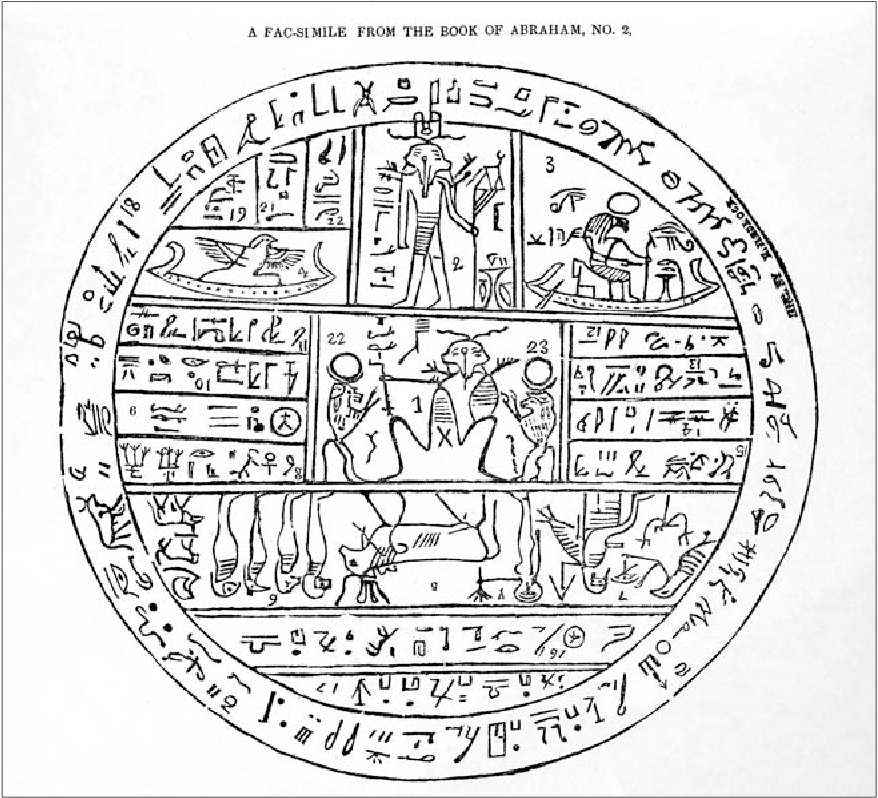


EXPLANATION


 Fig. 1 . Kolob, signifying the first creation, nearest to the celestial, or the residence of God. First in government, the last pertaining to the measurement of time. …


… Fig. 3. Is made to represent God, sitting upon his throne, clothed with power and authority; with a crown of eternal light upon his head; representing also the grand Key-words of the Holy Priesthood, as revealed to Adam in the Garden of Eden, as also to Seth, Noah, Melchisedek, Abraham, and all to whom the Priesthood was revealed. …


… Fig. 7. Represents God sitting upon his throne, revealing through the heavens the grand Key-words of the Priesthood; as, also, the sign of the Holy Ghost unto Abraham, in the form of a dove. …


When he published the Book of Abraham in 1842, he added focused translations of three illustrations known to the Latter-day Saints as “facsimiles,” all of which are reproduced to this day in LDS editions of the Book of Abraham. The hypocephalus presented as facsimile 2— a circle divided into numerous shapes, each containing a symbol and the whole surrounded by a band containing other symbols— includes textual descriptions that exemplify the astral Chain of Being of the 1830s.


… Within this [Nauvoo temple] liturgy, selected Saints began to learn more about the possibility that they would be celestial royalty and were encouraged to imagine themselves within the Abraham cosmogony as priests and priestesses in the postmortal Chain of Belonging. [106]


As he revealed this temple liturgy, Smith kept the creation of eternal associations between people central. Though plural marriage has generated significant controversy, it was, among other things, an idiosyncratically biblical mode of increasing the number of people to whom a man was sealed. [107] The model of the Chain of Belonging imparted to polygamy a decidedly dynastic scope. [108] Smith used dynastic images explicitly to recruit wives, counseling young Lucy Walker that her acceptance of a sealing to him “would prove an everlasting blessing to my father’s house. And form a chain that could never be broken, worlds without End.”[109] Helen Mar Kimball’s son eulogized her as the “golden link” connecting her father’s family to Joseph Smith. [110] Though these specific phrases are probably influenced by later events, they correctly emphasize the familial chain that polygamy strengthened.


By merging the chain’s hierarchy with familial images, Smith made the chain relationally dynamic. The capacity to reproduce helped believers see how they could acquire endless glory in the afterlife. Joseph Fielding understood well the implication of the doctrine, diarizing in 1844: “I understand that a Man’s Dominion will be as God’s is, over his own Creatures and the more numerous the greater his Dominion.”[111] Benjamin F. Johnson recalled that “the Prophet taught us that Dominion & powr in the great Future would be Commensurate with the no of ‘Wives Childin & Friends’that we inherit here.”[112] The new grades of heaven reflected no simple statement of merit or ontological superiority: they were an index of one’s placement in the genealogy of eternal “intelligences.” These “intelligences” were the Mormon version of the “crowns of many stars” anticipated by Protestant evangelists. [113] In this respect, the Mormon chain tapped a potential noted at least as early as the thirteenth century. In Lovejoy’s paraphrase of Aquinas, a human could “be like God in having pre-eminence over another” within the structure of the chain. [114] In the Mormon version, the human capacity to reproduce held the promise of eternal progress, and patterns of family life pointed to a generational hierarchy within the chain.


The ostensibly tripartite heavens espoused in Smith and Rigdon’s 1832 Vision hid the real extent of Smith’s heaven, which resided entirely within the celestial kingdom reserved for those who have “enter[ed] into this order of the priesthood.” Using code words for his marital system, the persistence of family life, and salvation, Smith warned that, outside his celestial kingdom in heaven, the dead “cannot have increase.”[115] This heaven was organized around Smith’s Chain of Belonging, the harmonizing “economy” at which his 1832 revelation hinted. It was the single place that family could persist eternally. The 1843 revelation authorizing polygamy made the point emphatically. Those who did not enter this distinctive celestial family “cannot be enlarged”; they would remain “without exaltation,” a perfectionist term equated with salvation in this conception of the celestial kingdom. [116] Those who rejected this form of marriage and family would be neutered angels who would endure salvation “separately and singly.” According to a July 1843 sermon, they would be “single & alone in the eternal world.”[117] These disobedient souls would inhabit an essentially theocentric heaven without interpersonal relationships, while the obedient occupied the distinctively kinship based heaven of the Chain of Belonging. 


… Binding the generations through temple rites and their associated priesthood constituted the Chain of Belonging [See Theology on Plural Marriage by the Gospel Learning Channel where Anthony Sweat explains Joseph Smith's belief in being "crafty" about taking advantage of God's sealing power in order to seal other's to you into a larger kinship group which expands your kingdom]. In May 1844, Smith explicitly told his followers that the temple would allow them to supersede the angels, a key element of the ontological flattening of the Chain of Belonging: “You must have a promise, some ordinance some blessing in order to assend above principalities.” [119] The “promise,” “ordinance,” and “blessing” were to be obtained in the temple.


The Mormon heaven was emphatically not the Victorian hearth of the increasingly popular domestic heaven. Smith’s genealogical chain extended from Church members to their Prophet. From Smith, the chain extended to the biblical patriarchs, all the way to Adam, who would in turn present his priesthood chain to Jesus the Son and God the Father in the valley of Adam-ondi Ahman. [120] The domestic heaven was generally seen to consist of reasonably independent nuclear families; Smith’s heaven consisted of one boundless family of eternal intelligences—“a perfect chain from Father Adam to his latest posterity.”[121] This lineage was crucial to Mormon salvation, as in Smith’s 1842 revelation to Newel Whitney, promising “honor and immortality and eternal life to all your house both old & young because of the lineage of my Preast Hood.[see Abr. 2:22]”[122] In the solicitous phrase of British convert Joseph Fielding to his friends, “We are dependent on each other as links in one vast chain.” They were making a soteriological point. [123] The chain was the theological infrastructure and Smith’s temple priesthood was the welding that connected the links together in a way that secured their salvation. Through these rites and doctrines, Smith promised to “link the chain of the priesthood in Such a way that can not be broken.”[124]


Divine Anthropology: The Eternal Progression of the Sons Ahman


One of the most striking modifications Smith made to the Great Chain of Being was in his characterization of the relationships among angels, gods, and humans, what I call his divine anthropology. He had made his broad approach clear as early as 1832 with his “Sample of Pure Language,” and he and his followers had made continual references to the Mormon up-ending of the traditional chain, particularly with regard to the status of angels. In Nauvoo, the message became loud and unmistakable: the apparently suprahuman chain contained humans, the Sons Ahman. In the divine anthropology, angels, gods, and humans were conspecific, all members of the species called Ahman. Smith’s revision of the chain meant several things. What other Christians understood as angels were in fact resurrected humans; Joseph Smith reserved the term “angel” for a lower level in the chain. Angels were ultimately less than human, humans would advance forever, and God was a family man.


… An 1843 revelation strongly emphasized Smith’s redefined status for angels, whose superiority depended only on their lineal priority. In fact, angels who could not be integrated into the family tree (along with those humans unfit for “exaltation”) would be retained as servants to their more exalted cousins, an inversion of Augustinian teaching. [132] They would be “appointed angels in heaven, which angels are ministering Servants to minister for those who are worthy of a far more, and an exceeding, and an eternal weight of glory.”[133] Stripped of family, these intelligences would become inferior to the core hierarchy of heaven. The demotion extended so far that the Nauvoo High Council asked rhetorically “Know ye not that we shall judge Angels?” then confirmed explicitly: “The saints are to judge angels.”[134] The supernatural beings who had been critical to religious valences of the chain ceded pride of place to Smith’s priesthood family. Though the imagery may be inflected by concepts of fraternal initiation, it is striking that the polygamy revelation told believers who had been adopted into the priesthood family by accepting plural marriage that they “shall pass by the angels” in the afterlife (D& C 132: 19). …


Note how Brown emphasizes Joseph's physicalist heaven, which was different from Augustine's conceptions. Brown goes on to discuss what I see as Smith's theology of God as an affirmation of fleshly life, for God was not a vaporous bodiless nothing (a spirit without a body as Augustine and others taught), but instead God the Father was a real physical being composed of spirit matter; and that God wanted humans to advance to Godhood and expand His divine Image (His Monogene), which Divine "Gene/Genus" was the power to resurrect and continue the lives via the male seed. Brown continues:

… Smith emphasized an even greater future for humans, using his royal image for angelized humans: “every man who reigns is a God.” [137] …


… The obliteration of suprahuman beings and the exaltation of humans in Smith’s chain collapsed the space separating humanity from God. By eliminating this space, Smith opened up the possibility of recasting God’s place in the chain in a direct assault on theocentrism. Though Protestants called God “Father,” Smith’s sacerdotal system understood the relationship in a new way. Just as God had stood above the pulpits at the Kirtland Temple, so he would stand at the head of the eternalized human family. This is the great mystery that Smith publicized in his most famous sermon, an address to the April 1844 Church conference inspired by the recent death of King Follett. There Smith announced the “secret” that “God Himself who sits enthroned in yonder heavens is a Man like unto one of yourselves.” [139] Smith’s God was not the ontologically distinct creator of the Scale of Creation, but the founding parent of its genealogical hierarchy.


In his June 1844 “Sermon in the Grove” a few weeks later, Smith clarified his chain, situating his polytheism—a “plurality of Gods”—within both biblical proof-texts and a restatement of the chain’s principle of gradation. After explaining that the intelligences of his chain would be called “kings and priests” (and by extension “queens and priestesses”) in a temple-saturated allusion to Revelation 1: 6, Smith quoted from and amplified his Book of Abraham (Abr 3: 18). The Mormon prophet explained that there “may exist two men on the earth—one wiser than the other—wo[ul]d. shew that an[o]t[he]r. who is wiser than the wisest may exist—intelligences exist one above anot[he]r. that there is no end to it.”[140] To Smith, in a way he never entirely worked out, the family of divinities had no end. His main point, however, was clear: Eternity was organized as a family. In the Sermon in the Grove, Smith also returned to the 1832 Vision. He explained that “Paul—says there is one Glory of the Sun the moon & the Stars—& as the Star differs &C.” The heirs of the astral glories, Smith continued, “are exalted far above princ[ipalities]. thrones dom[inions]. & angels—& are expressly decl[are]d. to be heirs of God.”[141] Smith’s followers, the heirs of God according to adoption theology, towered above the various grades of angels. Employing traditional names for hierarchies of angels (Eph. 3: 10, 6: 12; Col. 1: 16), Smith strongly emphasized the inversion of the chain. [142]


It is difficult to read Smith’s King Follett Discourse except as an application of the temporal Chain of Being. Smith explained that to be “joint heirs with Christ” (Romans 8: 17) meant “to inherit the same glory power & exaltation” and to “ascend [to] a throne as those who have gone before.” Speaking for Christ, Joseph continued, “when I get my K[ingdom] workfed [sic] out I will present to the father & it will exalt his glory” so that “he will take a Higher exhaltation & I will take his place and am also exhalted.” Thus the Father “obtns K[ingdom] rollg. upon K[ingdom]. so that J[esus] treads in his tracks as he had gone before.”[143] Speaking for Jesus, Smith explained the relationship between Father and Son as paradigmatic for all human relationships in the Chain of Belonging. “I saw my Father work out his kingdom with fear and trembling. . . . He obtains kingdom upon kingdom, and it will exalt his glory.”[144] Attendee George Laub employed even more typically the image of the temporal chain in his summary of Smith’s preaching: “We are to goe from glory to glory & as one is raised the Next may be raised to his place or Sphere and so take their Exaltation through a regular channel. And when we get to where Jesus is he will be as far ahed of us in exaltation as when we started.”[145]


The Chain of Being was the infrastructure of this progressive theology. In Smith’s phrase, “You have got to learn how to be Gods yourselves; to be kings and priests to God, the same as all Gods have done; by going from a small degree to another, from grace to grace, from exaltation to exaltation, until you are able to sit in glory as doth [sic] those who sit enthroned in everlasting power.” [146] These transitions are the progress of the entire chain. Adopting the traditional image of the ladder to explain the temporal Chain of Being, Smith said: “When you climb a ladder, you must begin at the bottom and go on until you learn the last principle; it will be a great while before you have learned the last. . . . It is a great thing to learn salvation beyong [sic] the grave.” [147] Smith was telling his followers to ascend a modern version of Jacob’s Ladder. As the Mormon faithful created sacerdotal families, they became heavenly fathers/mothers, priests/priestesses, and kings/queens. Thus did they become gods.


… William Phelps returned repeatedly to the image of the chain: in hymns, in a funeral sermon for the Smith brothers, and in a fictional presentation of the divine anthropology. Preaching Smith’s eulogy in 1844, Phelps used the rhetoric of the temporal chain, framing it within the Elijah sealing rituals. He announced to the grieving Saints, who had not yet completed construction of the Nauvoo Temple: 


When the temple is made ready for the holy work . . . we can go on from birth to age; from life to death; and from life to lives; and from world to heaven; and from heaven to eternity; and from eternity to ceaseless progression; and in the midst of all these changes; we can pass from scene to scene; from joy to joy; from glory to glory; from wisdom to wisdom; from system to system; from god to god, and from one perfection to another, while eternities go and eternities come, and yet there is room—for the curtains of endless progression are stretched out still and a god is there to go ahead with improvements. [149]


In this particular version of the temporal chain, God the Father pioneered the future perfections of humanity; Elijah’s temple was the nexus for Latter-day Saint connections to the Chain of Belonging. [Again, see Theology on Plural Marriage by the Gospel Learning Channel where Anthony Sweat explains Joseph Smith's belief in being "crafty" about taking advantage of God's sealing power in order to seal other's to you into a larger kinship group which expands your kingdom].


In his short 1845 fiction, “Paracletes,” Phelps referred to a universe “filled with a variety of beings,” an oblique allusion to the chain, which he saw as operative at the cosmogony. He then interpreted the King Follett Discourse and the Sermon in the Grove, stating that the “head” God [see D&C 121: 32] was indeed God the Father of the Old Testament, supervising the endless ramifications of kings and priests in the sacerdotal genealogy. [150] Phelps’s dedication hymn for the Nauvoo Temple maintained that “the wonderful chain of our union / Is tighten’d the longer it’s stretch’d.”[151]


… [Parley] Pratt reiterated Smith’s claims from his King Follett Discourse in an essay in early 1845. Latter-day Saints were to progress “till the weakest child of God which now exists upon the earth will possess more dominion, more property, more subjects, and more power and glory than is possessed by Jesus Christ or by his father; while at the same time, Jesus Christ and his father, will have their dominion, kingdoms, and subjects increased in proportion.” [154] This was the temporal chain. …


… On December 26, 1844 , Apostle Heber C. Kimball, “in his usual philanthropic manner, use[d] a chain as a figure to illustrate the principle of graduation, while in pursuit of celestial enjoyment in worlds to come.” [155] …


… Apostle John Taylor in 1846 explained that the Saints needed to understand “what ordinances to administer” that would “place you in a relationship to God and angels, and to one another.”[156] Though Brigham Young invested great energy in completing the temple and codifying its liturgy in Nauvoo, during the exodus from Nauvoo the matter of adoption specifically became more prominent. Sacerdotal family units served to organize the migrating Saints, as they attempted to maintain their durable society in the face of severe dislocations. Young frequently and repeatedly used the image of the chain. A significant sermon in February 1847 communicated Young’s view of binding people to the ancients: Those sealed to an apostle were “bound . . . by that perfect chain according to the law of God and order of Heaven that will bind the righteous from Adam to the last saint and Adam will claim us all as members of his kingdom we being his children.”[157] Young promised to “extend the Chain of the Pristhood backthrough the Apostolic dispensation to Father Adam just as soon as I can get a temple built.”[158]


“Diagram of the Kingdom of God,” Millennial Star 9, no. 2 (January 15, 1847): 23, attributed to Orson Hyde. Image courtesy of the LDS Church History Library; copyright Intellectual Reserve, Inc. 34 


Note that Brown's use of the diagram above is explained in this article:


Orson Hyde's Diagram of the Kingdom of God


This diagram by Orson Hyde was published in the Millennial Star in 1847. It shows his vision (and that of many early Latter-day Saints) of the organization of the Kingdom of God. The text below is quoted from the accompanying editorial.


The Kingdom of God


The above diagram shows the order and unity of the kingdom of God. The eternal Father sits at the head, crowned King of kings and Lord of lords. Wherever the other lines meet, there sits a king and a priest unto God, bearing rule, authority, and dominion under the Father. He is one with the Father, because his kingdom is joined to his Father's and becomes part of it.


The most eminent and distinguished prophets who have laid down their lives for their testimony (Jesus among the rest), will be crowned at the head of the largest kingdoms under the Father, and will be one with Christ as Christ is one with his Father; for their kingdoms are all joined together, and such as do the will of the Father, the same are his mothers, sisters, and brothers. He that has been faithful over a few things, will be made ruler over many things; he that has been faithful over ten talents, shall have dominion over ten cities, and he that has been faithful over five talents, shall have dominion over five cities, and to every man will be given a kingdom and a dominion, according to his merit, powers, and abilities to govern and control. It will be seen by the above diagram that there are kingdoms of all sizes, an infinite variety to suit all grades of merit and ability. The chosen vessels unto God are the kings and priests that are placed at the head of these kingdoms. These have received their washings and anointings in the temple of God on this earth; they have been chosen, ordained, and anointed kings and priests, to reign as such in the resurrection of the just. Such as have not received the fulness of the priesthood, (for the fulness of the priesthood includes the authority of both king and priest) and have not been anointed and ordained in the temple of the Most High, may obtain salvation in the celestial kingdom, but not a celestial crown. Many are called to enjoy a celestial glory, yet few are chosen to wear a celestial crown, or rather, to be rulers in the celestial kingdom.


While this portion of eternity that we now live in, called time, continues, and while the other portions of eternity that we may hereafter dwell in, continue, those lines in the foregoing diagram, representing kingdoms, will continue to extend and be lengthened out; and thus, the increase of our kingdoms will increase the kingdom of our God, even as Daniel hath said: “of the increase of his kingdom and government there shall be no end.” All these kingdoms are one kingdom, and there is a King over kings, and a Lord over lords. There are Lords many, and Gods many, for they are called Gods to whom the word of God comes, and the word of God comes to all these kings and priests. But to our branch of the kingdom there is but one God, to whom we all owe the most perfect submission and loyalty; yet our God is just as subject to still higher intelligences, as we should be to him.


… These kingdoms, which are one kingdom, are designed to extend till they not only embrace this world, but every other planet that rolls in the blue vault of heaven. Thus will all things be gathered in one during the dispensation of the fulness of times, and the Saints will not only possess the earth, but all things else, for, says Paul, “All things are yours, whether Paul, or Apollos, or Cephas, or the world, or life, or death, or things present, or things to come: all are yours, and ye are Christ's, and Christ is God's”


(Orson Hyde, “A Diagram of the Kingdom of God,” Millennial Star 9 [15 January 1847]: 23-24).


My source for this is the excellent Words of Joseph Smith: The Contemporary Accounts of the Nauvoo Discourses of the Prophet Joseph compiled and edited by Andrew F. Ehat and Lyndon W. Cook. In their footnote, they add this:


According to the teachings that the Prophet gave in private (but which he only hinted at in this discourse [13 August 1843]), to be heir to Abraham's promise that he would head an innumerable posterity, each individual and his children must be sealed for time and eternity. If this sealing was performed, he taught, the covenant relationship would then continue throughout eternity. The Prophet taught, moreover, that such a patriarchal priesthood of kings and priests would have to be established by sealing children and parents back through Abraham to Adam in order to fulfill the mission of Elijah (Malachi 4:5-6). When this was accomplished, the order within the highest degree of the Celestial Kingdom would then be eternally set. Probably no clearer statement of Joseph's theology regarding this concept can be found than what is given in an editorial by Orson Hyde. The following diagram began the editorial after which came the text.


Joseph Smith, The Words of Joseph Smith: The Contemporary Accounts of the Nauvoo Discourses of the Prophet Joseph, compiled and edited by Andrew F. Ehat and Lyndon W. Cook [Provo: BYU Religious Studies Center, 1980], 297.)


Returning to Samuel Brown's article, he continues:


Perhaps the best visual depiction of Smith’s Chain of Belonging is the “Diagram of the Kingdom of God” published in the Millennial Star and generally attributed to first-generation Apostle Orson Hyde. In Hyde’s description, this was 


the order and unity of the kingdom of God. The eternal Father sits at the head, crowned King of kings and Lord of lords. Wherever the other lines meet , there sits a king and a priest unto God, bearing rule, authority, and dominion under the Father. . . . The most eminent and distinguished prophets who have laid down their lives for their testimony . . . will be crowned at the head of the largest kingdoms under the Father, and will be one with Christ as Christ is one with his Father ; for their kingdoms are all joined together . . . and to every man will be given a kingdom and a dominion, according to his merit, powers, and abilities. . . . There are kingdoms of all sizes , an infinite variety to suit all grades of merit and ability.


Hyde explicitly equated moral (or the ontological) with sacerdotal-genealogical gravity within the chain. The worthiest servants would stand highest in the chain, kings of their own subkingdoms. Degrees of glory, rendered here as “grades of merit,” are explicitly defined by their patriarchal scope. …


… Orson F. Whitney, in his epic poem Elias, published in the late nineteenth century, returned to the images Smith had employed. Whitney evoked “might of heaven, the pure and potent chain.” It was 


The all-creating, all-controlling chain Whereby the Gods perpetuate their reign Whereby the higher, bending, lift the lower. [161]


Whitney continued to appreciate that the chain was central to Smith’s conquest of death and family-ordered heaven—that it was a way to describe the connections among people. Mormons were “Welding the parted links of being’s chain / Old making new, the dead live again.”[162]


… —Smith [had] announced to his followers a solution to death, one that mediated the contradictory demands of rising sentimentalism and the vast grandeur of patriarchal order. … Smith’s distinctive version of a formal philosophical construct provides several important windows into the cultural work of early Mormonism … [which] demonstrates his impressive intellectual resourcefulness in the face of death. Where others saw a defense against atheistic explanations of creation, Smith saw the weapon to vanquish the King of Terrors and protect kindreds from dissolution.


Finally, understanding temple rites and Smith’s divine anthropology as aspects of his death conquest provides an emotional and spiritual valence missing from accounts of Mormon eschatology based primarily in perfectionism or biblical hermeticism. Smith and his followers anticipated not just crowns and sacred power in the afterlife; they looked forward to the tender embraces of loved ones to whom they were connected by both blood and deliberate allegiance. Although Smith is hard to summarize simply, the thrust of his later years was the creation of a kinship network whose ties were invulnerable to death.


Note that we see in proto-orthodox Christianity and then in Catholicism and Protestantism, an emphasis on the angelic realm or the stars as stagnant, genderless, immobile, celibate, unmarried, etc., which are ideas stemming from the apostle Paul living in the first century based on his miscalculation of the immanent second coming of the Lord in his lifetime; which he was simply mistaken about. This is not to take away from Paul's genius as a theologian but to show that he did not emphasis family and children and retirement planning because he believed all mortal life was ending soon. Yet Paul still promoted the goodness of physical affection among married couples in 1 Corinthians chapter 7, even while promoting celibacy as the ideal based on his end-times expectation. In contrast, Augustine would stain the Christian tradition with a very negative attitude of all forms of sexual desire and his invention of the dogma of Original Sin which Smith repudiated in Article of Faith #2. So the restored gospel is if anything the radical affirmation of the sensual body and the human reproductive "seed" leading to the growth of families and kinship networks of friends and families through the vision of Zion. This can be said to be the restitution of all things. In other words, it was the restoration of the reproductive seed as holy, and the role of mothers and fathers as kings and priestesses in the holy role of generating a royal lineage as one finds in the Hebrew Bible. This was the restoration of the original Hebrew conception of God's kings given an elevated status by integrating human kings with the status of the Sons of God in the Divine Council. For these divine beings were sexual beings and were capable of breaking the rule of not mating with mortal women in Genesis 6. So Joseph restores the Hebrew theology of a physical Jehovah with a body and sexual Sons of God (in the Elohim/Divine Council) by describing Paul's holy ones (saints) as not ideally celibate but ideally sexually potent like Abraham and the kings of the Hebrew Bible.


In his article, Joseph Smith on Government (August 27, 2020), Craig R. Frogley provides these additional thoughts on the subject:


As early as Kirtland, Joseph was given a view of God’s government.  The restoration of the priesthood after the order of the Son of God, was its beginning but without Joseph’s vision of God’s government, priesthood would remain simply as a delegation of tasks rather than the majestic preparation and puzzling of an eternity of interdependent authority, vision, and channel of divine power.


In the school of the prophets, Orson Hyde reported the following sublimities from the prophet:


“The above diagram shows the order and unity of the kingdom of god. The eternal Father sits at the head, crowned King of kings and Lord of lords. Wherever the other lines meet, there sits a king and a priest unto God, bearing rule, authority, and dominion under the Father. He is one with the Father, because his kingdom is joined to his Father’s and becomes part of it…

…These kingdoms, which are one kingdom are designed to extend till they not only embrace this world, but every other planet that rolls into the blue vault of heaven. Thus will all things be gathered in one during the dispensation of the fullness of times, and the saints will not only possess the earth, but all things else, for, says Paul, ‘All things are yours…ye are Christ’s and Christ is God’s’” Orson Hyde, “A Diagram of the Kingdom of God,” by Joseph Smith Millennial Star 9: 23-24 (Jan 15, 1847)
Today, we recognize the fractal nature of the diagram, the kingdom. Each kingdom is an interdependent entity with all others under The Son’s which is included in the Father’s. ... In an editorial three years after his Liberty Jail experience with the state of Missouri, the Prophet Joseph compares this divine government with that which man creates: 

“The government of the Almighty has always been very dissimilar to the governments of men, whether we refer to His religious government, or to the government of nations. The government of God has always tended to promote peace, unity, harmony, strength, and happiness[1]; while that of man has been productive of confusion, disorder, weakness, and misery.


The greatest acts of the mighty men have been to depopulate nations and to overthrow kingdoms; and whilst they have exalted themselves and become glorious, it has been at the expense of the lives of the innocent, the blood of the oppressed, the moans of the widow, and the tears of the orphan.

Egypt, Babylon, Greece, Persia, Carthage, Rome-each was raised to dignity amidst the clash of arms and the din of war; and whilst their triumphant leaders led forth their victorious armies to glory and victory, their ears were saluted with the groans of the dying and the misery and distress of the human family; before them the earth was a paradise, and the behind them a desolate wilderness; their kingdoms were founded in carnage and bloodshed, and sustained by oppression, tyranny, and despotism.

The designs of God, on the other hand, have been to promote the universal good of the universal world; to establish peace and good will among men; to promote the principles of eternal truth; to bring about a state of things that shall unite man to his fellow man; cause the world to “beat their swords into plowshares, and their spears into pruning hooks,” make the nations of the earth dwell in peace, and to bring about the millennial glory, when “the earth shall yield its increase, resume its paradisean glory, and become as the garden of the Lord.”    TPJS p248

“Have we increased in knowledge or intelligence? Where is there a man that can step forth and alter the destiny of nations and promote the happiness of the world? Or where is there a kingdom or nation that can promote the universal happiness of its own subjects, or even their general well-being? Our nation, which possesses greater resources than any other, is rent, from center to circumference, with party strife, political intrigues, and sectional interest; our counselors are panic-stricken, our legislators are astonished, and our senators are confounded, our merchants are paralyzed, our tradesmen are disheartened, our mechanics out of employ, our farmers distressed, and our poor crying for bread, our banks are broken, our credit ruined, and our states overwhelmed in debt, yet we are, and have been in peace.” TPJS p249

Earlier, in Liberty the Lord had explained to Joseph that “it is the nature and disposition of almost all men, as soon as they get a little authority, as they suppose, they will immediately begin to exercise unrighteous dominion.” D&C 121:39

So, he concludes what we have come to expect in our day as well, “All, all, speak with a voice of thunder, that man is not able to govern himself, to legislate for himself, to protect himself, to promote his own good, nor the good of the world.” TPJS p250

... history shows the futility of this claim and corroborates the D&C 121:39 that unrighteous dominion has repeatedly destroyed culture after culture ...

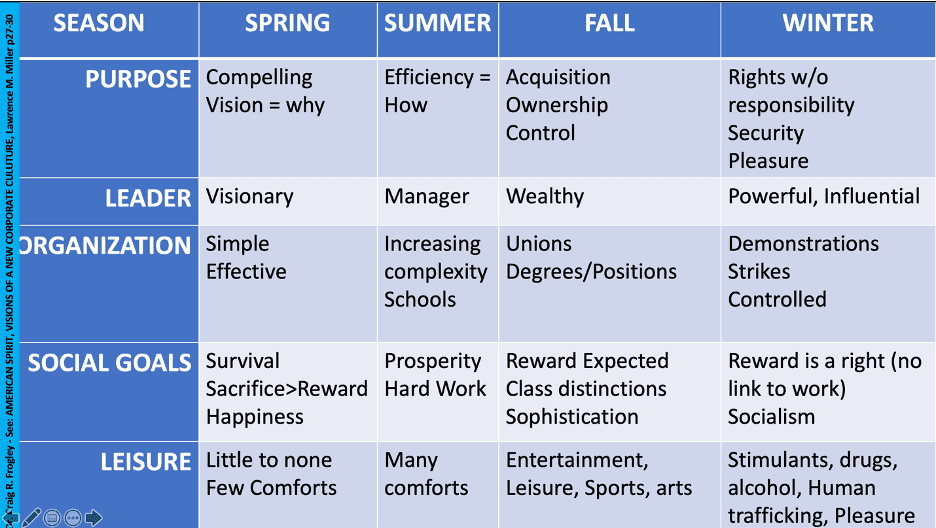
... In the book AMERICAN SPIRIT, VISIONS OF A NEW CORPORATE CULTURE[2], author Lawrence M. Miller shares evident patterns of the rise and fall of twenty-one world cultures compared to seasons of the year. 
SPRING: New life and abundant growth

Each culture began with a compelling vision and sense of mission led by a visionary leader. whoredoms, which decayed into human trafficking for the addicted pleasure hungry.

TWENTY-ONE TIMES = THE FALL OF THE CULTURE
Summarizing and customizing his data in a table shows us today’s shivering reality.


... Samuel Adams, cousin to the later president John Adams, ... stated it clearly, “While the people are virtuous they cannot be subdued; but when once they lose their virtue then they will be ready to surrender their liberties to the first external or internal invader.”[3] ...


... In this on-going war over the agency of man, the divine solution is a proximal caring for each other that will lead to a Zion society:


“And for your salvation I give unto you a commandment…let every man esteem his brother as himself, and practice virtue and holiness before me…I say unto you, be one…” DC 38:16, 24, 27


From this we can see that the restored gospel through Joseph Smith is a salvation theology about joining the Chain of Belonging, of souls ascending and advancing. It is not a sterile, life-denying cosmology but a life affirming cosmic theology that elevates the soul and the family into the celestial spheres; with theological backing from the Bible itself and the star-like glowing holy ones in the realm of the Sun-like-Jehovah and His shining Divine Council. 

Rather than the Catholic and Protestant emphasis on celibacy or abstinence as the ideal state, with celibate angels and an invisible bodiless Father God, Joseph Smith restored the original Hebrew theology of a God the Father with a body and early Christian deification, by explaining Paul’s saying Christians would judge angels by presenting a theology of progression that radically affirmed biological human instincts and the reproductive body, making earthly life good and holy.

Friday, October 20, 2023

Respecting your Heritage: The Book of Mormon: Plain and Precious Truths, a contemporary English version of The Book of Mormon

 I like the way this Community of Christ member puts it. He put together The Book of Mormon: Plain and Precious Truths, which is a contemporary English version of The Book of Mormon. He offers the book free as a PDF on his site and he states the following on his webpage (emphasis added):


There are 4 chief ways to interpret scripture of any kind: literal/historical, tropological (figurative that stresses morality), allegorical (delivers broader messages about real-world issues), and anagogical (higher spiritual meaning; alludes to the Divine/afterlife). Once people discover that The Book of Mormon is a pseudepigrapha and it’s stories are not literally true, many tend to have very little interest in the other possible interpretations. People have told me that this book represents all the negative teachings and practices of the church that I grew up in and any moral value in the book can be found elsewhere and without the baggage.


I absolutely see why some people would want to distance themselves from that church and thus The Book of Mormon. However, to me, this book transcends that church. The Book of Mormon is something that represents my heritage’s and my ancestors’ spiritual journey. My parents, grandparents, great-grandparents, great-great-grandparents, et cetera, all looked into this book to find themselves and to find the Divine. I feel a connection to them when I attempt to also find myself and the Divine through this text. These are real and valuable spiritual experiences to me, and I am having them in a way that feels familiar and comfortable to me.


Instead of abandoning the Book of Mormon altogether, I am choosing to breathe new life into it and interpret it in new ways. I see no reason why I can’t accept The Book of Mormon as a pseudepigraphical literary work from the 1820’s. Doing so allows me to explore scripture to find the Divine through an allegorical, tropological, and/or anagogical lens, without needing it to double as a history book; it allows me to connect to my ancestors who also treasured it; It allows me to explore what I believe is useful, truthful, and moral today in a familiar and comfortable way. It is refreshing to be able to have a relationship with my heritage, ancestors, and traditions on my own terms.


(Source )


This is similar to how I currently feel about being “LDS” as a Heritage Mormon, i.e. someone who respects my LDS heritage. Although, I have not chosen the same course as this author, like relabeling the Godhead as the Divine in order to avoid using masculine pronouns for God, and I have not joined the Community of Christ. I also think that while Joseph Smith certainly took part in creating the Book of Mormon himself (as many LDS scholars allow today to some degree), I am open minded to Blake Ostler's Expansion Theory and his response to critics of the theory. But I did find it useful to re-read the Book of Mormon through my own lens of interpretation, which I did in my document here: An Emergent Mormon Re-reads the Book of Mormon from an Emergent Perspective & Realizes it's Philosophical and Artistic Value


Why I'm a "DNA Mormon" (or Ancestrally Mormon) as My Heritage (Blog Series)


In Defense of the Brethren & Brighamite Mormonism

This website is a defense of what I call Emergent-Mormonism or Independent-Mormonism but is also Pro-Mormon in that I defend Brighamite Mormonism below in this blog series. So that Emergent Mormonism or being an Independent Mormon are prsented as options not prescriptions. So to be fair and balanced, here is my best good faith effort to present a positive case for sustaining the LDS Brethren and the case for a more Structured Hierarchical Church via Brighamite Mormonism and the options of being eithrr a New Order Mormon or a True Believing Mormon within the Brighamite sect:


> Start here: Big Tent Mormonism: Beyond "Mormon Demoninationalism" Toward "Unified Mormonisms"


> In Defense of the Brighamite Sect: The Cycle of the Invisible and Physical Church


> The Scriptural Case for Sustaining the Brethren despite their Flaws and Imperfections


> The LDS (Brighamite) Religion as Pragmatically Useful to Overcome Cultural-Nihilism 


> Books by Atheists on How Science Proves Moderate-Religiosity can be Healthy & Make us Happier


Wednesday, October 18, 2023

Nauvoo Polygamy as Nietzschean-like Selective Breeding of Supercouples toward Creating a separate "Nicer" People (Peoplehood as The Kingdom of God)

 After reading Nietzsche's Naturalist Morality of Breeding: A Critique of Eugenics as Taming by Donovan Miyasaki, and Selective Breeding and the Birth of Philosophy by Costin Vlad Alamariu -- here is a promo audio quote from Alamariu's book discussing the difficulty in discussing the concept of selective breeding -- it occurred to me that from a Nietzschean perspective, Nauvoo polygamy of the 1840s could be seen as a spiritual mechanism for selecting for higher types in the form of the breeding of Supercouples who carry certain moral traits into future generations. As covered in the introduction of Alamariu's book Selective Breeding:

Nietzsche believed that [the Hebrew marriage Laws in the 10 Commandments, including honor your father and mother] was the constitutive goal of the Hebrews, the striving that defined them as a people" .... [the Hebrew God had] decided to establish his law within a tribe or nation.[vii]. And the cornerstone of this foundation is the set of laws that has to do with breeding, marriage, and management of sexual relations [e.g. Leviticus 18] (Loc 128-135). 

Could this be what Joseph Smith was doing as well, attempting to create a spiritual tribe, a People, through the regulated practice of plural marriage within God's guidelines as a "house of order" (D&C 132: 8)? This reminded me of Denver's 2010 article on Peoplehood, wherein in writes:


What returned through Joseph Smith was not a religion, nor an institution, nor me
rely a faith. It was instead the radical notion that an ancient covenant family was being regathered into a separate People.


I explore such Peoplehood as the "Kingdom of God" in my blog post Orson Hyde's Diagram of the Kingdom of God & A Chain of Belonging as Tribal Psychology & Familial Will to Power. From this perspective, the Mormon People are a tribe, a People, a quasi-ethnicity through the selective breeding of polygamy in Nauvoo and in Utah. This would make Mormonism more than a religion or a creed, but a kind of ethnic Tribe, a People. This may be why even exmormons often admit that they are still cultural Mormons and even sometimes return to activity in the LDS Church or join another Restoration branch after more fully recognizing and appreciating their ancestral Mormon heritage; and how it goes deeper and is more meaningful than mere beliefs or disbelief. In other words, it's a matter beyond belief and disbelief and instead it's about socio-cultural energy, as in LDS Scripture and the "traditions of the fathers" acts as the artistic software, as a field of potential energy, through which can be bred and sprouted an empowered and vitally alive Mormon People: who move away from life-denying asceticism and Augustinian despising of the body, and toward the affirmation of the material Earth, the Body, the Family, and the tangible Joys of Life.

Part of what created this Peoplehood was plural marriage, which separated the early Mormons from the Augustinian and Lutheran sects and their sectarian Creeds. As this slide presentation points out:


Geographical isolation had become necessary for the Saints’ safety. Yet, as Terryl Givens has demonstrated, there was little aside from their theology which separated the Saints from general American society. (Givens, Viper on the Hearth, 18–93) Polygamy served as the perfect dividing line between “Gentile” and “Zion” America. The Saints remained relatively isolated until the coming of the railroad to Utah; by this time their status as a distinct religious and social culture was assured, given that they had spent most of the past half century in conflict with the U.S. government over polygamy.


~ Gregory L. Smith, Polygamy, Prophets, and Prevarication. Download available here.


... [Plural Marriage caused the early Mormons to not] only...abandon the false doctrines of the sectarians, but they [had to] appear to renounce cherished principles of monogamy which were viewed as the well-spring of civilization.

This made it so that similar to the Jews as a separated People, a "chosen people," the early Latter Day Saints were similarly isolated from the sectarians and given time to grow and flourish as a tribe, as a culture; which was a process similar to what Nietzsche described as the growth of a culture, a People, is like growing like plants in a greenhouse. So that being isolated in Utah and practicing plural marriage forged a group identity, causing the breeding of a culture, a People. From this perspective, being Mormon (especially if you have LDS ancestors going back to the Restoration's founding) runs deeper than mere belief or disbelief in the doctrines; and is beyond belief in the current correlated opinions and the policies and doctrines (which all change over time) and instead is a matter of lineage, of quasi-ethnic identity and tribal belonging through connection to one's ancestors as their gifted heritage. Even during my ex-mormon phase, I remember handling an 1891 edition of the Doctrine and Covenants, passed on in my family and reading the text gave me a sense of interconnection with my LDS ancestors who had read the same edition, touched the same pages, etc. This gave me a sense of enlarged identity through ancestral continuity, a feeling of enlargement and expansion, as I was connected to a Great People: something larger than myself that was in my blood as well as the page, something more lasting and durable than mere beliefs and ideas, but a feeling of deep rooted belonging to a People.

In the King Follet Discourse, Joseph spoke of ascending the spiritual ladder to godhood. The saint who practiced plural marriage from the 1840s to 1890, was this higher type. The lesser types, the less noble and righteous, who did not magnify their calling and ascend the ranks of the priesthood competence hierarchy, would not have been given access to plural marriage sealings during this time; and thus their seed, their traits, would have been bred to a lesser degree as monogamists; while the high priest who was a polygamist, multiplying his seed like Abraham, was able to breed his genes, his traits, more abundantly. Thus selecting out the lesser types and selecting for the higher spiritual types.

From this perspective, polygamy was in part a morality of breeding: a sociocultural selection and preservation of psychological types. The type being the new saints, saints meaning "holy ones" or set-apart or separated ones. Those who arise from the dust to be men (not celibates like the Shakers), kings and priestesses in royal elevation (not the lower ranked, the less noble, those dwindling in spiritual decline toward criminality).

The breeding of higher types was the breeding of noble Nephi-like natures and traits that separated the Mormon from the body-denying type, the celibate Shaker or life-renunciant Catholic priest; so that the life-affirming type, the masculine virile male and feminine nurturing woman was selected for in early Mormonism. The model for the higher type, the combination of Life Affirmation and spiritual holiness or kindliness, was based in the restored belief in the physical God of body parts and passions, as described in the Bible; so that rather than an emasculated deity, a father without a phallus nor a body, Joseph's restoration restored God's "manhood."

Similar to Nietzsche, Joseph's God was life affirming as a God who seeks to expand His Realm, His Kingdom, His Divine Genes, through the breeding of His Divine Image in his Image-bearers (the Saints); as the Latter Day Saint, through the renewing of their minds, through the Nauvoo doctrines and expiating ritual of plural marriage, would breed God's true bodily Image which mirrored the rank order of ascending Life; as God's Mind was reproduced, both through belief and in the selecting for the traits of the next generation of Mormons through polygamy.

Mirroring generative Life, God as a phallic God, first replicated his genome in Christ, His twin Image; then God sought to breed His Image as a Man of War and God of Love, as in Jehovah and Sophia "energy," into a new holy species, the Latter Day Saints: who have their blood transformed into the blood of Abraham, as they are called to "do the works of Abraham" (D&C 132:32), i.e., the breeding of a Zion People through one's priesthood as one's sperm (Abraham 2:11), producing a greater number of posterity, generation to generation, through the "strength in the loins" of the higher types; thus breeding a Zion People, the growth of morally good and mighty Supercouples. As the document The Abrahamic Covenant on studylib.net puts it:


From The Blessings of Abraham - Becoming a Zion People by E. Douglas Clark:


“All the sources attest that [Sarah] was a close relative—perhaps a half-sister (the daughter of his father through another wife) (Gen. 20:12), or perhaps a niece or a cousin. The close kinship with Abraham and the quality of her character suggest the possibility of mutual sympathy and support long before their marriage....“The name Sarai, which God would later alter to Sarah, means ‘princess’ or possibly ‘queen’ suggesting royal blood. Was this perhaps a reflection that her bloodline ran through the royal patriarchal line to which Abraham himself was heir? ...P. 59-61


“[H]er name was a fitting title for a woman who possessed singular loveliness of both body and soul. Her unequaled physical beauty would turn the heads of the most powerful kings, while she was also ‘gifted with every excellence’ and ‘great wisdom.’ It is said that her spiritual attainments matched and in some cases exceeded those of her remarkable husband, she being gifted with profound ‘intuitive Perception’ of spiritual realities. A number of sources assert yet another name for her—Iscah, meaning ‘prophetess’ or ‘seer.’ And with all her talents, she had a deep ‘love and compassion ... for the needy.’ She was indeed ‘a Princess in name and in nature.’... P. 59-61


“Jewish tradition insists that she is the one described in the famous Proverbs passage extolling the ‘virtuous woman’ (31:10). Her worth is far above rubies, and her husband safely trusts in her; she is an industrious homemaker, a tireless worker, and generous to the poor; she speaks wisdom and kindness, is cheerful and hopeful about the future, and is clothed with strength and splendor; she is, in short, the ideal wife, deserving of her husband’s highest praise. Sarah’s example was held up through the generations among her Jewish descendants, in whose homes the Proverbs passage was traditionally recited on the Sabbath eve. P. 59-61


“Sarah had her work, and Abraham had his, but it was all part of the same cause. From this point on in Abraham’s life, to speak of his mission and accomplishments is necessarily to include Sarah also.... Abraham and Sara were a part of something larger than either of them. They were a family, they were Zion, and they are to be remembered together, according to Isaiah: the righteous are to look not only to their father Abraham but also to their mother Sarah (Isa. 51:1-2).”P. 59-61


Abraham 2:6, 19: Promised Land—Abraham and his posterity would inherit the land of Canaan.


Abrahamic Covenant Summary - The Overarching Covenant:


“I WILL BE YOUR GOD;YOU WILL BE MY PEOPLE”

(Abr. 1:17-19; Gen. 17:7-8; Isaiah 41:8-10; D&C 132: 28-33, 47-50)


Covenant Element: Promised Land; Posterity (Abraham 2:9-11), Priesthood/Gospel—his posterity would be heirs to all the blessings of the Gospel (ordinances & covenants) available through the priesthood and would in turn take those blessings to all the families of the earth.


Mortal Promise: A land of inheritance to gather to and to worship God freely.

A) vast posterity b) A noble posterity who will bless all the families of the earth with the blessings of the Gospel. Descendants have a right to all gospel blessings, through the priesthood ordinances, which lead to Eternal Life - Inherit Eternal Life—the end result of gospel covenants


Eternal Promise Inherit: The Earth in its Celestial state. Innumerable Posterity; eternal procreation; “endless lives” (see D&C 19:10; D&C 132: 24). Descendants Have a right to all gospel blessings, through the priesthood ordinances, which lead to Eternal Life - Inherit Eternal Life—the end result of gospel covenants


Abrahamic Covenant:

Abraham 2:9-11; D&C 132:30: Posterity—innumerable descendants—like the sand on the seashore & the stars in the heavens.


“And so I go to the Salt Lake Temple and marry my wife for time and for all eternity, and so begins a new kingdom of God. And if we are faithful, that marriage exists here and it exists hereafter. And I have been given through that ordinance every promise that Abraham received. It is given on conditional basis. We must be true and faithful and keep the covenant that we make in the temple, but if we are faithful, we will receive the blessings." ~ Bruce R. McConkie Quorum of the Twelve ("The Promises Made To The Fathers," in Studies in Scripture: Vol. Three The Old Testament, p. 61)


"The crowning blessings of the gospel are received in temples.... It is in these holy houses that faithful couples enter into the ordinance of celestial marriage through which they become parties to the Abrahamic covenant, the covenant of eternal increase, the covenant that in them and in their seed all generations shall be blessed." ~ Bruce R. McConkie, Quorum of the Twelve (A New Witness for the Articles of Faith, p.539)


In a Nutshell:


Gather Israel


D&C 132: 19:


Kingdoms, Thrones, Principalities (Promised Land)


Powers, Dominions (Priesthood)


Continuation of Seed “forever and ever” (Posterity)


“Now I would ask who knows the seal of the living God? Behold the ignorance of the World!A measure of this sealing is to confirm upon their head, in common with Elijah, the doctrine of election or the covenant with Abraham—which, when a Father & mother of a family have entered into, their children who have not transgressed are secured by the seal wherewith the Parents have been sealed. And this is the Oath of God unto our Father Abraham and this doctrine shall stand forever.” ~ Joseph Smith President (The Words of Joseph Smith, p.241)


From the document quoted above, it is clear that the restored gospel and priesthood is the seeding of a Zion People through Supercouples who enlarge their power and dominion through their status and posterity.


Selective Breeding & The Happiness Letter


Returning to the book Selective Breeding and the Birth of Philosophy by Costin Vlad Alamariu, the following section in the book made me reconsider and rethink the early Nauvoo and Utah period (1840s - 1890): when polygamy can be interpreted as in part a form of selective breeding. For just as Abraham practiced plural marriage and bred a People: Israel; LDS members bred the Mormon People. Selective breeding is not just the practice of a genetic line but the selection of moral traits. As Alamariu points out, it was Catholic and Protestant Christian practices of breeding that literally changed the socio-cultural psyche of western man. In Selective Breeding, location 196 - 230 we read:


Nevertheless it is very clear in so many ways that it is through its laws of marriage and breeding that Christianity affected European society and political life most of all. First, precisely through the ideal of chastity, and the grudging concessions made therefore to monogamy alone, it is possible that Christianity stabilized family life and thereby promoted in many cases a salutary and steady but not Malthusian increase in population.


… one need not speculate about how the Church exerted its power throughout medieval Europe, which was precisely through its control over marriage. It is through its power to carry out marriages and therefore through its effect on inheritance, among other things, that the priesthood was able to exert such temporal power.


The Church disapproved of arranged marriages and in most of Europe it forbad cousin marriage. … Accordingly there developed a de facto practice of outgroup marriage in certain parts of Europe, which did away with clan identity and which encouraged broaderbased political identities, universal morality, and altruistic orientation toward non-family strangers.[xvii]


… it appears that in premodern England and Holland the ideal was the nuclear family, late marriage, adult children leaving the family home, and romantic love as opposed to tribal arranged marriage. …


The social and political consequences of the change described in the last two paragraphs are profound. Modern liberalism and capitalism, modern universal ethics or morality, are latecomers and piggyback on the fundamental and centuries-long work done by the manorial system and Christianity in reshaping and perhaps rebreeding European man—for there is strong evidence that many of the behaviors described, such as altruism toward strangers, are by now hereditary in certain populations. The culture of civility on which liberal, private society is built is inconceivable without this preparatory work done by Christianity, and which was carried out most effectively at the root, determining who married who, and therefore what kind of children were to be born. Thus it is arguably precisely through its marriage and breeding laws that Christianity shaped the modern world.
Friedrich Nietzsche thought likewise, and in this book we are going to see the same argument regarding Christianity that has just been made, but from a different, and hostile, point of view. For Nietzsche, Christianity laid the groundwork for the calamity of modern liberalism, modern democracy, and modern socialism, which threatened to destroy, maybe permanently, not only the possibility of philosophy, but of life in the full sense of the word. And yet this same phenomenon was for Nietzsche a great opportunity. The root of all of Nietzsche’s concerns about the possibility of the rebirth of philosophy, and about the future of mankind, is his “strange concern with breeding,” which according to a recent interpreter he “inherited” from Plato and not from any of his contemporaries—although surely this can’t be completely true…at the very least it would have also been motivated by the need to respond to Darwin’s lifting of the veil from this matter.[xix] It would be more accurate to say that Nietzsche and Plato are prominent in having explicitly brought out the fundamental problem of human life, political life, and of nature itself, which, indeed, does have to do with breeding. This is what this book is about.

What is more even more fascinating the more I thought about the contents of Alamariu's book on selective breeding, is that not only did the Jews selectively breed the Jewish race through which Jesus was born, and plural marriage acted as a selective mechanism for a higher type of holy man; but LDS Scripture itself presents a form of selective breeding where in D&C 132: 15-17, those in the early LDS Church (prior to 1890) who do not abide God's celestial marriage law of plural marriage and the moral strictures required to enter into the practice, were to remain separately and singly and thus do not have an increas i.e. they do not breed the future souls (earthly bodies) of men destined to become gods through the lineage of the righteous fathers. From this perspective, Mormonism becomes quasi-Nietzschean in that it selects out the uncivil and unkind who cannot handle the moral strictures of Mormonism, as well as the strong and capable of higher rank, prone to orderly conduct, and climbing the ladder of the priesthood hierarchy in order to gain access to plural marriages. Also similar to Nietzsche's biologizing of God, the LDS concept of divinity, of the Gods, is that of a biologizing of God as a God that reproduces His Genome and the Saints (Image-bearers) then breed a Zion People as Supercouples (gods). From this perspective, it would seem that just like Nietzsche, Joseph Smith was equally concerned about spiritually breeding a healthy culture and People, and to do so Joseph felt inspired to present God (Jehovah) himself in the same way God operated in the Hebrew Bible, as a God of a People, and polygamy was the selective mechanism for not just doing the works of Abraham on earth, but that all future gods themselves as biological divinities, reproduce and breed the Only Begotten/Monogene (God's Royal Image and Resurrect-able Nature), the Genome of God, through all time and eternity.

This perspective of interpretation gives new meaning, for example, to the Happiness Letter. Notice below that the language of the letter is collective, not individualistic. So here are excerpts from the Happiness Letter from the Joseph Smith Papers (emphasis mine and words and brackets my own):

Happiness is the object and design of our existence, and will be the end thereof if we pursue the path that leads to it; …


… This is the principle on which the government of heaven is conducted—by revelation adapted to the circumstances in which the children of the kingdom are placed. Whatever God requires is right, no matter what it is, although we may not see the reason thereof [breeding a Zion People and a new Hebraic consciousness] till long after the events transpire [not until post 1890]. If we seek first the kingdom of God [building a quasi-ethnic tribal culture as a People, as God's Garden], all good [culturally good] things will be added. So with [the polygamist] Solomon—first he asked wisdom, and God gave it him, and with it every desire of his heart, even things which might be considered abominable to all who do not understand the order of heaven only in part, but which, in reality, were right, because God gave and sanctioned by special revelation.[5]

[Footnote 5 reads:] Solomon reportedly had “seven hundred wives, princesses, and three hundred concubines.” A passage in the Book of Mormon states that “David and Solomon truly had many wives and concubines, which thing was abominable” and that unless the Lord should “command my people” to “raise up seed unto me,” they must obey the strict law of monogamy. In July 1843 [Joseph Smith] dictated a revelation in which the Lord answered JS’s request “to know and understand wherein I the Lord justified my Servents Abraham, Isaac and Jacob; as also Moses, David and Solomon, my Servents as touching the principle and doctrin of their having many wives, and concubines.” The revelation explained that these Old Testament patriarchs and kings married plural wives with divine approval. (1 Kings 11:3; Book of Mormon, 1840 ed., 125 [Jacob 2:24, 30]; Revelation, 12 July 1843, in Revelations Collection, CHL [D&C 132:1, 29–39].)


… as God has designed our happiness, the happiness of all his creatures, he never has, he never will, institute an ordinance, or give a commandment to his people that is not calculated in its nature to promote that happiness which he has designed, and which will not end in the greatest amount of good and glory to those who become the recipients of his laws and ordinances.


Note that the recipients are God's People today (Mormons), who are experiencing the good of a new post-Augustinian consciousness and being part of a Zion People, as a quasi-ethnic culture with LDS dances, temples, and wards and cultural hall activities, etc., which was accomplished through the early breeding of Zion traits through plural marriages. Joseph continues in the letter:

Blessings offered, but rejected, are no longer blessings, but become like the talent hid in the earth by the wicked and slothful servant[6]—the proffered good returns to the giver, the blessing is bestowed on those who will receive, and occupy; for unto him that hath shall be given, and he shall have abundantly; …


The word use of "abundantly" here could harken back to John 10:10 (EXB, emphasis added):


A thief comes [L only] to steal and kill and destroy, but I came ·to give life [L that they might have life]—life in all its ·fullness [abundance].


Life in abundance here is the eternal lives of those who receive the seed of Christ, the fulness of God's glory, producing a Zion People.

As D&C 132 explains:


22 For strait is the gate, and narrow the way [plural marriage] that leadeth unto the exaltation and continuation of the lives


24 This is eternal lives—to know [experience by knowledge gained, the knowledge of a physical God of flesh] the only wise and true God, and Jesus Christ, whom he hath sent. I am he. Receive ye, therefore, my law [of plural marriage].


55 But if she [Emma] will not abide this commandment, then shall my servant Joseph do all things for her, even as he hath said; and I will bless him and multiply him [his seed, see Abraham 2:11] and give unto him an a hundred-fold [i.e., a People] in this world, of fathers and mothers, brothers and sisters, houses and lands, wives and children, and crowns of eternal lives in the eternal worlds.


… 63 … for they [wives] are given unto him to multiply and replenish the earth, according to my commandment, and to fulfil the [Abrahamic] promise which was given by my Father before the foundation of the world, and for their exaltation in the eternal worlds, that they may bear the souls of men; for herein is the work of my Father continued, that he may be glorified.


Note as well that when Joseph mentioned the slothful servant who hides his talent, the footnote 6 in the Joseph Smith Papers says, "See Matthew 25:25–26", which reads (emphasis added):


Matthew 25:25-26

Expanded Bible:

So I was afraid and went and hid your ·money [T talent] in the ground. [L See] Here is ·your bag of gold [L what is yours].’


Matthew 25:26

Amplified Bible:

“But his master answered him, ‘You wicked, lazy servant, you knew that I reap [the harvest] where I did not sow and gather where I did not scatter seed.


Matthew 25:25-30

 J.B. Phillips New Testament:

24-25 “Then the man who had received the one thousand pounds came in and said, ‘

Sir, I always knew you were a hard man, reaping where you never sowed and collecting where you never laid out—so I was scared and I went off and hid your thousand pounds in the ground. Here is your money, intact.’ [Compare Genesis 38:9 where Onan spills his seed on the ground, rather than reproduce with the woman as commanded by God, which is the context in which Joseph Smith is using the concept of talents as seed].

26-30 “‘You’re a wicked, lazy servant!’ his master told him. ‘You say you knew that I reap where I never sowed and collect where I never laid out? Then you ought to have put my money in the bank, and when I came out I should at any rate have received what belongs to me with interest. Take his thousand pounds away from him and give it to the man who now has the ten thousand!’ (For the man who has something will have more given to him and will have plenty. But as for the man who has nothing, even his ‘nothing’ will be taken away.) ‘And throw this useless servant [compare D&C 132: 15-17] into the darkness outside, where he can weep and wail over his stupidity.’


Matthew 25:25-30 and John 10:10 are therefore used intentionally as a midrash against celibacy, and for emphasizing that building or growing the Kingdom of God is a process of seeding a People so that the slothful servant is like Onan in this regard. As the Abrahamic Covenant is the call to produce a People through breeding offspring on earth and to expand God's Image into the eternities. The slothful servant is comparable to the man who remains singly in D&C 132: 15-17 and does and expand his seed (his priesthood), which is the power to increase and become enlarged and glorify God the Father (see D&C 132:63). So that the restored gospel is the glad tidings of the continuation of the lives, the glorification of the continuation of lives, expanding the Kingdom of the First Cause, "Father of lights" (Lecture on Faith 2:2). So that God's Genome is like seed scattered into soil producing a Garden of Disciples, the Body of Christ, the True Vine. So in context, what Joseph Smith is saying is that the "talent" here that is being buried (hidden) and not planted (gaining interest, i.e. sprouting dividends/blessings as progeny and an expanded kingdom) is referenced in the Happiness Letter metaphorically as the man's seed; which can only sprout into the blessings of families and "eternal lives" through dynastic unions (as a great Chain of Belonging) and thus generating future progeny growing into the Mormon People.

The reason that Joseph goes on to say that engaging in non-monogamous sex outside the restraints of the plural marriage law commanded by God "would prove cursings and vexations in the end" and "wailings" and "regret", is because promiscuous sex leads to not building dynastic family ties and the seed growth of Peoplehood, but usually women feeling regret; and resulting in some form of emotional hurt and often unwanted pregnancies and illegitimate children, fatherless homes, and the breakdown of civil society. Remember that cursings in the Book of Mormon lead to the degeneration and dwindling or dismantling of families and a healthy culture due to atheistic selfishness; whereas God's blessings leads to an emotionally healthy, growing and thriving civil culture, a People: through the cultivation of traditional biblical families raising children, whether through monogamy or polygamy.


When joseph says in the Happiness Letter, "Our heavenly father is more liberal in his views, and boundless in his mercies and blessings" he is referring not just to an embodied God of flesh and his liberality regarding sexuality as a holy process, but he is likewise referencing Moses 1:39 in the Pearl of Great Price (words in brackets added):


39 For behold, this is my work and my glory—to bring to pass the immortality and eternal life of man [i.e. the continuation of eternal lives]


God is more liberal than Nancy's Augustinian puritanism, for at the time Joseph composed this letter, the ideas of the time were that celibacy was a more holy lifestyle, like among Shakers in the 1830s, resulting in the Shaker's dwindling to an incredibly small number today. Compared to the Mormon People thriving as a culture today after embracing a positive attitude regarding the body and sexual reproduction. So God is more "liberal" in that God not only condones the joys of the flesh, but God is not interested in monkish celibacy like the Catholics and Shakers, but God's commands the planting of the man's seed in order to produce and cultivate God's People abundantly: producing the blessings of a multiplicity of children and families. Thus, Joseph later says in D&C 132, regarding plural marriage:


… 63 … for they [wives] are given unto him to multiply and replenish the earth, according to my commandment, and to fulfil the [Abrahamic] promise which was given by my Father before the foundation of the world, and for their exaltation in the eternal worlds, that they may bear the souls of men; for herein is the work of my Father continued, that he may be glorified.


Plural marriage quickly multiplied and replenished the earth between the 1840s and 1890, with the most devout type of Mormon, with the best virtues of strength and virility as well as loyalty and self-control etc., and these traits were selected for during the process of the practice of plural marriage which produced the Mormon People. As Supercouples produced a super healthy growing culture overtime; through which the premortal Intelligences of Abraham 3 could obtain bodies and be born as souls; and God's work of creating eternal lives could continue through reproducing the divine Image (God's Monogene).


Joseph concludes the letter by having God say:


… for I delight in those who seek diligently to know my precepts, and abide by the laws of my kingdom, for all things shall be made known unto them in mine own due time, and in the end they shall have joy.


In the end, the practice of polygamy would produce a joyful Mormon People. Note that this can be combined with the beginning of the letter when Joseph states

Whatever God requires [to expand his Image and Kingdom Realm] is right, no matter what it is, although we [today in the 1840s] may not see the reason thereof [that of breeding a People and a new Hebraic consciousness] till long after the events transpire …


In other words, Joseph's letter is explaining that this sacrifice, of plural marriage, will make sense only in the future long after the event of the practice of plural marriage has transpired, as the reasons for it will be proven through the future fruition of a Mormon People in the future; which we see with Mormonism then growing into a global religion and largely populating an entire state, Utah. So that even though the practice was not understood then in the 1840s, the reason thereof would make sense to future generations. In other words, God's Kingdom is a seeded Garden, the cultivation of a vibrant culture, the LDS People. So that in the end, Joseph means that they (God's People) would more fully understand the reason for the practice of plural marriage long after the events had transpired, as the practice ended in 1890. For now today Mormons can clearly see the reasons for plural marriage, that the results of the sorrows and joys of their ancestors' dynastic unions, family ties, and their posterity, was the selective breeding of a People (Peoplehood). 


See this article on 19th century Mormon Polygamy and how BH Roberts argues that polygamy provided a filtering effect of both filtering in certain types of men and women and filtering out other types, thus producing what I call a quasi-ethnic Mormon People.


Today, LDS can look from the future backwards and see that those plural marriages provided future generations with the residual blessings of the polygamous Supercouples and extended dynastic families; and thus in the end, they (future generations) would indeed have joy being part of a healthy culture, the Mormon People. So, indeed, as D&C 132: 63 implies, in due time, all things were made known to the Saints: which is that the practice of plural marriage would and did lead to the net positive of the joys of family and children and the production of a healthy culture thriving in Utah and elsewhere today; and the joys of being part of a tight knit Mormon community is similar to the Jewish community, as a quasi-ethnic identity, as one's LDS Tribal Identity, as an extended spiritual family of brothers and sisters; all united as children of God, rooted and nourished as a collective People, a great Chain of Belonging, spanning the world over.


Cultivating a Luminous Countenance


Furthermore, this understanding of the breeding of Zion through the selection of higher "holy" types, is also in part the message of the Book of Mormon: wherein the repetitive theme is that of God encouraging what I call positive generational contagion; that is the contagious trait-reproduction of spiritual attitudes and a noble character, being spiritually bred into the next generation as the children of Christ, who have “the image of God engraven upon [our] countenances” (Alma 5:19); as Christ is the luminous Vine growing shining branches as LDS Christians.


 In order to accomplish this breeding of Vine-mindedness over Wickedness, the "mark" of black tattoo ink or a kind of skin disease on the Lamanites becomes unattractive to the white-lighted (i.e. purified by the refiner's fire), virtuous, Nephites. Hence Paul's admonition not to join with bad behaving and "dark" unbelievers, as light and darkness don't mix (see 2 Cor. 6:14). Thus, one's wicked ambience detours the righteous luminaries who choose other countenances of the Light and this acts as a culture producing selection mechanism; wherein, those infused with divine Light, shine like the white-lighted fruit in Lehi's dream; while the morally degenerate (selfish, hateful, and murderous) dwindle in their disbelief and become spiritually dimmed or "blackened" (in contrast to those who's demeanor is infused with Christ's luminary Light), and thus their "skins" (outer ambience) become metaphorically like rotting fruit with blackened skins signifying decay of soul and is off putting to those seeking the metaphorically ripe fruit of the Spirit as the fulness of glory growing a healthy body of believers; that is until the wicked ones repent, that is re-choose the path of Christ: the way of the Good (Culturally Generative), and the Plan of Happiness; and then their metaphysical "blackened" skin-peelings akin to fruit skins, becomes spiritually bright with life again; and these luminous traits and habits are selected for by other holy luminaries (saints) and this process overtime breeds Latter Day Saints.


Evidence of Selective Breeding & Mormon's as "Nicer," More "Christian" than Others


For some evidence of this above, see the Jolly Heretic's video Why Mormons Are So Nice? After the Jolly Heretic explains how Mormonism selects for people who are nicer on average (for the transcript see here), he then gets to plural marriage and says at 30 minutes the following (based on the YouTube Transcript):


In 1837, the Mormons went to Liverpool and by the 1850s there were 30, 477 English Mormons which was more than there were Americans. So they're genetically quite similar, they have genetic interests and they operate accordingly. The final issue is polygamy and what polygamy has done. The Mormons were polygamists until 1890 when their prophet…declared in 1890 that they were no longer polygamists. A previous prophet, John Taylor had declared (though it's disputed) that they had a new revelation saying that they should be polygamists and in the wake of this new prophet in 1890 saying they shouldn't, there [arose] various splits, the Mormons  Fundamentalist, the Apostolic Mormons and whatever, which exists today. What polygamy would have done with someone like Brigham Young having 55 wives is it would have very very much selected in favor of the qualities that make you have high social status because women will tend to sexually select for males who have high social status, because if they do that then their children are more likely to survive because they'll have access to wealth and resources; and so women are sexually selecting the status in a man … men tend to sexually select for youth and beauty and whatever. So something like Brigham Young’s 55 wives, what would he have been, he would have been a highly intelligent man because that predicts high social status but he also probably would have been high in general factors of personality, to flirt to a certain degree, high in agreeableness and conscientiousness because this helps to get you social status and indeed women are sexually attracted to these personality traits in men. So what this would have done is it would have selected out very heavily Mormons that are below in intelligence and low in general factors of personality, and it would have elevated the, superficial at least, niceness of Mormons. …


Here is the the data he draws from:

Sources

Apostate and Convert Personality: [What Drives Apostates and Converters? The Social and Familial Antecedents of Religious Change among Adolescents by Gregory S. Longo and Jungmeen Kim-Spoon]


Religion and Personality: Religion, Personality, and Social Behavior 1st Editionby Vassilis Saroglou  


Hills, P., Francis, L. J., Argyle, M. & Jackson, C. (2004). Primary personality trait correlates of religious practice and orientation. Personality and Individual Differences, 36: 61-73.


Who breeds? Slow and Steady Wins the Race: K Positively Predicts Fertility in the USA and Sweden June 2017 Evolutionary Psychological Science 3(2) DOI:10.1007/s40806-016-0077-1.


Blume, M. (2009). The reproductive benefits of religious affiliation. In E. Voland & W. Schiefenhövel (Eds). The Biological Evolution of Religious Mind and Behavior. New York: Springer. 


Mormon Religiousness: Gallup. (2009): Mormons most conservative major religious group in the US.

Stark, R. (2005). The Rise of Mormonism. New York: Columbia University Press.


From this perspective, LDS polygamy in Utah in the 1800s, can be seen as retaining the altruistic “nice” traits yet also deselecting for what Nietzsche would describe as the more docile or "Lutheran Christian" traits: as the men who were most assertive, strong, and vitally alive likely rose the ranks to high priesthood status through their people skills, wealth building accomplishments, and high status yet also their Christian attributes of civility, kindness and charity, etc.; and thus were given access to more wives and thus their genes were more likely to be selected for. This has always been an interesting thing about Mormons as a People, they are both “nice” but capable of assertive aggression and showing strength at the same time. Joseph Smith set the standard for the cultural embodiment of these core traits in the Saints, with his combination of having an agreeable, playful and cheerful nature but also a strong wrestler's athletic body, a lion-will, a drive to overcome, subdue, and conquer. This original ideal set the standard from the start. As I heard one modern LDS apostle once put it, "we get things done." Another modern member once quipped that LDS means Let's Do Something.


Also see Jacob Hansen's Is the Church Good? - Fruits of the Gospel, where Hansen relies on several polls and studies showing that LDS culture is a healthy culture.


With this understanding of polygamy as a selecting for the higher type, the holy and strong, this would make polygamy simply a jump start of a process, a kind of getting the ball rolling, of producing a Zion (Nicer) People. Once the the growth of a People was established, there would not need to be the continued practice of plural marriage after 1890, as it had accomplished its aim which was to "raise up seed" as a  "[commanded people" (Jacob 2:30), with the intent to expand one's "seed" to "abound most plentifully" (Jacob 2:12; also see D&C 132: 30, 19).