Friday, April 22, 2022

Temple Symbolism & The Pearl of Great Price Made Easier on the Abrahamic Covenant

In his book The Pearl of Great Price Made Easier (2009), David J. Ridges offers a detailed analysis of the verses in Abraham chapter 2 on page 128 of his book. Ridges explains the Abrahamic Covenant in verses 9-11; and on page 132 of his book, verses 9-11 are explicated with words in italics and brackets by the author to emphasize that Latter-day Saints become the seed of Abraham by adoption/inheritance through basically acting out the Abrahamic Way.

Reading Ridges' book, it was clear to me that the Procreative Way of Abraham is basically a prototype to imitate; as Abraham acts as an example of the expanding exalted gods. Achieving "exaltation" is thus entering into the Abrahamic Covenant of celestial marriage and expanding ones seed/progeny eternally (See D&C 132:19; 63) just like Abraham (who did so on earth and does so now eternally).

Ridges helps distinguish between immortality and eternal life. He explains that the phrase "life eternal" in Abraham 2: 11 means exaltation which he says means "becoming gods and living in the family unit forever." He then references D&C131:1-4, pointing out that immortality is for everyone who enter one of the Degrees of Glory, but exaltation (eternal life) is for those who achieve celestial glory by entering the Abrahamic Covenant. Thus, reading Ridges, I could see that eternal life is equated with eternal lives as we read about in D&C 132:19. He then points out using inserted brackets that there is a distinction between immortality and eternal life in the Joseph Smith Translation in Moses 1: 39: "immortality [resurrection] and eternal life [exaltation] ..."

On page 133 he quotes again Abraham 2: 11 and adds his own words in brackets: "...for I gave unto thee a promise that this right shall continue in thee [make sure we honor the priesthood and the priesthood ordinances we have received] ..." He then states that in verses 12-13, Abraham "has been saved from death on the altar. He has seen the Savior and, though still childless, has been told that his prosperity will grow into nations ..." Ridges does not say this, but as I have discussed elsewhere, I see this as Abraham being depicted as a heroic figure (as liberator from puritanism), by risking his life to preach science to the Egyptians (Abr. 3:15)  and the Abrahamic Way. Smith himself was taking a risk in introducing plural marriage, and in fact the Abrahamic Way did lead to his death. 

In the book, Temples: Sacred Symbolism, Eternal Blessings, David J Ridges writes on page 64

"general scriptural symbolism ... Loins: prosperity; preparing for action (gird up your loins)."

So if we combine this understanding of the word Loins with Abraham 2:9-11, we see that in the temple ritual when one speaks of  "health in the loins" and " power in the priesthood", and one's "posterity," that that means a healthy sex drive and potency of bodily Seed/Priesthood for reproduction "throughout all eternity."

Monday, April 11, 2022

The Case Against Cynical ExMormon Atheism & The Case for A Humanistic Mormon Pragmatism

Disclaimer: This post is not directed at the newly disillusioned Mormon, who read something on the internet about LDS history and is going through a faith crisis. This is directed at the long time ExMormon who has gone through the stages of loss and grief, and after several years are stuck in the angry phase and seem to take on the role of the crusading debunker of all things LDS; yet remain deep down a kind of idealist and believer despite their Worldview Atheism. 

As I see it, the antagonistic type of ExMormon Atheist has sought to feel certainty amidst the chaos of the cosmos, by forming a kind of secular religion around the Laboratory and Chalkboard that replaces their former LDS Ward and Scriptures. They replaced their ethical performance in the LDS Theater of Belief, if you will, by performing the role of Reductionist in the Realm of Cosmic Nothingness.


Here is what I see among many ExMormon Atheists:

  • Reductionism is just the opposite coin of Faith-building.
  • Nihilism is the eventual reverse trajectory of Supernaturalism.
  • The Sermon or Talk at Church is replaced with equations and theories on the "Chalkboard."
  • The formerly Religious replace supernatural Stories with Equations. They replace the Divine Filter with a Negative Filter.

Ex-this, Anti-that, type movements are a form of reverse Idealism: The former believer who seeks certainty via Metaphysical Truth, is just replacing their certainty-seeking with science-based Theoretical Truth. Nietzsche discusses at length how “pale atheists' ' retain their Christianity even as atheists (see quote below).

There are four main reasons, as I see it, to uphold the LDS Religion from a humanistic perspective:

  • Existential reasons
  • Communal reasons
  • Pragmatic reasons
  • Durkheiman reasons
  • Utilitarian reasons

Religion is not about pure objectivity, hyper-critical analysis, and laboratory results. It is about existential benefits, communal results, personal and social pragmatic benefits from acting out belief in one’s religion, and the utilitarian benefits; in that religions like Mormonism produce more good for the greater amount of people. It does this by changing individuals to be more civil and charitable (serving their community and being more ethical and law abiding), and this improves communities in which LDS members live. Thus the LDS subculture improves the overall ethic of the community in which they live. LDS temples act as a beacon symbolizing higher ideals. Here is in brief, why I find value in the Mormon Tribe (whether I am an active Chapel attender or not):


  • Existential Meaning in Life (The Will to Meaning according Victor Frankl)

  • Binding the Community around a Shared Story and Shared Standard:

The LDS Standard Works are akin to Governmental Laws and Patriotic Stories; the LDS Articles of Faith akin the Bill of Rights. Law courts function based on belief in supernatural free will and inalienable Rights endowed by our Creator: “Americanism” is a supernatural in its premises as Mormonism.

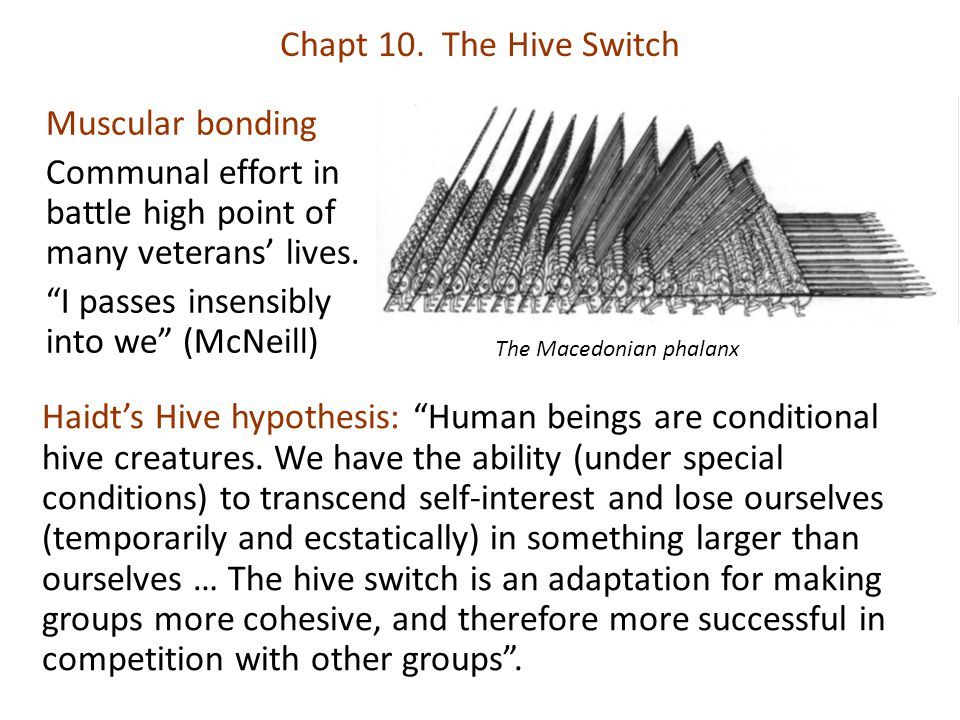
  • Spiritual Hiving: See Jonathon Haidt’s work, summarized below:

(Source). 

  • Pragmatic Benefits: This is covered by Joseph Campbell and Jordan Peterson and Bruce Sheiman (author of An Atheist Defends Religion). 


So as I see it, even on atheism, the LDS Church is still a useful cultural adaptation, or memetic structure that is useful, in producing an overall social good. This is because of the following factors that it provides:


  • Cosmic Identity & Existential Meaning in Life

  • Social Identity (Tribal Belonging)

  • Motivation for Ethically Performing a Civil Ideal


Even if one were to adopt Scientism, and argue we are mere gene-machines and are not a person as Rust Cohle argues in True Detective Season 1. From the scientific view, every human, every human ape, is performing an identity, whether it is as a stockbroker, librarian, mom, dad, American, English speaker, bowler, fan of said sport’s team, etc. The Anti-Mormonism type of ExMormon Atheist has not shed his human drive to seek an identity and belong to a tribe (for social belonging) and thus still seeks to perform an ethic and seeks an ideal. He remains as much a tribal ape as the active and believing Mormon. The Antagonistic type of ExMormon Atheist usually just seeks an Identity on an online Anti-Mormonism Forum, or joins another Religion or Secular Tribe, etc. They often continue to perform a shadow of their Christian Identity by declaring themselves on the side of the Good fighting Evil, calling out Cosmic Wrongs as they perceive it. But what they are missing in their reductionist habits is a cosmic Identity, belief in themselves as a soul, a "Child of God" (or infused with Divine acceptance and worth). Missing this ingredient, they are basically cosmic orphans so to speak. But they claim to embrace this cold hard reality as a sign of their existential strength. Yet the macho posturing is an illusion, for they still deep down are merely pretending they are true atheists; when they really are not non-supernaturalist atheists, as they still believe in the soul and objective Right and Wrong; as they act as if they and others have a soul and Right and Wrong are objective concepts. They act as if there is cosmic Right and Wrong. Hence their ongoing anti-Mormonism, as they perceive themselves fighting against perceived Darkness (LDS errors), as they are part of the forces of Light (the holy debunkers). They maintain the same cosmic drama they lived out as LDS. They maintain the same Christian Idealism of their being objective Right and Wrong, Truth and Falsehood.


They feel as if their is a cosmic Wrong (Mormonism) in need of a moral correction (in a Universe they will simultaneously claim is devoid of objective morals as worldview-atheists). They act out the role of heroes in this Anti Drama, as the the opposing saviors and saints, the righteous debunkers, the mockers of the con (as they put it). Yet they ignore the cosmic "con" of evolution's trick of making them feel like a person (as Russ Cohle explains in the link above). They fail to see that they are acting out "God's shadow," and playing the role of a "person" while not allowing the Mormon to play their role without being mocked. They are what Nietzsche called pale atheists when he wrote:


Now, let's consider, on the other hand, those rare cases I mentioned, the last idealists remaining today among the philosophers and scholars. Perhaps in them we have the opponents of the ascetic ideal we're looking for, the opposing idealists? In fact, that's what they think they are, these "unbelievers" (for that's what they are collectively). ... these people who say no today, these outsiders, these people who are determined on one point, their demand for intellectual probity, these hard, strong, abstemious, heroic spirits, who constitute the honour of our age, all these pale atheists, anti-Christians, immoralists, nihilists, these sceptics, ephectics, spiritually hectic (collectively they are all hectic in some sense or other), the last idealists of knowledge, the only ones in whom intellectual conscience lives and takes on human form nowadays—they really do believe that they are as free as possible from the ascetic ideal, these "free, very free spirits." And yet I am revealing to them what they cannot see for themselves, for they are standing too close to themselves. This ascetic ideal is also their very own ideal. ... . . . They are not free spirits—not by any stretch—for they still believe in the truth. . . . what compels a person to this unconditional will for truth is the faith in the ascetic ideal itself, even though it may be for him an unconscious imperative. We should not deceive ourselves on this point—it is a belief in a metaphysical value, the value of truth in itself, something guaranteed and affirmed only in that ideal (it stands or falls with that ideal). ... Strictly speaking, there is no scientific knowledge at all which stands "without pre-suppositions." The idea of such a science is unimaginable, paralogical. A philosophy, a "belief," must always be there first, ... and here I'm letting my book The Gay Science have a word (see its fifth book, p. 263)—"


The truthful person, in that daring and ultimate sense which the belief in scientific knowledge presupposes in him, affirms a world different from the world of life, of nature, and of history, and to the extent that he affirms this "other world" must he not in the process deny its opposite, this world, our world? . . . Our faith in scientific knowledge always rests on something which is still a metaphysical belief—even we knowledgeable people of today, we godless and anti-metaphysical people—we still take our fire from that blaze kindled by a thousand years of old belief, that faith in Christianity, which was also Plato's belief, that God is the truth, that the truth is divine. . . But how can we do that, if this very claim is constantly getting more and more difficult to believe, if nothing reveals itself as divine any more, unless it's error, blindness, and lies, if God himself manifests himself as our oldest lie?

Source: The Genealogy of Morals Third essay, paragraph 24.

In other words, the "pale atheists" act as if their is an objective floating Truth as a metaphysical reality, and their is an objective Good (despite their atheism). Thus they retain their Christian roots. Yet as worldview atheists the only truths that exists on worldview atheism are that of evolving Nature: where all is impermanent and evolving (its All just endless Change), and Nature is amoral, red in tooth and claw; the lying flower that tricks the bee, the deceptive insect tricking its prey, apes slaughtering other apes; life feeding on life, etc. All there is in science is approximations amidst evolving fluctuations which we can only perceive through a brain that itself evolved to perceive the world through limited filters making everything ultimately only a perspective. There remains no static Truth even in our best science; quarks pop in and out of existence and Dark Matter eludes us. Yet we wait for science to figure it all out, which we have faith will happen based on our belief in Scientism. But there is no 100% Truth, only ongoing Change.


Even if there were that holy grail, The Theory of Everything, that would only apply to this (our) Universe, which will soon end by either expanding into nothingness or collapsing in on itself; and the laws of physics in our Universe don't necessarily exist outside our Universe. Yet despite this ultimately Changing Unknowability, the ExMormon Atheist acts out the the Christian ideal of the True and the Good within cosmic Change in an amoral Universe. They act out a moral drama based on a belief in permanent Truth and cosmic Right and Wrong in a world of Impermanence/Change and evolving and amoral Organic Life with its cycle of deceptions, dominations, cruelty and pain; as Life eats itself to reform itself.


They fail to see that they have simply left the LDS theatrical stage so to speak, to still sit the theater; only now they sit in the dark, in the back of the auditorium, as spectators yelling at the stage and ruining the experience of those who are acting out a moral drama; as they still act out the drama while not participating in it by still believing in the theistic script of Right and Wrong, as they yell from the back of the theater complaining about the actor's moral performances and typos in the script, while they continue to play a part in the selfsame moral script.


They now seek solace in being a walking-Nothing (person-less gene-machine) in a dark sea of evolving organic forms fading into Ultimate Nothingness. Their identity is not permanent, but a pretend role, just as Rust Cohle explains. These quotes come to mind:


Speech: “Tomorrow, and tomorrow, and tomorrow”

BY WILLIAM SHAKESPEARE

(from Macbeth, spoken by Macbeth)


Tomorrow, and tomorrow, and tomorrow,

Creeps in this petty pace from day to day,

To the last syllable of recorded time;

And all our yesterdays have lighted fools

The way to dusty death. Out, out, brief candle!

Life's but a walking shadow, a poor player,

That struts and frets his hour upon the stage,

And then is heard no more. It is a tale

Told by an idiot, full of sound and fury,

Signifying nothing.


(Source)


That Man is the product of causes which had no prevision of the end they were achieving; that his origin, his growth, his hopes and fears, his loves and his beliefs, are but the outcome of accidental collocations of atoms; that no fire, no heroism, no intensity of thought and feeling, can preserve an individual life beyond the grave; that all the labours of the ages, all the devotion, all the inspiration, all the noonday brightness of human genius, are destined to extinction in the vast death of the solar system, and that the whole temple of Man’s achievement must inevitably be buried beneath the débris of a universe in ruins—all these things, if not quite beyond dispute, are yet so nearly certain, that no philosophy which rejects them can hope to stand. Only within the scaffolding of these truths, only on the firm foundation of unyielding despair, can the soul’s habitation henceforth be safely built.


~ Bertrand Russell, Free Man's Worship


Despite the secularist "truth" of these quotes, on atheism, I don't see the ExMormon Atheist acting like this is really true, that their lives ultimately signify nothing amidst unyielding despair. I instead see them morally outraged, basically worshiping Truth (albeit no longer metaphysical Truth but theoretical Truth sought in equations and the lab or logical argumentation). I see them seeking an identity, one exmormon online called himself Deconstructor. They play the role of Dismantlers, Weed Pullers, Cynics. Their new role consumes them as much as their former role as Believer.


They mask their atheist foundation built on unyielding despair by distracting themselves with chronic debunking of Mormonism, fueled by anger and hurt. Their former selves as believers defending the Faith and fueled by love and tribal loyalty, is now replaced with anger and revenge-seeking or righteous indignation; and sometimes (not always) forming new identities as extreme far-Left political activists (especially ever since 2020).


For myself, I have played both roles and performed both identities, the True Believer and the Angry Debunker. I have now chosen a moderate path, a middle way, as a religious humanist and a Mormon Pragmatist. This way I avoid the existential black hole of unyielding despair, masked by righteous indignation and a Negative Filter, and also avoid the credulity and the poor boundaries of the zealous True Believer; while embracing my all too human tribal nature and working with our universal human nature by Hiving in the LDS Tribe on my own terms, in my own way; while not rocking the boat so to speak and finding Identity in my Mormon Heritage; and performing the role of endorsing and promoting the 90% of Mormonism that is good and true and useful for myself, others, and the greater good.


In Conclusion


The point I making in the above is that many (not all) exmormon atheists are still Christians in their ethic. I consider that a good thing. What is unhealthy for them and those around them is their new role as chronic debunkers and their extremely cynical and presentist interpretations of LDS history. What I would hope is for them to yes point our errors and push for improvements, sure, but to also acknowledge the overall good of Mormonism; and be more respectful toward their LDS heritage and the social structure they grew up in which instilled in them the very Christian Ethic for Truth, Goodness, and Justice which they are acting out and using unconsciously as the basis for their crusades and criticisms. Rather than debunkers and dismantlers (seeking to destroy Mormonism), I would encourage them to focus on further reforms in LDS culture, and giving more weight to LDS scholars and appreciate the positive changes that has occurred in the LDS Church in the last ten to twenty years.


Sunday, April 10, 2022

Disclaimers Regarding Sexual Ethics, Modern Polygamists & The Flaws of Joseph Smith

In the following posts in the blog series Sex, Gods, & Mormon Zion, I will cover the transition of Joseph Smith's thought from his originally more Protestant theo-philosophy prior to 1836, and his progression in thought toward using revelatory wisdom in the direction of a more pro-body philosophy (that I have called Abrahamic Expansionism). In doing so the question will arise as to what shall one do with this information and philosophical analysis in regards to Mormonism today? If one is a Latter-day Saint, what does this mean? 


So I will begin by laying down my thoughts and positions here before we proceed, so as to avoid any misunderstanding as to my actual positions and points of view.


I Do Not Advocate Modern Polygamy & What Latter-day Saints Can Do in order to be True to their Polygamist Ancestors 


I want to present some disclaimers so that I am no misunderstood to be advocating things I am not. To begin, I don't think a modern LDS member should return to the practice of polygamy in order to maintain the spirit of Joseph Smith's Nauvoo Vision and his theo-philosophy of Abrahamic Expansionism. They can instead be true to the original vision by helping to eradicate the current shame culture in the Utah-based Mormon Church, knowing that it is sustained by Protestant Dogma and is similar to the purity cult mentality among Evangelicals. They can be more open to discussing sexuality more freely in ways that are not repressing and psychologically damaging, as the courageous Mormon Elizabeth Smart is campaigning for. On YouTube, you will find videos of active LDS members campaigning against this shame culture that is often perpetuated in Brighmite LDS Church culture.

Mormons can also embrace the spirit of Nauvoo by having happier marriages that are not sexually repressive by becoming educated in the joys of the sensual body within a committed monogamous marriage. They can focus on healthy sexual relationships in general. LDS culture can move toward treating Mormons who happen to divorce more compassionately with a less of a stigma put on them for being newly single. The Saints can move toward trying to remove feelings of shame one might feel after a divorce in Mormon culture. LDS culture can move toward not being judgmental of those have experienced multiple monogamous marriages. They can work toward becoming more acceptable and less shameful in general. 

Sexual Ethics 

A good summary of the sexual ethics I advocate is from page 237 of the book Living on the Inside of the Edge by Christian Kimball:


People are not objects

Sexuality feels good. Everything from a long, lingering hug to a kiss to more intense sexual actions can be mutually pleasurable for the people involved. But there is also a way to use sexuality for your own pleasure, to take more than you give, to treat people as objects for your own use. I believe that the appropriate use of sexuality involves treating your relationship partner as a whole person and not as an object. ... 

... Finlayson-Fife said, “As a faith community we need to do a better job of addressing single adult sexuality . . . and the way to do it is to talk differently about sexuality in general. We need to create an ethic around sexuality in which we teach the value and potential goodness of our God-given desires, as well as the importance of channeling our sexual energy toward choices that forge our strength and benefit those we love, depending on the relational context we are in.” [Footnote: Candice Madsen, “Expert Q and A: How singles can embrace both chastity and sexuality,” Deseret News, December 29, 2015.]


Also, while I am not a member of the Reorganized LDS Church (Community of Christ), I found their document Community of Christ Statement of Sexual Ethics as found on their website, something that I agree with as it states (words in brackets are my own):


The International Leaders Council (ILC), a group of 84 representatives from around the worldwide church, considered the Community of Christ Statement of Sexual Ethics [published in 2012, and retrieved from their website in 2022].


Statement of Sexual Ethics


We will…


uphold the principles of moral behavior and relationships provided in Doctrine and Covenants …, approved by the World Conference, as foundational for sexual ethics throughout the worldwide church. These principles are:


a. The worth and giftedness of all people

b. Protect the most vulnerable

c. Christ-like love

d. Mutual respect

e. Responsibility

f. Justice

g. Covenant

h. Faithfulness


We also Affirm…


a. Sexuality is part of the goodness and sacredness of human creation and is not inherently sinful.[1]

b. Humans are born as sexual beings and sexually develop during various stages of their lives.

c. Sexuality embraces the possibilities and joys of loving relationship, pleasure, reproduction, intimacy, and 

wholeness. All of these possibilities have physical, emotional, and spiritual aspects.

d. Moral sexual relationships demonstrate the principles of Christ-like love, mutual respect, responsibility, justice, covenant, and faithfulness.

e. People who engage in moral sexual relationships express sincere concern in motive and act for mutual consent, personhood, integrity, dignity, wholeness, and the Worth of All Persons. Human worth applies 

to all regardless of age, sex, gender, sexual orientation, or physical or mental capacity.

f. The sacrament of monogamous marriage, based on the principle of covenant initiated by God, is the relationship through which sexuality can fulfill its potential to bless human lives. The sacrament of marriage 

stresses sexual fidelity to one’s spouse. It promotes love, trust, companionship, intimacy, spirituality, and peace.[2]

g. Couples involved in sexual activity have responsibility for each other’s physical, mental, and spiritual 

health.

h. Sexual ethics should be the same for all people without discrimination.

i. People can lead fulfilling lives in harmony with God’s will without being sexually active.[3]


[1] Some Christian traditions view sexual desire and subsequent actions as resulting from original sin and in need of constant forgiveness. 

[2] Doctrine and Covenants 150:10a states that “monogamy is the basic principle on which Christian married life is built.” [Note: this is from the original 1835 D&C publication. The Utah-based Brighanite Church removed this section]. The church recognizes civil marriages as valid. The church offers the sacrament of marriage, which is recognized as legal by most governments. In addition to the human commitment made that includes legal rights, the sacrament of marriage emphasizes God’s desire to strengthen and enrich the marriage.

[3] Christian tradition teaches that celibacy is a valid personal 

choice or even the Spirit’s gift given to some as part of their 

discipleship or ministerial calling.


In Addition, We…


a. Evaluate the morality of sexual activity by the degree of mature love, justice, covenant, and faithfulness 

present in a relationship.

b. Stress that sexual desire itself does not morally justify sexual activity.

c. Renounce as immoral sexual activities that are selfish, irresponsible, promiscuous, degrading, or abusive.

d. Denounce all forms of exploitation, abuse, and sexual violence. …


I agree with everything written above, as it encourages monogamy and marriage but also embraces without shame other nonmarital forms of mature and healthy expressions of sexuality that is safe, consensual and legal; including a proper reverence for the voluntary choice of celibacy.


I also listened to one of the top leaders of the Community of Christ discuss how the idea of anyone going through a "worthiness interview" in their church and being shamed for engaging in safe, consensual and legal sexual activity would be unheard of. Thus, I find it intriguing that a group of Smith-Rigdon Restorationists, who consider Joseph Smith's revelations scripture, do not have the same Augustinian attitudes about sexuality as the Brigamite leaders do.


So to be clear, I'm not campaigning for a return to the practice of polygamy. I abhor the exploitation and crimes that have occurred in modern Fundamentalist-Mormon cult compounds. However, after watching documentaries like Netflix's My Three Wives, I'm not completely against consensual and healthy forms of polygamy. I believe in people practicing their free agency.


I think that for the Saints to have begun as practicing an alternative lifestyle, it is rather odd that the current Institutional Salt Lake based Church sounds like other Fundamentalist-Protestants in shunning others attempting to practice alternative lifestyles when their LDS ancestors did just that. The Utah-based Mormon Church can still endorse monogamy without so judgmentally and harshly condemning these alternative lifestyles. 


Manifesting the Spirit of Nauvoo in Non-Polygamist Ways


The spirit of Nauvoo can express itself in other ways as well. What would it be like for the Brighamite Mormon Church to preach financial modesty more than "modesty" when it comes to clothing style, when showing off your wealth and being selfish is much more often condemned in LDS scripture than how one dresses. What would it be like for Bishops not to ask young adults if they masturbate with a condemning attitude? What would it be like for Mormons to be able to go to the temple regardless of their sexual past (assuming such a past did not involve anything illegal and nonconsensual)? What if the temple questions focused more on the content of your character than on the use of your genitals?


Again, to be clear, I'm not advocating libertinism and "one night stands" and disrespecting and harming others in any way whatsoever. Again, I agree with the statement on sexual ethics by The Community of Christ listed above. I do believe that sex is a sacred act and probably not "safe" for most younger people who are less emotionally mature. I believe that there are dangers to premarital sex such as unwanted sexual diseases/illnesses and unwanted pregnancy. However, the solution is not the purity culture of the Evangelicals but a healthy and mature attitude about sex and people being taught safe sex. 


To be a modern Nauvoo Mormon in spirit, in my view, is to no longer see the body as depraved or shameful; and sexual activity among mature consenting adults (even outside of a monogamous marriage) as not inherently wrong or depraved. One could still choose to be celibate before monogamous marriage, but to be a Nauvoo Mormon in spirit is to no longer shame those who have engaged in legal sexual activity outside of monogamous marriage; in fact, I believe that to shame and condemn these Saints in such situations is to undermine everything that Joseph Smith sought to accomplish in Nauvoo. As I believe Smith was seeking to liberate the Saints from the body-degrading concept of the Protestant God who's without parts or passions, and was trying to overturn the Augustinian puritanical mindset: that preached that sex was for procreation only in a monogamous marriage, and sex for joy was often discouraged. Smith objected to this bodiless Protestant God and puritanical mindset and replaced it with his revelatory wisdom of Abrahamic Expansionism; so for modern Saints to return to that puritanical mindset that Smith essentially died to overturn, is to not be true to the spirit of Nauvoo. 


I believe that the original doctrine of Abrahamic Expansionism is a more empowering and positive philosophy and theology than puritanical theologies, as it has much of the positive aspects of Epicureanism, Stoicism, and Nietzscheanism, etc., but without the problematic aspects of those philosophies. In other words, I think that Joseph Smith was a great dramatic artist and masonic-midrashic philosopher, who was quite successful at integrating the masculine and dionysian aspects of the Hebrew Bible; and mixing it with the more feminine and apollonian aspects of the New Testament. I think Joseph Smith in many ways was more Epicurean like Thomas Jefferson was and yet more compassionate than Thomas Jefferson was; he was as pro-organic-Life as Nietzsche was but unlike Nietzsche's dangerous anti-Christian rhetoric, Joseph Smith was very much a Christian in many ways in temperament and vision.


Joseph Smith as Inspired but Not Perfect 


 I believe that, from a philosophical and ancient Hebrew Bible perspective, Smith was inspired to move away from Puritanism toward Abrahamic Expansionism. Even from an atheistic or naturalistic perspective, Smith was moving toward a more pro-organic-Life, a pro-body life affirming theology, that better reflects Life and Nature itself; sex as good and for joy and happiness not merely procreation, and the body as not metaphysically depraved. Hence, Smith was, at the very least, moving the Saints toward a more humanistic view of sex and the body which even atheists and agnostics can see as a good thing. 


Was Joseph Smith perfect? No. He was only human. Did he do things, in seeking to change the minds of the Saints away from Augustinian Puritanism and toward Abrahamic Expansionism, that are problematic? Yes. I am not going to defend all of Joseph's actions. I think that in his enthusiasm to restore the ancient attitudes and practices of the Hebrew Bible in regards to sexuality and the body through Plural Marriage, he often acted impulsively and imperfectly in his attempt to persuade some LDS members to the practice of Plural Marriage. Like many other fallible prophets throughout the Old Testament, he was not always free from error. But I found that when I examined each case of Smith's polygamists activities within the larger picture of him seeking to liberate the Saints through the social experiment of the Plurality of Wives, I begin to have more patience for Smith and his faults and mistakes in how he carried out this task. In other words, did he always act perfectly? No. Did he use methods most of us would disapprove of today? Yes. But we need to put things in perspective. For example, he did not marry anyone that was not of legal age (in that context of the 1840s). He always got consent from the parents of the younger women. So a lot of the criticisms leveled by Critics of the Restoration are not as bad as the fuller picture represents. For more details on the thorny issues of Joseph's polygamy and a defense of his behavior, see debunking-cesletter.com/polygamy-polyandry


The following site page lists several additional books and resources defending early LDS ploygamy:

ldsscriptureteachings.org/2021/10/dc-129-132-quotes-and-notes


It is also interesting that in many countries, polygamy is morally accepted; as this pew article explains and presents this image:


Click Image to Enlarge


Thus I find much of exmormon atheists decrying polygamy, has more to do with their far-Left political ideologies than the actual practice of polygamy. I mean these same exmormons would probably be respectful upon meeting a Nigerian Christian man and his wives. 


Joseph Smith is not faultless and he is not my guru, but I simply admire his unencumbered pro-body and soul-expanding Life Philosophy. I value his theological attempt to integrate the best in Christianity with the more pro-bodied erotic elements of Hebrew Bible; combining the best of the science and philosophy of his day, into a fraternal philosophical theology that can for many unify, liberate, and expand human consciousness.


Further Changes I would Like to See in Utah-based LDS Church Culture 


So to sum up, in my view, rather than returning to the Palmyra period and abandoning Joseph’s Nauvoo enlightenment period and his attempt to sexually liberate the Saints from body-denying Augustinism and Puritanism; I would instead promote some more cultural reforms in attitude about the sensual body within the current Brighamite LDS Church. I would go beyond just the Lds.org Essays and temple changes, which are a good start but not enough. I would especially like to see more cultural changes in regards to the current unhealthy LDS shame culture and the policies surrounding private worthiness interviews: where Mormons are asked intrusive, inappropriate and explicit sexual questions in the Brighamite sect. I would actually completely end “worthiness interviews” and declare all are worthy who come unto Christ, and focus instead on one's testimony of Jesus's Way/Path. 


I would put more of a focus on Smith’s doctrine of embodied, sensual, and loving Heavenly Parents (with sexual parts and passions as male and female Divinities); and talk more openly about safe sex and legal and healthy sexual activity within the bonds of love. I would promote the idea that consensual, legal, adult sex in and of itself is good (not inherently "dirty") and masturbation is not evil but natural. I would return to the early emphasis on Zion and tithing on one’s surplus and abandon correlating a set dogma within stifling manuals with one word answers to set questions; and focus more on LDS scripture itself, LDS history like The Joseph Smith Papers, and have a more "free form" in church with more open philosophical discussion and exploration for edification as was practiced freely in the days of Joseph Smith. 

Saturday, March 26, 2022

Excerpts from "... Words and Worlds of Early Mormonism" by Samuel Morris Brown

 Excerpts from:

 Joseph Smith’s Translation: The Words and Worlds of Early Mormonism by Samuel Morris Brown


Note: Words in bold, italics and underlined are my own for emphasis


Pages 69-75:


Life in Yon Time 


Joseph Smith’s primordialism is staggering; for him, the past had to be fully available in the present. With this as a goal, he implemented or proposed at least two striking practices that indicated the extent to which he expected that he and his followers would live in yon time. Both sound outrageous to a modern ear: biblical polygamy and animal sacrifice. (I discuss a third revival, the Nauvoo temple liturgy, in chapter 7.)


 Smith’s polygamy arose for multiple reasons. It resisted the shrinking Victorian nucleus, solved a logical puzzle from the Bible (the Sadducean thought experiment on remarriage after bereavement), served as a test of commitment that strengthened members’ resolve, integrated the ecclesiastical family, concentrated power in the hands of the Latter-day Saint hierarchy, and much else.[88]


 Many practicing Latter-day Saints have argued that, most importantly, God commanded it. But this polygamy also invited Smith and his followers to observe, bodily, certain customs of the Hebrew Bible. Abraham, Jacob, and David were notorious polygamists, and so would the Latter-day Saints be. (This was not the first time that Christian primordialism resulted in polygamy, as many critics observed, citing especially the sixteenth-century Munster Anabaptists.[89]) ...


The relationship between polygamy and time is important to understanding Joseph Smith’s theology. The main public argument justifying polygamy during Smith’s lifetime was the temporal displacement of remarriage after bereavement.[90] 


Polygamy resisted the separation that time imposed on serial monogamy occasioned by premature death. … In the official, confidential revelation sanctioning the practice (D&C 132), the Old Testament precedent played a central role. ... That the Saints felt they needed to adhere to ancient Hebrew marriage practices demonstrated that they were living ancient lives to an outrageous degree.[91] Early Church members weren’t just attempting to pattern their lives on biblical templates. They were reworking time. ... The rules of Smith’s marriage system “were instituted from before the foundation of the world” (132:5) and they would last beyond time [see 132:7, 13] … This is the language of sealing and binding, of merging earth into heaven. This language is deeply anti-secular: no marriage for time only is considered worthy. …


Smith, ever worried about the implications of human mortality, made clear that he was, in polygamy, creating a system that would defy death by binding the transcendent realm by rituals performed on earth. ...


 … Polygamy has always defined people out of polite American society—the eradication of Latter-day Saint polygamy was one of the basic tenets of the Republican Party’s first platform and generated seemingly endless recriminations and persecution— … 


… Another radically primordial practice never made its way into Church life: liturgical animal sacrifice. … In the Visions of Moses [by Joseph Smith] … we encounter an expanded treatment … an angel comes to Eve and Adam, leading them in a brief Socratic dialogue to ascertain the reason for animal sacrifice ... (Moses 5:7–8). In this phrase, Smith’s revelation sets the tone for both the Latter-day Saint understanding of time and the persistence of animal sacrifice after the coming of Christ. ... ” ...


... This was Smith’s signature antidispensationalist primordialism brought to its apogee. The Latter-day dispensation included even “the offering of Sacrifice ... Specifically, Malachi 3:3 required that the “sons of Levi” should “offer unto the Lord an offering,” and Malachi had to be fulfilled.[94] This offering, Smith knew, was animal sacrifice, that powerful emblem of the sacrifice of Jesus that began right after the Fall. If baptism extended before Jesus, then sacrifice would have to persist after Jesus.[95] If Smith’s merger of all times was going to be real, then it would have to include even the strangest and most ancient aspects of the Bible.


 … Smith’s priesthood was assiduously concerned with returning ancient Hebrew priests to the modern world. … A few months after his October 1840 sermon (D&C 124:39), Smith indicated that one reason for building the Nauvoo temple was to provide an authorized space for “your memorials for your sacrifices by the sons of Levi.” The problem of dispensational restoration was still on his mind. He made similar reference to the restoration of “daily sacrifice” by priests in the Millennium in 1843.[98]


 ... Smith .... clearly intended to recover the ancient Hebrew— indeed, Edenic, according to Smith’s revelations—religion in its entirety. This would include all the trappings of ancient priesthood. These trappings would one day include real ritual sacrifice of animals at the temple. Smith and his peers would have been more familiar with the slaughter of animals than we are in the twenty-first century. …


… Note this time-erasing symmetry:  Smith’s Book of Mormon had ancient Hebrews worshiping Jesus in deprecation of the then-current Law of Moses, and his nineteenth-century Latter-day Christians could look forward to practicing key aspects of the Law of Moses and patriarchal Hebrew life. ... [Smith] was arguing that time could not constrain his followers.


Pages 215-224:


 The Priestess and the Multiplication of Power 


In addition to sacred pictography, another important theme in the grammar documents is the divinity of women. Given the centrality of Eve to the Garden of Eden story and the intimate ties—mediated through Abraham and Sarah— between priesthood and reproduction, we should not be surprised to see images of female power in the Egyptian Bible [that is, the LDS Book of Abraham in the Pearl of Great  Price]. In fact, the Egyptian materials, especially the grammar documents, abound with accounts of women’s sacred authority. The gender association may have benefited from the depiction of several female figures in the papyri themselves. … Smith…had other things in mind for the figure of Eve. Eve permeated the grammar documents both directly and through her female offspring. Notably, Eve was the one God instructed to multiply and replenish the earth (Genesis 1:28) in the Bible account. That sense of multiplication, kindred to the notion of semantic ramification, played an important role in Smith’s Egyptian targum and its engagement of the priestess. Especially as it connected with the recreation of the world in the aftermath of the flood—when Noah and his wives received the same commandment as Eve, to multiply and replenish the earth (Genesis 9:1)—Smith’s Egyptian project contains accounts of female priestly power spread across multiple figures and scenes. This female sacerdotal power, tied to reproduction, is in many respects a prequel to the full flowering of Smith’s parental system of priesthood in the Nauvoo temple (chapter 7), in which women were formally ordained as queens and priestesses.[105] 


The priestess theme in Smith’s Egyptian Bible encompasses two main aspects. The first concerns the discovery of Egypt by a woman who is the eponym for the Egyptian nation. ...  


the second is his connection between women, priesthood power, and the generations of time. The specific female figure—the eponymous matriarchal founder of Egypt—joined others in wielding female power in the expression of matriarchal authority over later generations. …. Repeatedly, then, glyphs for women represented royal power and authority. Commonly in early Restoration thought, such invocations of royal power were tied to priesthood.[114] 


.... We can trace this figure, Katumin, through the grammatical degrees of the GAEL. A series of glyphs follows her, an archetypal princess, through a process of maturation from a young virgin to an established mother. In other words, the grammatical degrees track her ascent along a reproductive hierarchy that parallels the extension of priestly power.[116] The grammatical degrees of reference run alongside the expansion of a genealogical priesthood power through marriage and reproduction in Katumin’s life. … . 


[114] The suggestion of a royal priesthood underlying the equivalence of kings and priests seems to be an exegesis of Revelation 1:6 and 5:10, which Smith understood to be using the term “kings and priests” as a synonymous couplet rather than a list of separate statuses. Smith used that imagery in his 1832 Vision (D&C 76:56–58), journal entries in 1843 (JSPJ3, 66, 86), and sermons in 1844 (Historian’s Office, General Church Minutes, April 7 and April 8, 1844, CR 100 318, bx. 1, fd. 19, CHL). ...


To recap, a princess named Katumin, bearing specially charged records, represents a lineage and exemplifies the idea of grammatical and reproductive degrees as fulfillment of the biblical mandates to multiply


The Egyptian Bible and the Cosmic Order 


 … appears to be tied to parenthood, procreation, and the cycle of generations. In other words, women are central priestly participants in the realization of the Abrahamic blessing in the world.[120] … Within the canonized Book of Abraham, the main reflexes of princess Katumin’s story are a brief reference to priestly virgins sacrificed by pagan priests (Abraham 1:11) and the ongoing emphasis on genealogy and reproduction. While the Book of Abraham doesn’t make this point explicit, this merger of reproduction and priesthood power suggests that the instructions to Eve and Adam to “multiply and replenish the earth” (Genesis 1:28), mirrored in the parallel instructions to Noah and his family (Genesis 8), were in fact priesthood callings. According to the Egyptian project, men exist with power parallel to that of women. One glyph for a powerful patriarch describes the “extension of power by marriage or by ordination,”[122] suggesting the ongoing interconnection of marital and priestly power. This reference again ties the priesthood that Smith associated with both Egypt and his temple to parenthood, a physical and metaphysical force in which both men and women participated. ...


... In the published scripture, God tells Abraham that he and his seed are, by definition, “Priesthood” (Abraham 2:11). ... In place of the relatively simple announcement of Abraham’s covenant in Genesis, Smith’s Abraham offered an expansive reframing in terms of a priesthood that could interconnect all of humanity.[124] As opposed to the terse promise of plentiful offspring in Genesis, the Book of Abraham reveals that Abraham’s progeny “shall bear this ministry and Priesthood unto all nations.” The ministry is the evangelism of strangers into Abraham’s family—“as many as receive this gospel shall be called after thy name and shall be accounted thy seed.”


[120] Hovorka, “Sarah and Hagar” suggests that women are involved in the Abrahamic covenants in the Bible. Hovorka probably did not go far enough in her appreciation of the power attributed to women in Smith’s Egyptian project. Stapley, Power of Godliness, does emphasize the role of women in that early notion of priesthood. 


... The Book of Abraham hammered home the deep and necessary dependence of priesthood (the power that converted believers and organized them in the church) on parenthood (biological multiplication), specifically that of Abraham and Sarah. Priesthood was thus explicitly the power by which Abraham’s and Sarah’s sacred parenthood could unfold across the globe. ... 


The promise of priestly power for women was exciting for many participants, even as it unfolded in the context of assumptions about the nature of gender that have not weathered the interceding decades well. Smith and Phelps were endorsing neither late modern gender equality nor Victorian sexual norms. The priestess theology of the Egyptian Bible engaged the intersection of heavenly and earthly powers as they concerned genealogy and reproduction.[125] In Smith’s Abrahamic system (especially as manifest in the Egyptian Bible and the accompanying temple liturgy), women were sources of power, although their power could only be wielded in company with men. This was true throughout the early Restoration—women had striking power, which they could not wield in isolation. … This was the combination consistently present in Smith’s thought—women had vast cosmic powers that they wielded with men who stood higher in an ontic hierarchy.[127] Smith’s Egyptian Bible highlights aspects of a female priesthood—centered in the fulfillment of the Genesis command to multiply and replenish the earth— that came to fruition over the course of the Egyptian project as it became the Nauvoo temple liturgy. While in the temple that female priesthood became formally codified and implemented, the textual tributaries appear in Smith’s Egyptian Bible. Women’s connection to life, mediated through the first mother Eve, makes the human family possible. Smith’s Egyptian Bible, with its focus on parenthood-based priesthood, brings women directly into the royal line. ...


Women thus stand at the center of the Chain of Belonging, another major theme within the Egyptian project.


Pages 260-263:


Living the Temple 


The Nauvoo liturgy was pretty heady stuff. … The temple included preparation for evangelism, proxy baptism, anointings, an initiation ceremony, and celestial marriage (with celestial marriage divided into marriage per se and a royal anointing called the anointing for burial or Second Anointing). Celestial marriage encompassed the eternity of family ties, the postmortal durability of community, and the plurality of wives. We can’t blame participants for being distracted by polygamy—plural marriage was a huge pill to swallow for most people. We should also remember that only the elite participated in Smith’s live temple liturgy; the vast majority of Latter-day Saints only participated in temple rites after Smith’s death ... Most Saints encountered the rites under Young’s hand ...


. … Sarah Dearmon Pea Rich remembered her experience several decades later. She felt a strong need to justify polygamy, but she also had found a way to remain deeply committed to her faith for fifty years by the time of her reminiscence. In her account, what the temple brought above all else was a confidence about salvation and family. “We ware his chosen people and had embraced his gospel,” she reported. For four straight months, she had a sister wife watch her children while she and her husband labored in the temple from seven in the morning to just before midnight. “Many ware the blessings we had received in the House of the Lord which has caused us joy and comfort in the midst of all our sorrows and enabled us to have faith in God.” She continued, “if it had not been for the faith and knowledge that was bestowed upon us in that temple by the influence and help of the Spirit of the Lord our journey would have been like one taking a leap in the dark.” ... The special secrets of the temple contained a set of ritual knowledge and an approach to the holy that bound Church members together .... Rich continued to think through the meanings of the temple, explaining, “As the gospel with all its fullness had been restord to the earth through the Prophet Joseph Smith of course all the former ordenences were restord. Allso among other things celestial marriage was restord and the ordenences there onto ware performed in the temple just eluded to.” Reflecting and responding to the close relationship for participants between temple and polygamy, she explained, “I could not have [accepted polygamy] if I  had not believed it to be right in the sight of God and believed it to be one principal of his gospel once again restored to the earth that those holding the preasthood of heaven might by obeying this order attain to a higher glory in the eternal world and by our obedience to that order we ware blessed and the Lord sustained us in the same for through obedience to that order my dear husband has left on this earth a numers posterity like the ancient Apostles and Servents of God.”[107] In this account, Rich is working through polygamy and the Chain of Belonging simultaneously. Admitting that she’s writing in reminiscence, she says that she found in the temple a powerful reassurance that Smith’s Chain of Belonging made genealogy and salvation synonymous. One can see the threads coupling the different phases of the temple, especially its connection to marriage, reproduction, and the Abrahamic promise. Priesthood was tied to heaven, which was in turn tied to one’s offspring. The temple was about building a heavenly family modeled on that of Abraham and Sarah. Rich seems to have understood well what was at stake. The “higher glory” she refers to is a part of the deification of human beings effected within the Chain of Belonging. Mercy Fielding Thompson also essentially lived in the temple during its early operation. She was one of the few who received her endowment under Smith’s direction, in this case guided through the rituals by Smith’s first wife Emma. Of that initial endowment, she recalled primarily that Smith told her that the endowment ceremony “will bring you out of darkness into marvelous light.”[108] In this reference, he was retooling 1 Peter 2:9. Although other Christians wouldn’t read the passage that way, notably for his purposes, the verse starts with a reference to “a chosen generation, a royal priesthood, an holy nation.” For Smith the juxtaposition of generations, priesthood, royalty, and statehood seemed relevant to the promise of enlightenment associated with the temple rites. It was specifically the temple’s union of the various components that made its promise of enlightenment so portentous. He saw himself as expanding minds, translating bodies, and creating kingdoms. Mercy’s brother Joseph Fielding noted in his nearly contemporary diary regarding the Nauvoo temple, “I entered it for the first time, and I truly felt as though I had gotten out of the world.”[109] .... Phelps, reflecting shortly after Smith’s death on the prophet’s scriptural legacy—especially as it regards the Egyptian Bible, which played an important role in the Nauvoo temple—counterposed Smith’s revelations to the claims of “deists, geologists, and others.” The distance between the two was so great, in Phelps’s mind, “it almost tempts the flesh to fly to God, or muster faith like Enoch to be translated and see and know as we are seen and known!”[111] Phelps thus associated translation with obtaining knowledge. And not just any knowledge, but knowledge of the truths about human identity in the temple. 


After the Saints arrived in Utah and had a little more time to attend to and process the temple experience, some waxed more eloquent about its meaning. A woman writing under a pseudonym described the practice of saving the dead in the temple. She wrote, “not only are men favored with these great and sacred blessings but women also are saviors of women. There is no inequality even in ministering for the dead. Woman acts in her sphere as man in his. Therefore is man not without the woman, nor the woman without the man in the Lord. The work of performing the ceremonies requires as much labor and falls with as much dignity upon woman as man. Therein is the goodness of our Father to His daughters made manifest. Holy women now minister in the Temple of God.”[112] In this account, the writer drew attention to both the priestly power of women within the temple and a complex variant of the notion of complementary gender spheres. She maintained that the language of Paul (1 Corinthians 11:11) indicated that both men and women would work together within the temple. For participants, the temple had a great deal to say about the structure of the world and their prospects for power both in this world and afterward. There was in that a sense of movement between spheres. God too would straddle the spheres.