Tuesday, May 21, 2024

Big 5 Personality Theory, Religion and Mental Health, & How Mormon Culture Filters in more Agreeable, Conscientious, and Friendly People

Here is a summary of the Big 5 Personality Traits:

Conscientiousness is a fundamental personality trait—one of the Big Five—that reflects the tendency to be responsible, organized, hard-working, goal-directed, and to adhere to norms and rules.

(Source

Openness (also referred to as openness to experience) emphasizes imagination and insight the most out of all five personality traits. People who are high in openness tend to have a broad range of interests. They are curious about the world and other people and are eager to learn new things and enjoy new experiences.

(Source)

Agreeableness is a personality trait that can be described as cooperative, polite, kind, and friendly. People high in agreeableness are more trusting, affectionate, altruistic, and generally displaying more prosocial behaviors than others.

(Source)

Extraversion. Extraversion (or extroversion) is a personality trait characterized by excitability, sociability, talkativeness, assertiveness, and high amounts of emotional expressiveness. People high in extraversion are outgoing and tend to gain energy in social situations.

(Source

Neuroticism, one of the Big 5 personality traits, is typically defined as a tendency toward anxiety, depression, self-doubt, and other negative feelings. All personality traits, including neuroticism, exist on a spectrum—some people are just much more neurotic than others.

(Source


This video explains the Big Five Personality traits in regards to religiosity. In the video it says that based on a metanalysis there is some association between religiousness and Agreeableness and Conscientiousness. People with these personality features tend to be religious and hold the view of a benevolent God. Those who tend to be dogmatic and Fundamentalist in their religious orientation tend to be low on Openness. Thus, the data seems to show that people with personalities who are high in agreeableness and conscientiousness will tend to be religious but not dogmatic nor fundamentalist in their religiousness.


This is also confirmed in this video Is There An Atheist Personality Type? (Psychology of Atheism Part 2)": wherein the personality types that tend to be atheist are compared with those who tend to be spiritual or religious. This explains why the personality type of many or most Mormons tends to be high in conscientiousness and agreeableness.


According to the scientific paper Within-person associations between Big Five traits and religiosity (2023) by Mohsen Joshanloo, the abstract states:

Cross-sectional studies suggest that of the Big Five personality traits, agreeableness and conscientiousness correlate most strongly with religiosity. ...  A higher than typical level of openness was associated with a lower than typical level of religiosity after about a decade

A Canadian study found the same thing. In Religion and the five factor model of personality: An exploratory investigation using a Canadian university sample, authors Andrew Taylor, Douglas A MacDonald found that "Agreeableness and Conscientiousness domains are significantly related to and affected by religion ..."

A 2016 article How does personality vary across US cities? by JonahS states:

Seven of the 10 cities with highest average agreeableness are in Utah. This corresponds to Utah residents being almost 60% Mormon: as a group, Mormons have exceptionally high average agreeableness. 

The article goes on to say, "New Yorkers really are unusually disagreeable." Not surprising there are hardly any Mormons in New York.

So it is clear that religion either produces or attracts those who are high in agreeableness and conscientiousness, while those who are high in openness may not feel at home in more fundamentalist religions. This explains why I personally struggled with maintaining my LDS faith in my 20s and 30s during the McConkie era (which was more "fundamentalistic" in my view), because I am higher in openness. I was curious and open to exploring nontraditional ideas and philosophies while other LDS members most often were not during the 1990s to early 2005. I left the Church around 2004. A year later in 2005 there began an explosion of openness in LDS scholarship, from Rough Stone Rolling to the theological explorations of Terryl Givens. Yet I am also high in agreeableness and conscientiousness which meant I never felt at home in secular culture and always felt more at home among LDS members who like me tend to be high in agreeableness and conscientiousness. I am also high in the Big 5 trait Neuroticism, being prone to anxiety and in my 20s while LDS I developed scrupulosity and this contributed to my eventual disaffection from the LDS Church around 2004. I now realize that this is subjective on my part, and that others who are low in neuroticism on the Big 5 will not experience scrupulosity in the LDS Church like I did (or at least not to the same degree that I did). I became aware of this after watching Barriers to Belief: Mental Distress and Disaffection from the Church - 2018 FairMormon Conference. The LDS Church Leaders have also begun to speak out against ideas and policies in LDS culture that often facilitate scrupulosity and feelings of inadequacy.  For example, on August 2021 at a Stake Leadership meeting at the Herriman Utah Rose Canyon Stake, Area Seventy Richard N Holzapfel spoke out against past ideas on body shaming and went on to admit that the LDS Church has taught hurtful things about repentance leading to toxic perfectionism. So if the LDS continues to reform such harmful cultural ideas that are not actually in the LDS Scriptures (which  do not promote scrupulosity and perfectionism), then LDS culture will become more and more only a force for good with mostly agreeable and conscientious people.

I found more evidence that Mormons are more agreeable and conscientious in the article America’s mood map: Utah found as most agreeable place in the country, author Haley Beckstrand writes in 2013:

Utah was found in a recent study to be the number-one most agreeable state and the least neurotic place in the country, confirming that Mormons may be as nice as we think we are.

 The 13-year study, published in the Journal of Personality and Social Psychology, gathered 1.6 million data response surveys from 48 states and concluded that lines could be drawn in the U.S. based on the personality of a region.

Large samples of people from across the states took the “Big Five” personality test based on extroversion, agreeability, neuroticism, openness and conscientiousness. ...

...  Bob Ridge, a social psychology professor at BYU, said these personality traits help give key insights into individual and community behavior.

“Agreeableness is a tendency to be compassionate and cooperative,” Ridge said, “while neuroticism measures emotional stability and impulse control.”

Commenting on the theory of the study instead of the methodology, Ridge said Utahns can look to their past to help explain these results.

“People that live in Utah tend to be cooperative rather than antagonistic,” Ridge said. “I think you can trace that to the original pioneer ethic and is also consistent with the values of Christianity.”

Ridge said people in Utah are emotionally stable, and there are many environmental factors that offer insights into why.

“One could theorize that comes from the value system and Christian teachings,” Ridge said. “Those Christian values are passed down from generation to generation.”

...  Sam A. Hardy, an assistant professor in the psychology department, said ... something about Utah’s culture is unique from the rest of the country.

“We’re a more highly religious state,” Hardy said. “So the high agreeableness could be a product of high religiosity.” 

 Hardy also said Utah is fairly homogeneous across race, religion and politics, and those factors could help account for the results of the study.

“If agreeableness is getting along, then it’s probably easier to get along when we are all the same,” Hardy said.

This is more evidence for Mormons being in my view a quasi-ethnicity, as Jews are also "fairly homogeneous across race, religion and politics." Yet it is not just Utah, Mormons in other states are more agreeable and conscientious. So it is more than just about geography, but more about culture and ethos in my view. 

From this data it is clear to me that Mormonism selects for more agreeable and conscientious people. In other words, those with traits on the Big 5 that makes them happier and healthier, tend to gravitate toward Mormonism. I believe this because of plural marriage in the 1800s, where certain personality traits were selected for in the birthing of the Mormon People. 

I did my own experiment in California, and asked several random people if Mormons are nicer than other groups. I usually asked the question along the lines of which group is the nicest and friendliest, Catholics, Protestants, or Mormons? Or I got more specific and said Jehovah's Witnesses, Lutherans, Jews, Baptists, etc. Everyone I asked always said the Mormons.

Several studies show that those who are high in Agreeableness, Conscientiousness, and Extraversion tend to be happier with greater well-being on average. Going on an LDS mission led me, as an Introvert (low on Extraversion), to develop an Extroverted persona and when I did that (being social and outgoing a few days a week at LDS socials) I did feel happier than when I tend to enter my isolated introverted state sometimes for long periods. 

If you read Jacob Hanson's article below on how the LDS Church is good you will see several sources of data showing that Mormons are happier and healthier than most other groups. What I realized reading the following articles is that Mormons in general (there are exceptions of course) are happier and healthier than other groups in part because of the Big 5 traits. These articles provide evidence that Mormons are one of the healthiest and happiest groups:


So we have clear evidence in the data above that religiousness leads to more agreeableness and conscientiousness and increased well-being and happiest among most religious people. In contrast, a lack of faith or belief or higher meaning in life often leads to nihilism and mental illnesses, as covered in this video and essay: Why the Lack of Religion Breeds Mental Illness by Academy of Ideas.


Then if you watch this video on the positive affects of religion, the author looks at the scientific data on religion and mental health and at 9 minutes he talks about the effects of social capital or being part of a social group has on your mental health. Listening to this I realized that every time I have had anxiety it's gotten worse when I've been in isolation. In fact, it was my going to LDS Church at the age of 17 after having panic attacks, that those panic attacks reduced after being part of the LDS community. And it was leaving the LDS Church and being more isolated as an agnostic in my 20s and 30s when my anxiety became its worst. At 11 minutes in the video he makes a really good point about the reduction of ego when being part of a religious community. Those who are more willing to give up their ego or being self-absorbed, and being agreeable and conscientious and conforming to social norms are going to be more religious and happier; because they're not constantly self-centered but more other-centered which means you're going to generate positive feedback loops of mutual reciprocation; and also by thinking less of oneself you're going to be less depressed. He goes on to talk about how prayer and other religious exercises act as a form of mindfulness meditation which increases well-being and happiness. At 6 minutes he does say that there are some negative side effects that can occur in the religious life like feeling unhealthy guilt or shame or being subject to abuses of power. However, with healthy boundaries and more LDS leaders like 70 Richard N Holzapfel speaking out against past ideas on body shaming and toxic perfectionism, it appears that for most people religion, and Mormonism in particular, can be a net positive in their life (especially if they are high in agreeableness and conscientiousness). 


Friday, May 10, 2024

Orson Hyde on aiming for Power

 Orson Hyde at General Conference 1853 (JD Vol. 1: 22) The Man to Lead God's People ... (Audio version here):


... But, says one, "If this be correct, it is giving to one man almighty power. It is giving to one man supreme power to rule." Admit it. What are we all aiming for? Are we not aiming for supreme power? Are we not aiming to obtain the promise that has been made to all believers? What is it? "He that overcometh shall inherit all things, and I will be his God, and he shall be my son." Are we not all seeking for this, that we may overcome, that we may inherit all things? For says Paul, "Therefore let no man glory in men. For all things are yours; Whether Paul, or Apollos, or Cephas, or the world, or life, or death, or things present, or things to come; all are yours; And ye are Christ's, and Christ is God's." Well, then, if all things are ours, we should be very insensible to our best interests if we did not seek diligently for that which Heaven promises as a legacy to the faithful. It is our right, then. Do we not all expect to be armed with almighty power? Is there a Latter-day Saint under the sound of my voice, whose heart is fired with celestial light, but that seeks to be in possession of supreme power (I had like to have said) both in heaven and on earth? It is said, we are "heirs of God, and joint heirs with Jesus Christ." Does Jesus Christ possess all power in heaven and on earth? He said, when he rose from the dead, "All power is given unto me in heaven and in earth." Are we heirs of God, and joint heirs with that illustrious character? He has so declared! If we are, do we not, in common with him, possess the power that is in heaven and on earth!  If one individual, then, is a little ahead of us in obtaining this power, let us not be envious, for it will be our time by and by. We ought to be the more thankful, and glorify God that He has armed one individual with this power, and opened a way that we may follow him, and obtain the same power. Instead of it being a cause of envy, it ought to be, on the contrary, a matter to call forth our warmest thanksgivings and praise to God, that He has brought back that power again to the earth in our day, by which we may be led step by step to the point we hope to attain.

Wednesday, May 8, 2024

Orson Hyde Confirms Father and Son "[resemble] each other exactly in features and stature."

 According to this site, “Orson Hyde wrote a treatise on the faith, doctrine, and history of the Church which he then translated and published in German. Hyde’s work was titled Ein Ruf aus der Wuste, which was the first time an account of the First Vision was published in a foreign language.” In his description of Joseph Smith First Vision, in 1842 Orson Hyde clarifies and integrates the 1832 and 1838 First Vision versions thus:

At this sacred moment, the natural world around him was excluded from his view, so that he would be open to the presentation of heavenly and spiritual things. Two glorious heavenly personages stood before him, resembling each other exactly in features and stature. They told him that his prayer had been answered and that the Lord had decided to grant him a special blessing. He was also told that he should not join any of the religious sects or denominations, because all of them erred in doctrine and none were recognized by God as his church and kingdom. …

The 1832 First Vision emphasizes Jesus only as Lord and Joseph Smith receives a forgiveness of sins. We see no contradiction with the 1838 account based on Hyde saying “They told him that his prayer had been answered and that the Lord had decided to grant him a special blessing.” This could be the blessing of a forgiveness of sins. Then Hyde says, “He [Christ] also told …” In Hyde’s version we then see what Joseph Smith may have meant by the 1832 account that only mentions Jesus, which is that because Jesus and God the Father “[resemble] each other exactly in features and stature” (as Hyde puts it). it is understandable that Joseph Smith would only mention Christ in the 1832 version, as seeing Christ was in his mind the same as seeing the Father, which is corroborated in John 14:8-9 (NKJV):

Philip said to Him, “Lord, show us the Father, and it is sufficient for us.” Jesus said to him, “Have I been with you so long, and yet you have not known Me, Philip? He who has seen Me has seen the Father; so how can you say, 'Show us the Father'? 

In other words, the Father and Son were nearly “identical twins” as a duplicate genome basically, which I discuss in my blog series here

The New Covenant of the Priesthood and Plural Marriage as the Means to the End of Raising Up a Righteous Seed (Peoplehood) and Generating Zion as a Circle of Friends


In my blog series here, I discuss gene-culture coevolution and argue that certain personalities and character traits were selected for during the 1800s when plural marriage (i.e. polygamy was practiced among Mormons). Thus there was a type of funneling process where difficult, disagreeable, and unfriendly types chose (and choose today) not to be part of the LDS fold; and so over time there was a filtering in of mostly happy, strong, agreeable and civilized type people into Mormonism, so that the early LDS polygamists unintentionally selectively bred a kind of quasi-ethnicity as a cultural identity that became known as the "Mormons."

In the book Joseph Smith's Quorum of the Anointed, in the forward Todd Compton basically confirms what I think which is that the LDS Priesthood is in part connected to plural marriage which we see with Abraham 2:11, as Compton writes on pages 4-6 (emphasis added):


Foreword by Todd Compton 


This is an important book, documenting a key chapter in Latter-day Saint history that few Mormons know about. The Quorum of Anointed (also known as the Holy Order) was the secret, elite group which founding prophet Joseph Smith organized and to which he revealed for the first time the ordinances of washing and anointing, the endowment, and the “fullness of the priesthood”—the foundation of modern LDS temple ritual. …


… Joseph Smith undoubtedly stood at the center of things; around him revolved a number of social circles, many of them secret, that only occasionally intersected. There was the extremely secret inner circle of those who had been introduced to, and were beginning to practice, plural marriage; there was the Council of Fifty, the sub rosa political kingdom of the church, which would privately crown Joseph Smith king of the theocratic kingdom of God. … the women’s Relief Society, led by Emma Smith, who was generally an opponent of polygamy and did not know of many of her husband’s plural marriages; and her counselors, Elizabeth Whitney, the mother of one of Joseph’s wives, and Sarah Cleveland, herself a wife of Joseph. Finally, there was the circle documented in this book, the Holy Order, the Quorum of the Anointed, sometimes simply called the priesthood, intersecting with all these groups. …


The editors of this volume suggest that the Quorum of the Anointed [again, “sometimes simply called the priesthood”], to which Joseph Smith introduced the LDS temple rites, was closely connected to his introduction of plural marriage to his most trusted disciples. The Quorum of the Anointed facilitated the teaching of secrecy; and Joseph’s polygamy, which could have had disastrous legal implications and caused adverse publicity if it became public knowledge, was one of the main reasons secrecy was needed. In addition, sometimes the reward of entering the quorum gave Mormons motivation for accepting polygamy.


Thus the priesthood was connected to plural marriage as the keys to raise up a righteous seed, seed meaning a Peoplehood (a Mormon People), just as Abraham's seed raised up the Israelites. Mormons who were of the Lost Tribes of Israel (usually of the Tribe of Ephraim) were simply integrated back into Israel (usually as Ephraimites). Those who were not of Israelite blood, who were more fully Gentile, receive Jesus’ supernatural seed as Gentile Brides/Christians who receive his divine sperma/DNA as pneuma (pronounced nooma). Thus, just as Jesus supernaturally seeded multiple brides (among non-Israelite Christians), breeding a Christian People (i.e. the Jesus People), the Mormon priesthood was the Order of the Son of God (see D&C 107:3) as in it is the order of seeding a People (see Abraham 2:11) through plural marriage among Ephraimites. Thus the priesthood was the order of plural marriage, the power to seal friends and couples and produce a People.


The priesthood order was ultimately a Circle of Friends: “... I [Christ] say unto you, my friends, for from henceforth I shall call you friends ..” (D&C 84:77; compare John 15:15). So after Christ repeatedly refers to LDS Christians as his friends in scripture, we then read about the greeting ritual of the LDS School of the Prophets in D&C 88 (emphasis added):


3 Wherefore, I [Christ] now send upon you another Comforter, even upon you my friends, that it may abide in your hearts, even the Holy Spirit of promise; ...


62 And again, verily I say unto you, my friends, I leave these sayings …


117 Therefore, verily I say unto you, my friends, call your solemn assembly, …


127 And again, the order of the house prepared for the presidency of the school of the prophets, established for their instruction in all things that are expedient for them, even for all the officers of the church, or in other words, those who are called to the ministry in the church, beginning at the high priests, even down to the deacons—

128 And this shall be the order of the house of the presidency of the school:


130 And when he cometh into the house of God, for he should be first in the house—behold, this is beautiful, that he may be an example—

131 Let him offer himself in prayer upon his knees before God, in token or remembrance of the everlasting covenant.

132 And when any shall come in after him, let the teacher arise, and, with uplifted hands to heaven, yea, even directly, salute his brother or brethren with these words:

133 Art thou a brother or brethren? I salute you in the name of the Lord Jesus Christ, in token or remembrance of the everlasting covenant, in which covenant I receive you to fellowship, in a determination that is fixed, immovable, and unchangeable, to be your friend and brother through the grace of God in the bonds of love, to walk in all the commandments of God blameless, in thanksgiving, forever and ever. Amen. 


In The Grand Fundamental Principles of Mormonism: Joseph Smith's Unfinished Reformation, author Don Bradley argues that Joseph Smith was seeking to build a society of genuine friends bonded in friendship. One way to do this was through marriages between families through plural marriages where everyone is interconnected as sons in law and fathers in law and mothers in law and daughters in law, etc., as a circle of friends seeking to build Zion: by producing a righteous seed (a quasi-ethnic encultured Mormon People). This is why Don Bradley has recently argued as of 2023 (see this Ward Radio podcast episode  starting at the 15 minute mark), that new research reveals Joseph’s motivations for plural marriage had more to do with generating a circle of friends bonded together through celestial sealings: as in many cases he was plurally married to women who were already months into a pregnancy and about to give birth to another man's child, and in that culture in the 1800s pregnant women did not have sex as that was considered taboo; and thus those particular polyandrous plural marriages would have most likely been sexless marriage sealings for eternity only. So obviously there was a different motive for such sealings which Bradley discusses.


If we then consider the motivations for temple rituals like baptism for the dead which was ultimately about bonding the dead to the living as eternal friends and brothers/sisters in the celestial realm, just as Joseph saw in vision his deceased brother Alvin in heaven. So sealings of deceased fathers to sons, deceased siblings to siblings, generated a great Chain of Belonging.


So as I see it, Joseph Smith was trying basically game the system of God's laws so to speak. In other words, I think he believed he found a loophole in God's laws and ordinances as found in the Bible. So for him, believing God was inspiring him, meant that just as God inspired him to compose the Book of Mormon and gather Israel, so too he believed that just as Christ gave the power to seal to his disciples, he could also seal or bind his loved ones and friends to him to secure their exaltation in heaven. As Episode 5: “Looking Toward Eternity” of the Nauvoo Temple Podcast explains (emphasis added):


Spencer: ... What do I mean when I say “sealing”? Joseph Smith taught that the keys of the priesthood contained the power to seal something on earth and have it sealed in heaven. In the Bible, Jesus is recorded granting this power to his apostle, Peter, in Matthew chapter 16 verse 19. “And I will give unto thee the keys of the kingdom of heaven: and whatsoever thou shalt bind on earth shall be bound in heaven: and whatsoever thou shalt loose on earth shall be loosed in heaven.” As Joseph Smith would teach, this sealing power had been restored to the earth and could be used to seal a marriage between a man and a woman, thus making their marital relationship extend for eternity. Early Latter-day Saints often referred to this doctrine as celestial marriage, and they soon understood the doctrine as sealing not just a man and woman to each other for eternity, but their posterity to them as well. Now, if we are to more fully understand the history of the sealing ordinance in Joseph Smith’s ministry as a prophet, we need to talk for just a moment about plural marriage. What appears to be in part the result of Joseph Smith trying to understand how several biblical prophets—such as Moses and Abraham—were permitted by God to have more than one wife, Joseph told some trusted friends that he had received a revelation commanding him to practice plural marriage. As a result, Joseph married multiple women and introduced the practice to close associates. ...
Sharalyn: Most of the early sealings were in fact plural marriages, and so when we talk about sealing, we can’t divorce it from plural marriage. They’re just very much a part of the same discussion. But these sealings, they occurred in a number of ways. There were sealings for life only, there were sealings for eternity only, or for time and eternity. And the problem that we have in even trying to explain sealings and, by default, plural marriage during this time frame is that we have a dearth of contemporary sources on plural marriage. It makes it really problematic to identify the type of sealing that is occurring in every circumstance. What we do know is that Joseph Smith privately taught the principles of celestial marriage and sealing to individuals. He would approach a family member about sealing prior to approaching the particular woman of that family about being sealed to him. Sealings were performed by Joseph Smith himself or with Joseph Smith’s permission. There was one point where Hyrum Smith ended up sealing a couple and Joseph wasn’t aware of it, and he rebuked his brother because Joseph was not aware of the sealing and Joseph had not given his permission for the sealing to occur. So, this was a very important component of the sealing, it had to be sanctioned by Joseph Smith himself. And this sealing could be extended to people through priesthood holders who were appointed by Joseph Smith. But the sealings were generally kept secret. Most members of the church weren’t even aware that they occurred.

...  Spencer: So, when, under the direction of Joseph Smith, did the first sealings occur? That’s unclear. Some scholars argue that they occurred as early as the 1830s. We know that Joseph Smith was teaching about the endurance of marriage in the next life to some church members then, but the actual performance of sealings at that time is not documented. However, we do have records of sealings being performed in Nauvoo in 1841.


Sharalyn: The broader context that we have for sealings occurring is in 1841 when Joseph Smith was sealed to three women, Louisa Beaman, Zina Huntington Jacobs, and Presendia Huntington Buell. Now, Joseph Bates Noble sealed Louisa Beaman to Joseph Smith. From that event, Noble recounts that Joseph taught him the principles of celestial marriage, and that Joseph Smith had received a revelation from God about it. Joseph also taught Marinda Nancy Hyde about celestial marriage in 1841. He was not sealed to her at that time; he was eventually sealed to her in 1843, but all in all, prior to Joseph Smith’s death, we only have approximately 100 men and women who were sealed in addition to Joseph being sealed to his wives. So again, we have a very, very small number of people who are being sealed.


Spencer: But were all sealings in Nauvoo plural marriages?


Sharalyn: No, they’re not. Some of them are life marriages of couples who had been civilly married who ended up being sealed, that Joseph extended the sealing blessings to them. There’s other individuals where we have a woman who is a church member who is civilly married to a man who’s not a member of the church, this woman is extended the blessings of the sealing to a man who is a member of the church. Part of the sense of this is that the sealing was granted these women an opportunity of exaltation that they simply did not have with the husband that they were civilly married to.


Spencer: And this seems to be the driving force behind the introduction of the sealing ordinance, this desire to connect the human family together in order to ensure that as many people as possible had the opportunity to receive ordinances that Latter-day Saints believed were essential for eternal life.


But it was often messy. This desire to connect the human family for a larger, spiritual purpose was a simple desire but not one that was always easy to implement. ...


... Spencer: A July 12, 1843, revelation from Joseph Smith, what today is Doctrine and Covenants section 132, describes both plural marriage and sealings. The Joseph Smith Papers has published an annotated version of this revelation with a historical introduction for those who are interested in studying this history in greater detail. ...


... Spencer: Now let’s talk about another temple ordinance that Joseph Smith introduced in Nauvoo even before the temple was completed. Let’s talk about the endowment.


Do you remember in episode 2 of this podcast when we talked about why Latter-day Saints built temples? We spoke about a general endowment of power, a gift of power, that would occur within the temple, an endowment that Latter-day Saints understood as coming closer to God. And the Saints felt that they had achieved this purpose in the Kirtland Temple. But, in Nauvoo, Joseph’s religious teachings took this notion further.


The endowment ritual consists of a re-enactment of the creation of the world. In the process, those participating in the ceremony make several covenants, promising to keep specific commandments of God, and are promised certain blessings in return. At the end of the ceremony, participants are symbolically welcomed back into the presence of God.


And while this ordinance is symbolic, Latter-day Saints then, and now, believe that keeping the covenants made in the endowment will in fact empower men and women to return to God’s presence after they die.


In describing the purpose of this ordinance, Brigham Young publicly stated, “Your endowment is, to receive all those ordinances in the house of the Lord, which are necessary for you, after you have departed this life, to enable you to walk back to the presence of the Father, passing the angels who stand as sentinels, being enabled to give them the key words, the signs and tokens, pertaining to the Holy Priesthood, and gain your eternal exaltation in spite of earth and hell.”


In 1842, even before the completion of the Nauvoo Temple, Joseph began to share the endowment ordinance with a small group of church members. He taught that it was revealed to him by God. We do not know much about that revelatory process. For instance, we don’t know if it was given to him all at once or over an extended period of time. And we don’t know to what extent experiences in and around Nauvoo served as catalysts to that process. But what appears clear from his history is that for some time before the completion of the temple, Joseph was preparing the Saints in Nauvoo to receive this ordinance. It was part of the restoration of the “fulness of the priesthood” that the January 1841 revelation had promised.


As I see it, Joseph Smith had come believe in the importance of teaching the first Mormons that God the Father has a body of flesh and bone and the body is not sinful and unholy. So the temple ritual of entering the presence of the Lord was in part meant to teach God the Father's embodiment. This is why the original temple endowment also included a criticism of the Catholic and Protestant creeds that believed a god without parts or passions. I discuss this in more detail in my document Toward a Theology of the Body.

Joseph Smith once said something along the lines of we need to get clever and seal as many to us as possible. I interpret this as Joseph truly believing he could produce a kind of written religious contract that God would be bound to uphold.  The priesthood was the authority to do this, like the license of a real estate agent. As temple high priesthood, Joseph could seal couples and secure their exaltation. I think this was the core intention of the development of the priesthood. With the end of plural marriage around 1890, I believe this also ended the need for the priesthood. The ultimate aim of the priesthood was to seal friends and families in order to breed a new People and this had been accomplished by 1900. Thus the priesthood has fulfilled its purpose, just as the Old Testament priesthood had fulfilled its purpose of animal sacrifices in preparation of the sacrifice of Christ which nailed the law to the cross and ended to the need for Old Testament temple priests. So too, plural marriage through temple priests ended around 1900 and thus the priesthood ended around 1900 as well. 


Tuesday, May 7, 2024

Ex-Mormon Jonathan Streeter argues for the "Truth" of Mormonism by Seeing Religion as an Evolutionary Living Framework of Action, Ideals, Tradition and Heritage

 In the "TOTAS: Religion as an Evolutionary Living FAITH w/ Troy Leavitt" on YouTube, Jonathan Streeter and Troy Leavitt, basically discuss gene-culture coevolution at 25 minutes. They also discuss how studies show that religion does make most people healthier and happier in general.

At 35-38 minutes, host Jonathan Streeter comes to the same conclusions that I have, which is that from the perspective of gene-culture coevolution, it doesn't even matter if the ideas of a religion are objectively true or not; from a lifeward perspective, it is about ideas having evolutionarily and cultural usefulness in generating greater social cohesion and the unifying of the family and the tribe; so that the ideas are replicated into future generations and make the individual organism and the tribe more fit and reproductively successful and powerful. 

So after starting this blog series it was validating to see somebody else who spent over 10 years out of the LDS Church in the exmormon world, to then upon further scientific investigation and rational inquiry, came to realize that there is another way of assessing and valuing Mormonism: through the perspective of it being a cultural phenomenon as an evolutionary successful form of ideas aiding in the health and flourishing of the Mormon People. Once one opens their eyes to this evolutionary fitness view, it moves one further away from anti-Mormonism and more towards a respect of their Mormon heritage.

They then discuss the importance of religious ideas and how they have the ability to reproduce the species successfully. They point out that, in my own words, from the perspective of Life what is actually true is that which lives and grows. So that from an evolutionary perspective the only "truth" is that which evolves the newest forms successfully. Otherwise there is nothing, no form, to call truth to begin with. So from this perspective, Mormonism is true as an adaptable form of ideas because it is a proven theological system for reproducing the species. 

At 45 minutes, Jonathan Streeter then has an epiphany, realizing that when he became an exmormon and felt that he was "escaping the prison of Mormonism" at 39 years old, he had not fully realized that he was looking at Mormonism only through an individualist and empirical perspective and not a bio-cultural perspective and how religion empowers cohesion in a family and tribal culture. Very similar to Jonathan, my leaving of the LDS Church around age 25, I had the same perspective as him and it took me also a decade or more to fully realize what I do now.

Venerating your Ancestors 

At 47 minutes, Jonathan Streeter talks as if he had been reading my mind the last few years. As he also talks about the importance of respecting your Mormon Heritage and basically if you have a veneration for your ancestors you're less likely to leave one set of belief propositions for another set, because you are more deeply rooted in the religion due to your ancestral respect. Furthermore, he argues that that the Cultural Heritage is a substrate of a moral foundation which provides the means toward growing an ethical culture. 

His guest agrees and says at 50 minutes that a good example of a group of an "ex-" group opposing tradition is the Chinese revolution trying to overturn their cultural heritage and ethical foundations and it ending in disaster. As he was saying this I thought about how most of exmormon culture has degenerated into self-worship, mean-spirited insult fests, and offering no better worldview alternative except nihilism and wokeism. 

They then give the analogy of Chesterton's fence. Streeter then, at about 53 minutes, argues that the demand for moral perfection from the founders of a religion is ultimately misguided, and what is more important is the ethical norms and cultural guidelines of the overall religion; as it produces nicer and happier people. Because if you base your criteria of judgment of Mormonism on the perfection or imperfection of the founders of that religion, and you find all these "skeletons in their closet," and then you leave Mormonism (or Catholicism or whatever), you will then likely try to find another worldview or cultural system of ideas to live by; but then you are likely going to find similar "skeletons in the closet" of the people who formed those new ideas and philosophical systems. Therefore it is better to evaluate Mormonism on its cultural value and ethical guidelines and norms for producing better and nicer civilized people and functional families. In other words, the founders of the LDS Religion and its current leaders don't need to be morally perfect to find great value Mormonism; just like we can criticize the American Founding Fathers but still realize that America is great and we respect our American Heritage and don't intend to renounce our American citizenship just because this or that Founding Father was morally imperfect or the current political leadership is less than ideal. 

Wednesday, April 24, 2024

Gene-Culture Coevolution & The Domestication of The Mormon People

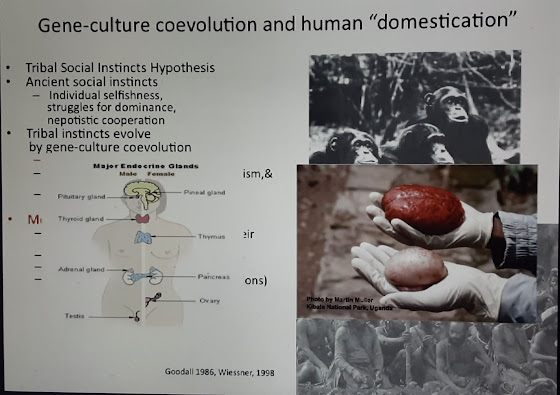
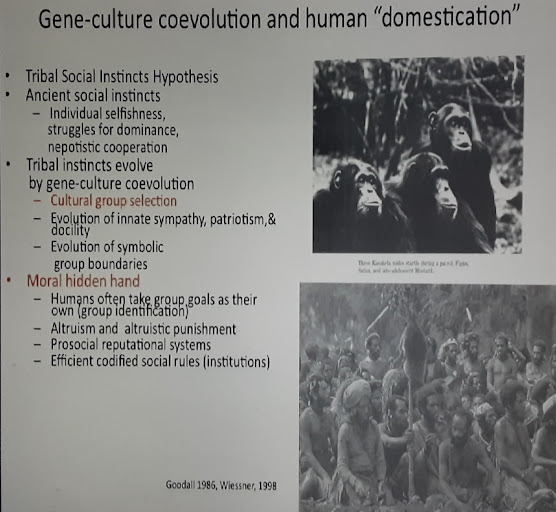
In the YouTube video Culture-Gene Interactions: Peter Richerson-Culture-led Gene-culture Coevolution by University of California UUCTV), at 3 minutes the speaker Richerson puts up the slide that says that culture is a form of inheritance and that culture evolves in a Darwinian fashion by descent with modification. He argues that culture can evolve more rapidly than gene pools. Turns out that domestication is actually a good thing, despite Nietzsche's protests that it is "bad" to be a domesticated human animal. But what is wrong with domestication, who wants an undomesticated dog that tears up your furniture, takes a crap in your shoes every morning after peeing on the carpet and attacks every person it comes into contact with causing you legal hassles from the injuries your dog causes. The fact is that without what Haidt calls our hive instincts we would not have been able to form human tribes and flourish into societies and cities and countries, etc. If everyone were selfishly struggling for dominance in the social hierarchy without cooperation and cohesion, we would have just killed each other off and gone extinct as a species! This explains why Mormonism is a positive force of cultural ideas and customs, as it produces nicer people, more civilized people. See my post: Evidence that Mormon's are "Nicer" i.e. More "Christian" than OthersHere are two of the slides summarizing the theory that culture and genes coevolved:


Click to enlarge


Click to Enlarge


Friday, April 12, 2024

Evidence that Mormons are "Nicer" i.e. More "Christian" than Others


In the Jolly Heretic's video Why Mormons Are So Nice? he argues that nicer/kinder and more friendly and agreeable people are Mormon and choose LDS culture; while less agreeable and friendly people will choose to not be LDS or leave the LDS Church. He argues that many exmormons are likely less nice and agreeable compared to most Mormons. Here is the transcript provided by YouTube with my editing for ease of reading, starting about 6 minutes (words in bold for emphasis):

... one of the things that people always notice about Mormonism is that the people are so nice. They come across so nice and I wondered what is it, why would they be so nice ... such nice people. Well first of all it seems that they would be expected to be very high in the personality trait of openness. People who are high in openness tend to be trusting, ... in its early stages even when Joseph Smith was alive, Mormonism was highly evangelical and it sent lots and lots of missionaries over to the UK, to Wales, and Ireland and Scotts, and all kinds of port cities to convert people to Mormonism; and there was actually a point where there were considerably more Mormons in the UK than there were in America.


.... there's an element to which being trusting and thinking that other people are trusting is a part of being a nice person. So openness, the second thing that tends to predict migration is extraversion. So people that are prepared to take risks but also people who feel positive feelings strongly ... people who have a positive feeling strongly take risks and they take that risk in order to achieve the payoff; if you feel the positive feeling of your food or whatever it is strongly, you'll probably eat more food which is one of the reasons why extroverts tend to get fat and they have a lower life expectancy; but extroverts feel positive feelings strongly, they're amiable people and those would have been the kind of people that would have migrated from the UK. ... they would have been inclined to migrate again up to Utah, so they'll come across as nice people ... but even if they're not actually nice they'll come across as friendly engaging sort of people which Mormons do because they'll be high in extraversion as predicted by their ancestor's tendency to migrate ... remember these traits are somewhere in the region of at least 50% heritable if not perhaps as much as 70%.


 So we've got so far people who are high in openness and thus trusting and kind on a certain level ... it's people who are high in agreeableness and high in conscientiousness; agreeableness is about empathy, about being kind to people, about wanting to be nice to people; that is the nature of religious people, there is a clear correlation with religious people who are more nice and Mormons are particularly religious; and there was a survey in I think about 2009 in the USA which asked people how religious they were and of the Mormons it was the highest category that stated they were very religious ... most Mormons in all these categories that said they were very religious. Most people in Utah said they were very religious, 61% I think, it was exceeded only by Mississippi. So they're very religious and this would predict being high in agreeableness, so again a nice person.


Then you have to ask, who leaves? And this is quite interesting because a lot of people are leaving Mormonism ... Utah was 75 percent Mormon, in the year 2000 it's now gone down to about 60% Mormon, and among Millennials it seems it's going to be about 44 percent; so it will lose its Mormon majority ... People are leaving the Mormon Church and they may well be leaving the Mormon Church because of the degree to which the Internet allows them to find out things about the Mormon Church ... So you can see how they're more likely to start doubting things and so Mormonism. This raises the question of who stays and who goes. Well we have interesting data on this [... it was] demonstrated that those who leave and those who stay in religious groups in which they're born, they are high in social competence; in other words they are high in agreeableness, those who convert to other religious groups those who have a conversion experience become religious, they are lower in agreeableness than those who are born into the religious group. So those who were born in, there's clearly a degree to which its genetic. Those who are born into it will be very high and agreeableness because they've never even had ancestors recently who weren't religious.


Those who aren't from Mormonism or some other religion and convert into it they are relatively high in agreeableness, but they're lower in agreeableness than those who were born into it. Those who are the lowest of all in agreeableness are those who are apostates. They are lower in agreeableness even than those who convert, they are the lowest in agreeableness of all. So it means that those who are coming into Mormonism are going to be relatively high in agreeableness, they're perhaps not as high as those who were born into it but those who are leaving are going to be low, they're gonna be low in agreeableness. In other words, nasty people leave. Every generation just by genetic chance, some Mormons will be born and there'll be not very nice people and those people are going to leave Mormonism. So this will again elevate the degree to which Mormons are nice people.


Then we have to look at who has children, now for a long time there was a lot of pressure among the Mormons, really until the 70s to not use contraception at all and a certain degree of that pressure remains. There are these ideas in Mormon teaching that you should have as many children as you can possibly afford, it's God's will for you to have massive families. Mormons are very family-oriented and in that way you can see why the religion would have been adaptive because the genes associated with being a Mormon would have spread throughout the country. In a context in which there is contraception in which contraception is increasingly allowed then we have data on this. ... [those] invested in nurture of course did better at nurture ... as you have to be a nicer person and once you then end up with groups that are competing with other groups then the group that is more internally cooperative but externally hostile [to outsiders and threats], we know from the computer models is the more likely to survive and so this is going to select for people who are basically increasingly nice ... Those are the people that have children because those who don't want to have children are those people that don't want to nurture, they just wanna have sex ... that concept means they can have all the sex they want and they don't have to have children they don't have to nurture ... it's gonna mean that the un-pleasant don't have so many children and the nicer Mormons have more children which will again elevate the level of agreeableness the level of niceness among the Mormons.


Another factor that you have in the Mormon Church is the correlation between education level and fertility, you don't get this normally. The more educated a person is the fewer children they tend to have, in Mormonism this is reversed; and it seems that the reason for this is that Mormonism preaches that you need to be self-sufficient, it preaches that you shouldn't rely on anybody else; it preaches that you shouldn't rely on the community and so if you were a genuinely believing Mormon then you will only have as many children as you can afford. In America if you are wealthier and and Mormon you are consequently able to afford more children. You'll want to have more children because God is telling you to have more children and it's considered a blessing from God. So you have this relationship between education and fertility, now what predicts education level or one of those things is intelligence, its IQ, IQ predicts education level at about 0.5 something like that overall education level.


Another predictor, it's actually a slightly higher predictor is conscientiousness, so having self-control (being the kind of person doesn't lose their temper and whatever), basically to a degree correlates to being a nice person. So it can be argued that the whole system again will elevate niceness among Mormons, [while] the less nice people as long as they are accepting of the religion and do as the religion dictates will have fewer children.


Another issue is people marry people who are genetically similar to them ... they're also psychologically very similar. Consider that ... we've got data on the high heritability of these different personality traits and it's on these that people that marry tend to be more similar. So what this means is they'll tend to get on very well. ... These people who get along really really well have really strong marriages. Now what this will give people at the environmental level of personality is a very safe background, of everything's gonna be okay, a background where you can trust, a background of love, a background that sets you up for a slow life history strategy that sets you up to trust people and be kind and basically just be a nice person.


As a Mormon you're not allowed to drink alcohol, you're not allowed to drink coffee, you're not allowed to drink tea, you're not allowed to have sex before marriage and there's so many other strictures, you're expected to tithe, you're expected to give huge amounts of time over to the church. There's lots and lots of social pressure to be extremely cooperative. Indeed it's absolutely fascinating, this will of course select out people who are not you know particularly high in conscientiousness, agreeableness. Though you'd imagine that if they simply wouldn't be able to cope with it they would become Jack Mormons. These are Mormons that are brought up in it but they don't tithe and they don't keep to the rules of the church and so they're not allowed to enter the temple because Mormons have these temples that you can get married in but you're only allowed to go there with a temple recommend which you can only get if you're considered a Mormon in good standing. So that would select out these disagreeable, less "nice" people, it will just remove them. So again it would elevate the degree to which Mormons are these very nice people because you have this signaling based religion.


There was some research ... which found some evidence that Mormons can kind of look identical and Mormons as well can identify other Mormons just from the face, a degree to which it would be impossible by chance. Now part of this could be genetic similarity as I said, I mean most of Utah is the most English state in the Union. There would be genetic signals of that and perhaps people would be able to kind of identify it but another factor apparently was the quality of the skin Mormons seem to have nicer skin than non-Mormons, healthier skin than non-Mormons, and so there's a degree to which you can't really fake it, if you drink coffee and drink alcohol in private people will kind of unconsciously know it and you will be kind of treated accordingly. So again this helps to explain and push out people who are less agreeable.


Another issue is the issue of what's called group selection ....the group which is more likely to survive is the group that is high in cooperation and impulse control, positive ethnocentrism, ... Mormons are high in positive ethnocentrism ... high ethnocentrism, in much the same way that the Japanese come across as very very nice people, very kind people, a bit suspicious of change, a bit suspicious; but they'll be very nice to you, they'll be very nice to you but if you trigger them to think they're under threat then they will go for you and you see this in the way that the Japanese treated enemy soldiers during World War 2. ...


 This is also confirmed in this video Is There An Atheist Personality Type? (Psychology of Atheism Part 2)": wherein the personality types that tend to be atheist are compared with those who tend to be spiritual or religious. This explains why the personality type of many or most Mormons tends to be high in conscientiousness and agreeableness on the Big 5 Personality. Exmormons who tend to identify as atheist are therefore more likely to be low in agreeableness which explains the mean-spirited and unkind communication patterns on most exmormon forums. There are of course exceptions to the rule and there are some very kind and thoughtful and "agreeable" exmormon atheists, but in my personal experience they extremely rare


Here are the sources and the data he draws from:


Apostate and Convert Personality: [What Drives Apostates and Converters? The Social and Familial Antecedents of Religious Change among Adolescents by Gregory S. Longo and Jungmeen Kim-Spoon]


Religion and Personality: Religion, Personality, and Social Behavior 1st Editionby Vassilis Saroglou  


Hills, P., Francis, L. J., Argyle, M. & Jackson, C. (2004). Primary personality trait correlates of religious practice and orientation. Personality and Individual Differences, 36: 61-73.


Who breeds? Slow and Steady Wins the Race: K Positively Predicts Fertility in the USA and Sweden June 2017 Evolutionary Psychological Science 3(2) DOI:10.1007/s40806-016-0077-1.


Blume, M. (2009). The reproductive benefits of religious affiliation. In E. Voland & W. Schiefenhövel (Eds). The Biological Evolution of Religious Mind and Behavior. New York: Springer. 


Mormon Religiousness: Gallup. (2009): Mormons most conservative major religious group in the US.

Stark, R. (2005). The Rise of Mormonism. New York: Columbia University Press.


From this perspective, LDS culture seems to retain within it the more altruistic “nicer” traits, the Christian attributes of civility, kindness and charity, etc.

Also see Jacob Hansen's Is the Church Good? - Fruits of the Gospel, where Hansen relies on several polls and studies showing that LDS culture is a healthy culture and Mormonism is good.